Get Full Government Meeting Transcripts, Videos, & Alerts Forever!
Get email alerts on the Paid Family Medical Leave topic
No spam. Unsubscribe anytime.
Advocates, Democratic lawmakers urge Minnesota not to delay 2023 paid family and medical leave law
Summary
Speakers at a Minnesota legislative event pressed lawmakers to preserve the paid family and medical leave law passed in 2023, opposing Republican proposals to delay or repeal the program and pressing officials to keep the 2026 launch intact.
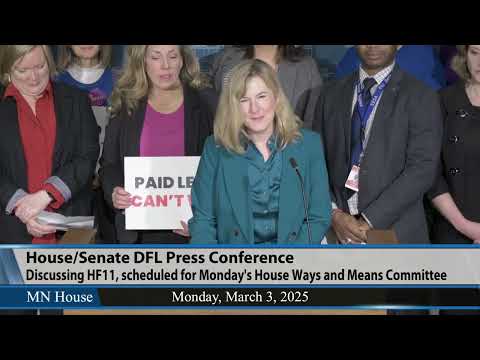
Minnesota advocates and Democratic lawmakers gathered to press state legislators not to delay or repeal the paid family and medical leave law enacted in 2023, saying Minnesotans cannot afford further postponement of benefits intended to let workers care for themselves and family members without losing jobs or income.
The coalition of speakers — including Melissa Hortman, Cedric Frazier, unions and small-business owners — said the program reflects long-standing public demand and warned that Republican proposals under consideration would effectively strip families of protections. "Every other industrialized nation in the world has figured out how to offer family and medical leave," said Melissa Hortman, Speaker Emeritus in the House. "Minnesotans have waited long enough. There's no reason to delay paid family medical leave."
The message echoed across multiple speakers. Representative Cedric Frazier (District 43A) said "paid family and medical leave is about recognizing and upholding human dignity," arguing the policy prevents people from being forced to choose between a job and caring for a newborn, a dying parent or themselves. Claudia Gordon, a Saint Paul resident, described her son's battle with glioblastoma and urged lawmakers not to push back the program's start date: "We can't wait. Our time might run out. We want the chance as a family to take care of Hunter in his home."
Unions and employers also spoke in favor of keeping the law intact. Chris Rubich, president of the Minnesota Nurses Association, said the union joined other groups to make the benefit universally available instead of an item negotiated only in some contracts. Jessica Peterson White, a Northfield bookstore owner and city councilor, said paid leave helps small businesses compete and retain employees: "My business needs this program urgently in order to compete on a level playing field with bigger employers."
Take Action Minnesota representative Jackie Lane said parents "can't wait" and urged preserving the law's current 2026 launch date. Teacher Erin Thompson recounted losing sick days after moving to Minnesota and said short maternity leave hurt her ability to return to work: "Giving birth is not a health neutral event. After 10 days, I couldn't walk down the hall, let alone manage a room full of 33 teenagers."
Senate Majority Leader Erin Murphy reiterated Democratic commitment to the law and its funding, saying last year's enactment was one of the Legislature's major accomplishments and that Democrats "are going to keep it. It's not going away." Murphy said the forecast week will provide updated budget information but stated the Democratic leadership has made "a strong and firm commitment to paid leave and that fund is intact and protected."
Senator Elise Mann, the Senate author, summarized research she said supports the policy's health and labor-market benefits. Mann said actuarial work shows a premium rate of roughly 0.44 percent under the policy the Legislature adopted and noted an alternative design with retroactive payments had shown a 0.88 percent rate: "0.44% is what people are gonna pay, slightly more than a cup of coffee, so that we can stay home and take care of our new babies..." She added, "As of this moment there are no changes and no tweaks — we are ready to go."
Speakers also placed the program in the state's fiscal context. Murphy and others cited a projected cash surplus at the end of the current biennium and a separately held reserve. Specific figures mentioned during the event included a roughly $670,000,000 seed fund for the program, a projected $3,700,000,000 cash surplus in the current biennium, a $3,500,000,000 reserve, and a projected $1,500,000,000 surplus in the next biennium; Murphy said those balances leave room for the state's commitments to the leave program.
No formal votes or legislative actions were recorded during the event. Speakers framed the session as an advocacy and information effort aimed at preventing legislative delays or repeal and urging lawmakers to preserve the program and its planned implementation timeline.
The event brought together lawmakers, union leaders, small-business owners and residents sharing personal stories to underscore the law's intended purpose: to give Minnesotans paid time to address major life events without sacrificing job or income stability.
Meetings and debates on the program are expected to continue in the legislative session; speakers asked constituents to contact their legislators and state senators to support maintaining the law and its timeline.