Get Full Government Meeting Transcripts, Videos, & Alerts Forever!
Get email alerts on the Grants Management topic
No spam. Unsubscribe anytime.
DEED outlines pre‑award risk assessments, monitoring and recoupment tools for state grants
Summary
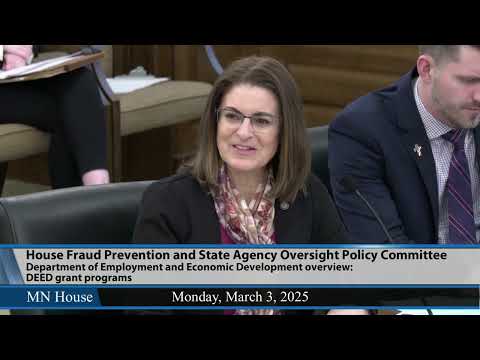
The House Fraud Prevention and Agency Oversight Committee heard from Department of Employment and Economic Development Commissioner Matt Verlick about how DEED reviews, approves and monitors grant recipients, including pre‑award risk assessments, conflict disclosures and on‑site monitoring.
The House Fraud Prevention and Agency Oversight Committee on an unspecified date heard from Department of Employment and Economic Development (DEED) Commissioner Matt Verlick about how the agency reviews, approves and monitors grant recipients — including legislatively named grantees — to guard taxpayer dollars and verify program delivery.
Verlick told the committee that DEED performs pre‑award risk assessments and applies the same oversight controls to competitive grants and direct appropriations “as part of the process of getting to a contract.” He said the agency seeks to “strike the appropriate balance” between efficient distribution of funds and “stringent financial oversight to protect taxpayer funds from fraud and mismanagement.”
Why it matters: DEED manages hundreds of grant programs and large appropriations that steer public dollars to nonprofit organizations and businesses. Committee members pressed the agency on whether current checks — audited financials, IRS determination letters, state registrations and site visits — are sufficient to prevent misuse, to detect conflicts of interest and to ensure grantees deliver measurable outcomes.
What DEED told the committee
Program scale and types: Verlick said DEED administers dozens of programs and 30 competitive grant programs totaling about $163,000,000 for fiscal 2023–24, plus 136 direct appropriations valued at about $268,000,000 for the same period. He added the agency also oversees other economic programs such as broadband infrastructure. Members noted the legislature also provided roughly $1.1 billion in legislatively directed funds to nonprofits during the last biennium.
Pre‑award risk assessment and eligibility checks: DEED requires an identical pre‑award risk assessment for legislatively named recipients and competitively selected grantees before a contract is executed. The agency checks for an IRS 501(c)(3) determination letter, audited financial statements, Secretary of State registration, outstanding unemployment insurance debt, and whether an organization appears on debarment or suspended‑vendor lists. Verlick said those documents are required “as a matter of getting the grant contract in place, not as a matter of identifying the recipients.”
Conflict of interest and reviewer recusal: State grant policy requires disclosure of actual, potential or perceived conflicts. Verlick described the approach as “transparency — awareness, disclosure and recusal.” Deputy Commissioner Mark Majors said recusal “will definitely occur” when a conflict is identified, and noted that in some voting scenarios an individual “may or may not actually … leave the meeting.” The committee discussed gaps agencies have reported when conflict paperwork is missing, with members emphasizing that missing forms can prevent verification of whether a conflict exists.
Selection, community reviewers and RFP posting: For competitive grants DEED issues a request for proposals (RFP) posted for a minimum of 45 days, seeks geographic balance, and uses community reviewers (about 20–40 hours of review time per reviewer) to supplement staff scoring. Community reviewers and staff must sign conflict‑of‑interest forms before reviewing proposals; DEED has at times provided small stipends (about $100) funded by a foundation to some reviewers.
Financial review, monitoring and workforce reporting: DEED’s process includes a fiscal team that reviews financial ratios (current ratio, debt‑to‑equity, asset tests) and evaluates grantees’ financial management systems. Grantees must use the Workforce1 reporting system for workforce programs by statute, and DEED requires quarterly progress reports (OGM requires at least annual reports; DEED uses quarterly as its standard). Monitoring practices include at least one on‑site visit before final payment for grants over $50,000 and annual monitoring visits for grants over $250,000; DEED also performs a financial reconciliation before final payment and requires a final report and final payment request within 20 days of closeout.
Payments and reimbursements: DEED generally pays on a reimbursement basis; limited cash advances are authorized with additional documentation. Reimbursement requests must be certified by grantee executives; DEED’s fiscal staff and program monitors cross‑check certified reimbursement claims against supporting documentation during monitoring.
Committee concerns and follow‑up requests
Several lawmakers raised concerns about oversight of legislatively directed grants and nonprofit capacity. Representative Barrack said he has seen nonprofit executive salaries “that far exceed what the governor makes,” and questioned the legislature’s front‑end vetting. Representative Greenman cautioned that Office of the Legislative Auditor findings often reflect missing paperwork rather than confirmed conflicts, saying “we should be really clear what the problem is.” Vice Chair Anderson urged a stronger focus on measurable outcomes: “I hope that as we try to tighten up everything that we actually start looking at what outcomes are we getting for these dollars.”
Members asked DEED to provide additional information after the hearing, including how many times DEED has stopped or withheld payments in recent years, boilerplate contract language that authorizes withholding, and a breakdown of staff dedicated to monitoring and fiscal review. Committee leadership also invited DEED back for a future briefing on eligibility and other DEED programs.
Votes at a glance
• Approval of Feb. 24 committee minutes — motion to approve by Representative Rehrig; the chair called for a voice vote, members said “aye,” minutes were approved (voice vote; counts not specified in the transcript).
What the agency declined to assert
DEED officials declined to assert that their processes eliminate all risk. Commissioner Verlick said the agency tries to balance oversight with assistance for nonprofits that lack financial capacity, and Deputy Commissioner Majors said some high‑risk applicants have been declined when DEED could not verify sufficient safeguards.
Ending
Committee members thanked DEED for the presentation and said they expect follow‑up materials and another briefing. The committee adjourned after closing remarks.