Get Full Government Meeting Transcripts, Videos, & Alerts Forever!
Get email alerts on the Paid Family And Medical Leave topic
No spam. Unsubscribe anytime.
Minn. Ways and Means debates pause of paid family and medical leave; amendment withdrawn, no final vote
Summary
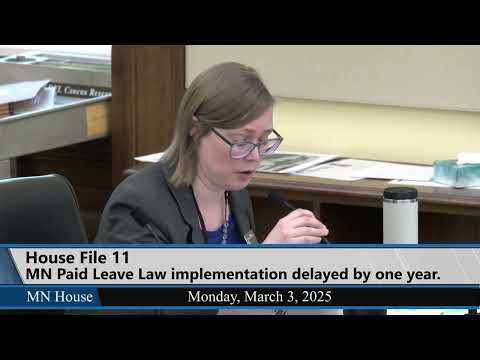
The Minnesota House Ways and Means Committee considered House File 11 on March 3, 2025 — a proposal to pause implementation of the statewide paid family and medical leave program — but withdrew a technical amendment after extended fiscal-policy debate and recessed without taking a final committee vote.
ST. PAUL, Minn. — The Minnesota House Ways and Means Committee debated House File 11 on March 3, 2025, a bill described by its author as a one-year “pause” to the state’s paid family and medical leave program, but did not record a final vote after members raised questions about fiscal language and implementation details.
Representative Baker, the bill’s author, told the committee, “House file 11 is not a repeal, it is a pause,” and said the intent was to give lawmakers more time to address concerns raised by businesses, school districts and other employers. The committee considered, then withdrew, a technical amendment (referred to as the A1 amendment) intended to change the timetable and interagency fund transfers used to pay administrative costs. After debate and a short recess to resolve the amendment language, Baker withdrew it and the committee recessed without taking a final roll-call on the bill.
Why it matters: The bill would affect the timing and implementation of Minnesota’s paid family and medical leave program and how state agencies access funds to cover administrative costs. Lawmakers and executive-branch witnesses debated whether the amendment would actually allow agencies to use existing account balances in 2026 or whether the text, as written, left a funding gap. Committee discussion also touched on the program’s fiscal note, software readiness for benefit administration and the potential impacts on employers and workers.
Most of the committee’s hour-plus discussion focused on a technical change to section 4 of the bill that House Research staff said would restore language allowing data sharing and transfers so that agencies could draw on program funds for administration on the earlier schedule. Anna Schelling, House Research, described the amendment as removing a date change so “the data sharing and ability to spend money out of the account for this program, goes into effect on the current schedule rather than being moved back by one year.”
Evan Rowe, Deputy Commissioner at the Department of Employment and Economic Development (DEED), told the committee that under current law the department may draw up to 7 percent of projected benefit payments to cover administrative costs when the program begins. He said the department had not had time to review the exact amendment language before the hearing and described a possible funding gap if the amendment’s language and the bill’s delays were not aligned: “the department would not be able to draw administrative funding, until 2027,” and the amendment was “intended to rectify that.”
Several members questioned whether the amendment’s wording would achieve its stated purpose. Representative Stevenson said the language “doesn’t allow them, because it only allows them to spend money based on the projected benefits, and because the bill delays the start of benefits by a year, there won’t be any projected benefits,” suggesting the amendment as written did not match its intent. Nonpartisan staff agreed the text needed clarification; Schelling said the change was intended to let agencies use existing funds and to permit interagency transfers to cover administrative costs during the delayed period.
Fiscal concerns animated much of the debate. Committee members referenced figures in the fiscal documents and in past appropriations: witnesses and members cited roughly $660–$688 million set aside for the program in earlier legislation (different speakers used slightly different figures on the record), and members also referenced line items from the fiscal note, including a cited first-biennium cost of roughly $379,000 related to interagency agreements. Representative Robbins urged members to approve the amendment, saying uncertainty was harming businesses; Representative Pinto and others pushed for clearer fiscal language or referral back to committee of jurisdiction.
Members also raised implementation risks beyond the account language. Representative Nash warned that the custom software needed to run the program was not yet in testing and said a pause could allow time to finish development and testing. Representatives and witnesses also discussed how the program’s requirements would interact with collective bargaining agreements and existing employer-provided leave policies and whether small and seasonal businesses were adequately accounted for in the statute.
Procedure and outcome: Representative Baker moved adoption of the technical A1 amendment and asked nonpartisan staff to describe it. A roll call on the amendment was requested by Representative Clayborn; before the roll call was completed and after a short recess to clarify language, Representative Baker withdrew the amendment. The committee then proceeded to consider the bill “as originally presented” but recessed for lunch with the fiscal note on the bill standing and no final committee vote recorded in the transcript.
What was not decided: The committee did not record a final vote on House File 11 during the March 3 hearing. Members said they intended to move the bill forward from Ways and Means to the general register, but several members asked for further clarification of fiscal language and suggested work remain to align the bill text with the fiscal note and agency needs.
Quotes from the hearing represent exact language in the transcript: Anna Schelling, House Research, said the amendment “removes the changes to one of the sections of the bill so that the data sharing and ability to spend money out of the account for this program, goes into effect on the current schedule rather than being moved back by one year.” Evan Rowe, DEED Deputy Commissioner, said the proposed change was “intended to rectify” a situation in which the department “would not be able to draw administrative funding, until 2027.” Representative Stevenson said the amendment’s wording “doesn’t allow them” to access funding because it tied spending to projected benefits, which would be zero in the delayed year.
Next steps: Committee members and the bill’s author said they expected further technical work on the bill text; Representative Baker said he was willing to negotiate additional changes as the bill moves toward the House floor. No additional committee action or final vote was recorded in the transcript excerpt for March 3, 2025.
Ending note: The committee recessed to allow staff and members time to resolve the amendment language; the A1 amendment was withdrawn and the committee left the fiscal note as presented when they recessed.