Get Full Government Meeting Transcripts, Videos, & Alerts Forever!
Get email alerts on the Pensions topic
No spam. Unsubscribe anytime.
Senate committee advances bill capping counted sick and personal days for TRS retirement calculations
Summary
The Senate State and Local Government Committee voted to advance Senate Bill 9, which would limit the number of sick and personal days that the Teachers' Retirement System (TRS) may count in retirement calculations to 10 sick days and 2 personal days per year (12 total), and add reporting requirements for participating agencies.
The Senate State and Local Government Committee voted to advance Senate Bill 9, legislation that would standardize what the Teachers' Retirement System (TRS) counts when calculating final compensation for retirement and require new reporting to the system.
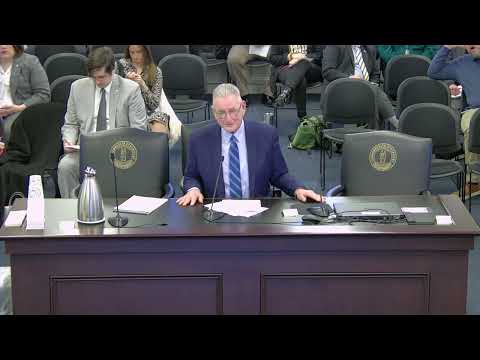
Senator Higdon, the bill sponsor, told the committee the measure would direct TRS "to only cover up to 10 sick days and 2 personal days per year in retirement calculations," effective July 2026. He said schools may continue to provide additional leave but that districts would be responsible for the actuarial cost of any days counted toward retirement beyond the 12-day limit. The committee adopted the bill; the chair recorded the vote as 10 yeas and the bill passed the committee.
Higdon described the change as part of a broader effort to address TRS funding challenges. He told members the General Assembly has made "extra $500,000,000 per year contributed beyond the statutory obligations" to TRS since February 2016 and that projected payments for unfunded liabilities could "surpass $2,000,000,000 annually." He said TRS has experienced "an annual negative cash flow of over $900,000,000 in recent years." He argued the bill will standardize treatment across Kentucky's 177 local school districts and the other agencies that participate in TRS.
The measure also would codify reporting and oversight requirements for participating agencies and co-ops, prohibit rolling annual leave into sick leave for purposes of retirement calculations going forward, and add a 30-day maternity leave provision limited to maternity use only. Higdon said the bill would require TRS to report annual leave and sick-day liabilities yearly and allow school districts to make voluntary contributions to a supplemental account for Tier 4 teachers of up to $5,000 as an incentive.
During committee discussion, Senator Mills asked how districts would be billed for days above the 12-day limit; Higdon answered that after the effective date the district would be responsible for the actuarial cost for any days beyond the 12 days reported to TRS. Mills and others discussed the uncertain per-day actuarial cost; Higdon and other members referenced various illustrative figures but did not settle a definitive statewide per-day number. Higdon offered a hypothetical example of an administrator with a $350,000 salary and 260-day contract; using figures he presented, he calculated a combined lump-sum addition to final compensation of roughly $201,922 from sick and annual leave in that scenario and an estimated additional retirement benefit of about $3,200 per month. Those illustrative numbers were provided by the sponsor to show how leave payout practices can affect retirement calculations.
Senator Mays Bledsoe asked about the bill's maternity leave language and whether it would conflict with counties that already offer paid parental leave. Higdon said his draft specified "maternity leave" and that the language and timing (to 2030 in part of the draft) were intended to give districts time to plan; he acknowledged the language could be amended in the normal legislative process.
The committee recorded the final tally as 10 yeas; the chair said the bill "passes 10 and should do likewise on the floor." The bill now heads to the Senate floor for consideration.