Get Full Government Meeting Transcripts, Videos, & Alerts Forever!
Get email alerts on the Behavioral Health topic
No spam. Unsubscribe anytime.
Commissions defend grants, trauma funding and AHEAD preparations as advocates press to restore consortium money
Summary
DLS and multiple state health commissions briefed lawmakers on grants to school behavioral health programs, Medicare/MA issues, trauma funding and AHEAD model preparation; community groups urged restoring full consortium funding for student behavioral health.
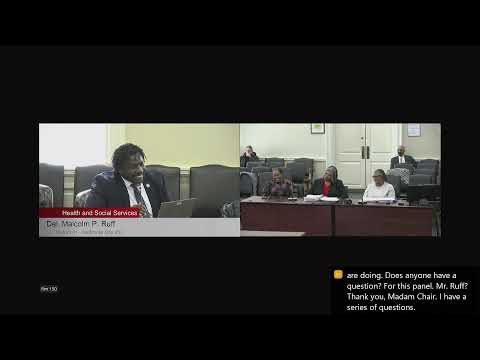
The Health and Social Services Subcommittee heard a series of presentations on health regulatory bodies, the community behavioral‑health consortium grants created under the Blueprint for Maryland’s Future, trauma funding, and the state’s transition to the federal AHEAD model.
DLS analyst Anne Braun briefed the panel on the fiscal 2026 allowances for the health regulatory commissions—Maryland Health Care Commission (MHCC), Health Services Cost Review Commission (HSCRC), Community Health Resources Commission (CHRC), and the Prescription Drug Affordability Board—and highlighted several key items for the subcommittee’s attention: proposed reductions to mandated consortium funding in the governor’s BRFAA language, the state’s preparations for the federal AHEAD total‑cost‑of‑care model, changes to trauma funding tied to vehicle registration surcharges, and activity by the Prescription Drug Affordability Board.
Nut graf: Why it matters
The commissions oversee or help fund services that affect provider payments, school‑based behavioral health access, trauma center finances and drug affordability; proposed budget changes and statutory language could change how grants and provider payments are distributed across the state.
Consortium grants and school behavioral health
Braun described the consortium on coordinated community supports (the consortium) as originally mandated in the blueprint with $130 million a year for grants. Budget language in the governor’s proposal would reduce ongoing mandated funding by $90 million and level‑fund the program at $40 million beginning in fiscal 2026. Braun noted there were $109 million in active consortium grants approved through fiscal 2025 that report serving more than 143,000 students, with per‑student grant amounts that vary widely across jurisdictions.
CHRC leadership defended the program and described outreach and grant‑selection processes. Ed Case Meyer, CHRC chair, and Mark Lochner, CHRC executive director, said the consortium awarded grants that could not be provided within existing local budgets and that implementation had rapidly expanded school access—CHRC reported services available in roughly 80 percent of schools and tens of thousands of students served since the program began. Lochner told the committee the commission had required letters of support from local education agencies as part of the grant application process to avoid supplanting existing services.
Advocates and providers testify
Multiple advocacy organizations and grantees testified in favor of restoring full consortium funding. Speakers, including representatives from the Mental Health Association of Maryland, Parent Encouragement Program (PEP), Chesapeake Bay Psychological Services, the Horizon Foundation and Strong Schools Maryland, described services begun under consortium grants—school‑based therapy, parent support groups, training and crisis interventions—and warned that a cut from $130 million to $40 million would force hiring freezes or program closures.
Trauma funding and Shock Trauma
Braun summarized recent legislative changes that increased vehicle registration surcharges and allocated a larger share to the Maryland Trauma Physician Services Fund and Shock Trauma. The HSCRC and MHCC were asked to clarify how much funding shock trauma should receive. John Crom, HSCRC’s executive director, said the commission expected to complete two audits of trauma costs in the second half of fiscal 2026 and supported releasing $125,000 in special funds subject to required reporting. Dr. Thomas Scalia of R Adams Cowley Shock Trauma reported tangible operational gains after recent appropriations: increased operating room capacity (from six to eight rooms), reduced patient length of stay for operative cases, and fewer lost inter‑hospital transfers.
Other commission activity and AHEAD preparation
HSCRC representatives discussed Maryland’s transition to the federal AHEAD model, which builds on the state’s total cost of care approach and adds cross‑payer cost‑growth targets and primary care investment requirements. HSCRC said it had proposals to align incentives for Medicare Advantage plans with hospital rate‑setting to reduce utilization and create shared savings opportunities, but that such options require federal approval and interagency coordination.
Prescription Drug Affordability Board
Andrew York, representing the Prescription Drug Affordability Board, said the board had referred drugs for review and obtained approval from the legislative policy committee in October 2024 for an upper payment limit action plan; the board was updating regulations to match that plan.
Ending
The subcommittee took testimony but did not take formal action. DLS recommended continued oversight and requested updates from the commissions on grant disbursements, trauma cost audits and evaluations of primary care programs under the AHEAD framework.