Get Full Government Meeting Transcripts, Videos, & Alerts Forever!
Get email alerts on the Water Rates topic
No spam. Unsubscribe anytime.
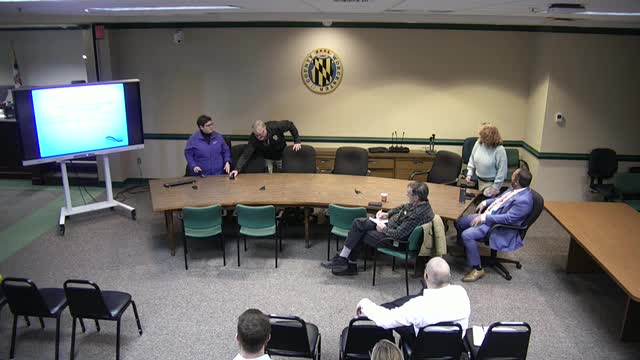
County discussion centers on water-rate structures, affordability and irrigation metering
Summary
At a Worcester County meeting, speakers discussed rate structures for water and sewer service, recommending minimum-plus-volume billing, low or zero gallon allowances, irrigation metering or surcharges, and affordability thresholds tied to median household income. No formal vote was recorded.
An unidentified speaker presented options for setting water and sewer rates to the Worcester County meeting, recommending a minimum-plus-volume (base charge plus measured usage) structure, limiting included gallons and targeting affordability metrics.
The presenter said the most equitable structure is to charge customers only for what they use: “0 is the most equitable way,” referring to including zero gallons in a minimum allowance, and recommended, “no more than 3,000 gallons a month.” The presenter discussed tradeoffs among flat/uniform rates, minimum-plus-volume (base charge plus a volume charge), and block rates designed to encourage conservation.
Why it matters: rate design determines who pays fixed system costs, how the system funds reserves and debt service, and how affordability burdens fall across households. County officials heard that design choices affect conservation incentives, political acceptability and eligibility for state and federal funding programs.
Key points from the discussion included guidance on calculating base charges and variable charges. The presenter described a standard approach used to check rate proposals: identify fixed costs (debt service, reserves, salaries), apply a reserve factor (examples cited: 10%–15%), account for delinquency (example 5%), then divide by projected customer counts to set a per-EDU base charge. In the presenter’s example (fixed cost $100,000; variable cost $300,000; collection assumptions), the calculated minimum worked out to about $80.70 per year, or $20.17 per quarter, and an example variable rate of about $1.82 per thousand gallons.
Affordability benchmarks were emphasized. The presenter described that a commonly used rule of thumb is that combined water and sewer bills for a typical customer (estimated here as 5,000 gallons per month or 15,000 gallons per quarter) should not exceed roughly 1.5%–3% of median household income. The presenter also noted federal program references, saying the U.S. Department of Agriculture (USDA) sometimes uses flat-dollar annual affordability ranges ($400–$800 per year per service, i.e., $800–$1,600 combined) and that Maryland’s State Revolving Fund (SRF) program applies its own targets when evaluating grant/loan packages.
Speakers raised operational and equity issues. Several participants asked how to treat irrigation or seasonal-heavy use and short-term rentals (Airbnb). The presenter recommended separate irrigation meters where feasible; when separate meters are not practical, possible alternatives discussed included a dedicated rate class for irrigation, an increasing block surcharge for usage above a threshold, or charging base fees per EDU even when multiple units share a single meter (for example, charging an apartment building’s 10 units 10 base charges plus measured volume).
The presenter also discussed options for small, separate systems within the county: either rate each system on its own cost basis or adopt a uniform countywide approach that pools costs (a policy choice that would shift some economies of scale from larger systems to smaller ones). The presenter cited Snow Hill as an example of significant public outreach and public-information efforts when that town restructured rates, and referenced guidance in the American Water Works Association (AWWA) manuals M1 and M52 as technical references for rate-setting.
No formal motion or vote on rate changes was recorded during the portion of the meeting covered by the transcript. Discussion focused on technical options, equity considerations and outreach strategies. Several attendees asked for more granular data and examples to apply the described calculations to county systems.
Looking ahead, presenters and attendees discussed next steps including public information meetings, calculating system-specific costs and reserve targets, and exploring grant programs (Maryland SRF, USDA) that can lower customer rates through grant/loan packages. The meeting record does not show a decision to adopt any particular rate structure or schedule.