Get Full Government Meeting Transcripts, Videos, & Alerts Forever!
Get email alerts on the Park Safety topic
No spam. Unsubscribe anytime.
Parks department updates council committee on safety plan, cameras and staffing
Summary
Deputy Director Renee Johnson briefed the Parks, Trails and Environment Committee on the department’s park safety and security strategic plan, describing interagency coordination, community engagement, equipment and infrastructure investments and next steps on camera monitoring and staffing.
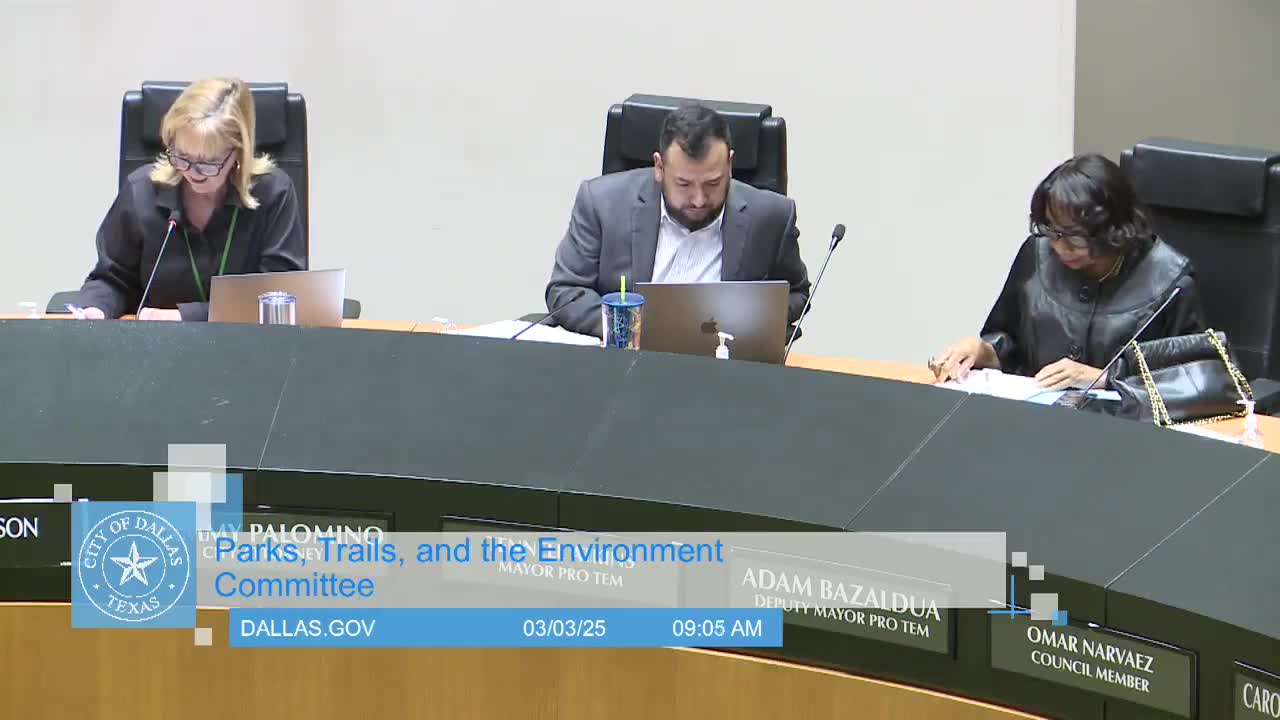
Deputy Director Renee Johnson briefed the Parks, Trails and Environment Committee March 3 on the Parks Department’s park safety and security strategic plan, outlining interagency efforts, equipment and infrastructure purchases, community engagement and planned investments in surveillance and staffing.
Johnson said the plan rests on four pillars — interagency initiatives, community engagement, equipment and infrastructure inventory, and safety strategy guidelines — and described ongoing coordination with Dallas Police Department, Code Compliance, the Office of Homeless Solutions and other city divisions to respond to park problems and reduce illicit activity.
The department reported a number of local action plans. At Katy Jackson Park, Johnson said staff increased law-enforcement presence, installed security cameras and loop-trail lighting and coordinated enforcement; she told the committee the initiative produced parking citations and multiple vehicle impounds during the operation. At Valley View and other parks the department said it cleared brush, removed encampments in collaboration with maintenance districts, improved sight lines and organized community events that department staff said increased park use and reduced reported incidents. Johnson said the department has expanded ranger programming and volunteer-led beautification agreements — the department maintains more than 150 such agreements with neighborhood groups.
On equipment and infrastructure, Johnson said the department has installed surveillance systems at 58 locations across recreation centers, golf facilities and parks; 43 installations are complete and 11 remain to be powered and finished. She told the committee the department has allocated $4,400,000 for facility upgrades and security equipment overall and that $2,580,000 of that came from ARPA funds. The department said it is operating with an allocation of 20 marshals but continues to face hiring and staffing challenges.
Committee members pressed the department about operational details and staff safety. Council members asked whether marshals and park marshals would have access to any centralized camera monitoring; Johnson said the department is exploring linking park cameras to a fusion center monitored by DPD and that the details on operational access are still being worked out. Council members also asked for lists of citations by park and for follow-up reporting on how bond-funded camera projects will be coordinated with ARPA-funded equipment.
The committee raised recurring concerns about park rangers’ authority and safety equipment. Jeremy McMahon of the Rangers and Marshals program said park rangers are civilian employees, wear a uniform but are not sworn officers, and that rangers may undergo DPD training and may carry OC (pepper) spray if they choose. McMahon and other witnesses said rangers’ primary role is education and de-escalation and that rangers file incident reports and may call marshals or DPD for response when a situation exceeds their authority. Marshals described themselves as uniformed civilian officers with licensing under the city’s T‑code; marshals reported they are equipped under their classification with vests, handcuffs, pepper spray and firearms and can effect arrests.
Reverend Dr. Jenkins, speaking from long experience in the parks system, summarized the department’s approach as a three‑layer model: (1) rangers to educate and be “eyes and ears,” (2) marshals for onsite enforcement when needed, and (3) DPD for serious criminal incidents or 911 responses. Committee members agreed the strategy needed ongoing review as the department builds out technology and staffing.
Johnson listed future investments the department plans to pursue, including additional camera trailers, digital messaging, more camera monitoring and a proposal to have the fusion center monitor park cameras in the next fiscal year. She said security will be a priority in the department’s next 0‑based budget package. The committee also flagged enforcement of decommissioned homeless encampments as an outstanding operational challenge.
The department committed to provide the committee follow-up information requested during the briefing, including a parks-by-parks breakdown of citations and a plan for how bond and ARPA investments will be layered at sites receiving multiple funding sources.
The briefing concluded with committee members thanking staff and asking for a return report on operational details and the fusion‑center monitoring proposal.