Get Full Government Meeting Transcripts, Videos, & Alerts Forever!
Get email alerts on the Wildlife Management topic
No spam. Unsubscribe anytime.
Connecticut lawmakers press agency for bear management plan as human-bear conflicts rise
Summary
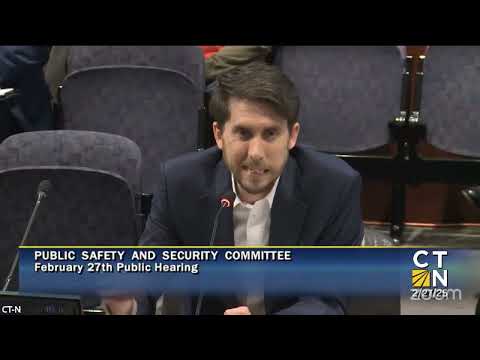
At a Public Safety and Security Committee hearing, Department of Energy and Environmental Protection officials described steep increases in human–bear conflicts and urged a multi-part management plan; biologists and police stressed growing public-safety risks as bears lose fear of people.
Mason Trumbull, Deputy Commissioner for Environmental Conservation at the Department of Energy and Environmental Protection, told the Public Safety and Security Committee that human-bear conflicts in Connecticut have risen sharply over the past decade and that the agency supports preparing a formal management plan.
"A decade ago, bears did not pose a public safety risk here in Connecticut. However, a lot has changed over the last 10 years," Trumbull said, summarizing DEEP's view for the committee.
The testimony laid out statistics DEEP plans to publish in an annual bear report: the agency told lawmakers it received roughly 500 human-bear conflict reports about 10 years ago and about 3,500 last year; home entries increased from fewer than 10 a decade ago to 67 last year; and a pattern of bear attacks has emerged since 2020, with seven attacks in total, including a severe injury to a 10-year-old child in 2022.
"Based on habitat suitability analysis that we've done, we believe that the suitable bear habitat for the state, only about 1 third of it is currently occupied," Jason Holly, DEEP senior bear biologist, told the committee, adding that the population and range are expected to expand.
Why the hearing matters
Lawmakers said they convened the hearing after incidents in residential neighborhoods and recent attacks raised public-safety concerns. Committee members pressed DEEP on short- and medium-term options as the agency prepares a formal plan required in draft legislation (SB 7051) that would direct DEEP and another state agency to produce a statewide bear management strategy.
What DEEP said it has done
Trumbull described extensive public-education efforts — seminars, local partnerships, social media and billboard advertising, and hazing and relocation in the field — but said outreach alone has not reversed the trend. DEEP staff said relocation often shifts problems to other areas and that many Connecticut bears have become food‑conditioned and habituated to humans.
Holly said the agency has a working draft of a bear management plan required for a federal grant and updated it periodically, but the draft has relied heavily on population management through harvest. He told lawmakers the plan has not moved forward because, he said, the state lacks the same harvest tool other states use for population management.
Public‑safety details and field response
Chris Lewis, colonel for the environmental conservation police, described how the conservation police — a force of about 62 sworn officers — and municipal police respond to calls. He said last year officers responded to more than 270 priority human-bear calls and that field responses can range from hazing to euthanasia when a bear poses an immediate threat.
DEEP staff and the EnCon police read sample officers’ call logs into the record, including incidents where residents were inside a house while a bear was downstairs and where families sheltered in a garage.
What lawmakers pressed for
Members asked whether a hunt would reduce risks. Holly and other DEEP staff said a harvest is the only population-management tool they do not now employ and that it could be part of a broader toolbox. DEEP repeatedly emphasized that a plan would include prevention, education, municipal coordination and monitoring — not a single action.
Several lawmakers said they want a completed management plan sooner rather than later and asked whether DEEP could provide the committee a working plan or substitute language that would speed implementation.
What residents and officials said
Several public speakers described repeated property and neighborhood incidents and urged the committee to act sooner. Senator Martin, representing a largely rural district, told the committee the bill "doesn't go far enough" and urged measures to reduce risk before more severe attacks occur. Local fire and police officials described bear encounters in downtown Hartford and other municipalities, underscoring that incidents are not limited to rural areas.
Ending
The hearing left lawmakers with detailed agency data, field accounts and competing views about tools to reduce conflicts. DEEP said it has draft plan elements and additional data that it will provide to the committee. Lawmakers signaled they expect further briefings and may consider legislative changes to accelerate a statewide management strategy.
(Reporting from the Public Safety and Security Committee hearing on SB 7051.)