Get Full Government Meeting Transcripts, Videos, & Alerts Forever!
Get email alerts on the Impaired Driving topic
No spam. Unsubscribe anytime.
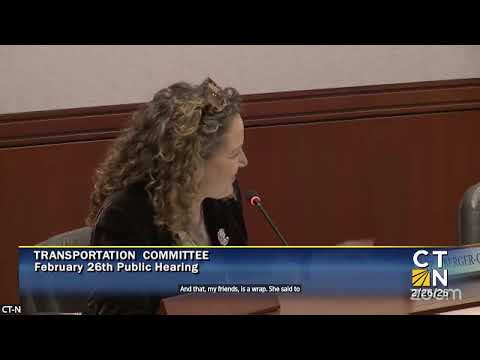
State hears argument to lower impaired-driving legal limit to 0.05 as safety measure
Summary
NTSB and state transportation officials urged the Connecticut Transportation Committee to adopt a 0.05 per se blood-alcohol concentration limit, saying the change would deter impaired driving and save lives. Lawmakers questioned enforcement, equity and data from Utah and other jurisdictions.
A National Transportation Safety Board official and Connecticut transportation leaders urged the legislature’s Transportation Committee to support bills lowering Connecticut’s per-se blood-alcohol concentration limit from 0.08 to 0.05, saying the change would reduce fatal alcohol-related crashes and act as a public deterrent.
Tom Chapman, identified in testimony as a member of the National Transportation Safety Board, told the committee that the NTSB has recommended a 0.05 limit since 2013 and cited Utah’s experience after it enacted the standard. “The benefits of lower BAC limits are well documented,” Chapman said. “Because we know it works, we at the NTSB strongly support legislation that will lower the legal BAC per se limit to 0.05.”
Why it matters: The committee was told alcohol remains a leading contributor to road deaths. NTSB and state experts argued that lowering the legal threshold is not a cure-all but a cost-effective, evidence-based tool that tends to change behavior and thus reduce fatal crashes. Lawmakers pressed witnesses on whether the change shifts enforcement burdens, whether the effect is purely educational or punitive, and whether Utah’s experience can be generalized to Connecticut.
What witnesses said: Chapman said Utah saw a deterrent effect and no large increase in arrests after the change. “Rather than increased enforcement, we saw a public reaction that indicated people were much more aware and it served as a deterrent,” he told the committee. Commissioner Gary Iguolito of the Connecticut Department of Transportation testified the state is “among the worst in the nation” for drunk-driving rates and said he supported the reduction. He noted the change would be another tool alongside enforcement, public education and vehicle-based technologies.
Questions from lawmakers: Committee members asked whether enforcement would grow, whether officer field tests could distinguish 0.05 from 0.08, and how much of Connecticut’s alcohol-involved crash toll sits in the 0.05–0.079 range. Chapman acknowledged that people can be impaired below any fixed number, and that 0.05 is primarily an evidentiary rule that creates a per-se presumption useful to courts and prosecutors. When asked about the relative scale of crashes in the 0.05–0.079 range in Connecticut, NTSB and state staff said their data show fatalities with BAC in that band but stressed high-BAC crashes remain a much larger share of deaths.
Context and next steps: Committee members asked for comparisons with other states and countries. Witnesses pointed out more than 100 countries use a 0.05 or lower standard; Utah remains the only U.S. state to adopt 0.05 so far. Lawmakers also discussed related policies heard at the same hearing: expanded enforcement tools, electronic warrants for timely blood collection, police phlebotomy programs and long-term vehicle technologies to detect impairment.
Ending: Committee members said they wanted more data on Connecticut-specific crash distributions by BAC and on enforcement costs, while several advocates reiterated that 0.05 is a pragmatic step that could reduce deaths and encourage planning before drinking. The bill will return to future committee work with follow-up data requested from state and federal agencies.