Get Full Government Meeting Transcripts, Videos, & Alerts Forever!
Get email alerts on the Teachers Pensions topic
No spam. Unsubscribe anytime.
Senate committee considers bill to cap sick‑day credit in TRS, mandate uniform reporting
Summary
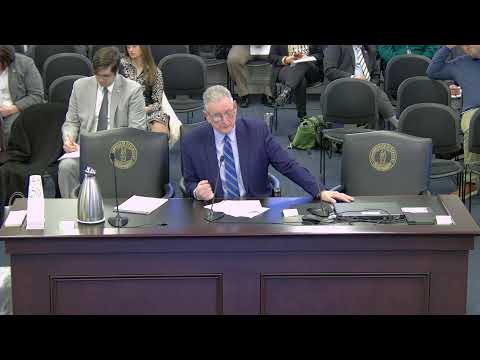
Senator Higdon, speaking to the Kentucky Senate State and Local Government Committee, outlined Senate Bill 9, legislation to standardize which leave days can be converted into retirement service credit in the Teachers’ Retirement System (TRS) and to require uniform reporting of accrued leave across participating agencies.
Senator Higdon, speaking to the Kentucky Senate State and Local Government Committee, outlined Senate Bill 9, legislation to standardize which leave days can be converted into retirement service credit in the Teachers’ Retirement System (TRS) and to require uniform reporting of accrued leave across participating agencies.
The bill would direct TRS, effective July 2026, to count at retirement a maximum of 10 sick days and 2 personal days per year (12 days total) toward the calculation of final compensation; school districts that allow more days would be responsible for the associated costs. The measure also would prohibit rolling annual leave into sick leave for the purpose of retirement credit, require mandatory annual reporting of sick‑day and annual‑leave liabilities by participating agencies, and add 30 maternity days that are non‑accumulable and usable only for maternity leave. Senator Higdon said he will offer a floor amendment directing the state auditor to audit TRS and report on agencies’ sick‑day and annual‑leave policies.
Why it matters: Higdon told the committee that TRS remains significantly underfunded despite years of extra contributions from the General Assembly. He said that since February 2016 the legislature has made supplemental payments (an additional $500 million per year beyond statutory levels), yet system funding moved only modestly, to about 58.6% funded in 2024. He warned that, if current trends continue, annual payments on unfunded liabilities could exceed $2 billion in upcoming budget cycles and that TRS has experienced annual negative cash flow exceeding $900 million in recent years. Higdon summarized the policy aim as “fairness, accountability, transparency, and consistency” in how leave is treated across districts and agencies and said, “We need to fix this leaky bucket.”
Details and examples: The bill would:
- Limit TRS‑countable leave to 10 sick days and 2 personal days per year for retirement calculations, effective July 2026; districts may offer more leave but must fund the additional retirement cost themselves. - Prohibit annual leave from being converted into sick leave for retirement calculation purposes. - Require mandatory, detailed annual reporting of accumulated sick and annual leave for all agencies participating in TRS, including school districts and education cooperatives. - Add 30 maternity days limited to maternity leave use only (non‑accumulable). - Allow school districts to make voluntary supplemental contributions for Tier 4 teachers (up to $5,000) as a sign‑on bonus, per the bill text described to the committee.
Higdon gave a hypothetical example to illustrate the fiscal effect on a single high‑salary administrator: a 30‑year employee earning $350,000 on a 260‑day contract with 300 sick days and 60 days of annual leave would, in his calculation, receive roughly $121,000 for sick leave and approximately $80,769 for annual‑leave payout added to final compensation, a combined $201,922 lump sum that, he said, would materially increase the retiree’s final‑average pay and the system’s unfunded liability. Higdon characterized the aggregate, long‑term cost of such practices as burdening taxpayers and future legislatures.
Oversight and reporting: Higdon said administrative regulations discussed with TRS staff have not been fully implemented and that the bill would mandate the reporting needed for long‑term planning. He also noted that TRS participates with more than 30 state agencies and four non‑state agencies, and that current leave policies across those entities are inconsistent; the bill seeks uniformity.
No committee vote on SB 9 is recorded in the provided transcript excerpt; committee members asked questions and thanked the sponsor for the information. The discussion included technical figures about past contributions and funding status as presented by Higdon; the transcript did not show a final action by the committee on SB 9 in the excerpt provided.
Context and next steps: Higdon framed the change as not reducing the statutory number of sick or personal days teachers may be granted by districts, but instead standardizing what TRS will consider in retirement calculations. He said schools may continue to offer additional leave but would be financially responsible for any extra retirement cost. He invited committee members to follow up with questions and indicated he would file a floor amendment directing an audit by the state auditor.
Ending: The committee discussion on SB 9 covered funding history, several technical calculations provided by the sponsor, and proposed reporting and audit provisions; no formal committee vote appears in the transcript excerpt.