Get Full Government Meeting Transcripts, Videos, & Alerts Forever!
Get email alerts on the Cfpb Oversight Rulemaking topic
No spam. Unsubscribe anytime.
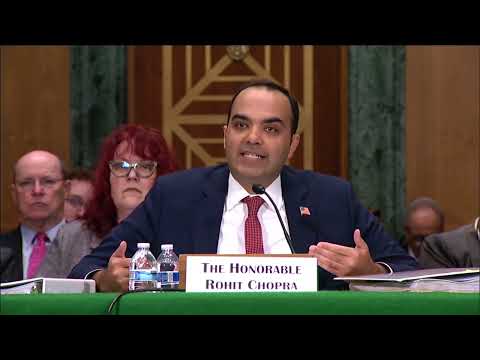
GOP senator questions CFPB official on resignation, rulemaking and supervisory failures
Summary
A Republican senator asked CFPB official Chopra whether he planned to resign on Jan. 20 and criticized the bureau—s recent rulemaking and supervision of large institutions; Chopra defended ongoing rulemaking, said he had initiated a related inspector general review and defended the bureau—s focus on large nonbank firms.
A Republican senator asked CFPB official Chopra whether he planned to resign from the Consumer Financial Protection Bureau on Jan. 20 and accused the agency of pressing ahead with rulemaking despite a November demand to stop.
The exchange took place during questioning in which the senator cited national credit figures and a recent inspector general report to challenge the bureau—s handling of supervisory transitions and its push to extend oversight to large nonbank firms.
The senator opened by asking, "Doctor. Chopra, do you have any plans to resign from the CFPB on January 20?" He later told Chopra that he had sent "a letter on November, demanding that the CFPB cease all rule making activity," and criticized the bureau for issuing "a final rule and 2 new proposals since receiving that letter." The senator also cited figures in his opening statement: "there's $1,300,000,000,000 of credit on credit cards around the country. 83,000,000 households who've lost on average a little bit over $10.75 dollars of spending power under the Biden economy. It's $83,000,000,000 of spending power lost every month by an average American family leading to the largest credit card balance in the history of our nation." (Quote attributed to the senator as spoken in the hearing.)
Chopra responded that the bureau remains active because consumer harm continues between election day and inauguration day, saying, "people between election day and inauguration today are still getting scammed. They're still being subjected to questionable account closures. They're still being the victims of so much wrongdoing." He said recent proposals, including "initiating a rulemaking process to help survivors of domestic violence and elder abuse," had bipartisan congressional support.
On the inspector general report the senator cited, Chopra said the review had been initiated at his request: "Well, that report was initiated by me. I was concerned about how those transitions occurred." Chopra added that the bureau had shifted supervision away from some banks toward "the biggest non banks who touch almost every wallet in our country," and that the rule the agency issued did not expand the bureau's jurisdiction because "we are not allowed to expand our authority. Only Congress is able to do that." He also said the CFPB already has enforcement powers it can use.
The senator countered that the bureau appeared to be expanding into regulators' jurisdictions and questioned how the CFPB could seek more authority while, he asserted, failing to carry out existing responsibilities. He referenced the bureau's creation under Dodd-Frank, saying the agency was not completing supervisory transitions "timely or effectively," citing the inspector general's findings.
No formal actions or votes were taken in this exchange. The hearing focused on oversight questions: whether the CFPB should pause rulemaking in response to the senator's November letter, the bureau's handling of supervisory transitions identified in the inspector general report, and the scope of CFPB authority over large nonbank financial firms.
The discussion did not produce a directive or a vote; Chopra defended the bureau's ongoing rulemaking and supervisory priorities while the senator pressed for limits and accountability.