Get Full Government Meeting Transcripts, Videos, & Alerts Forever!
Get email alerts on the Conservation Program topic
No spam. Unsubscribe anytime.
Placer County staff outline conservation program, answer public questions on fees, scope and implementation
Summary
Planning staff and the Placer Conservation Authority reviewed the Placer County Conservation Program (PCCP) and answered public concerns about mitigation fees, what counts as a covered activity, and how avoided lands may be incorporated into the program’s reserve system.
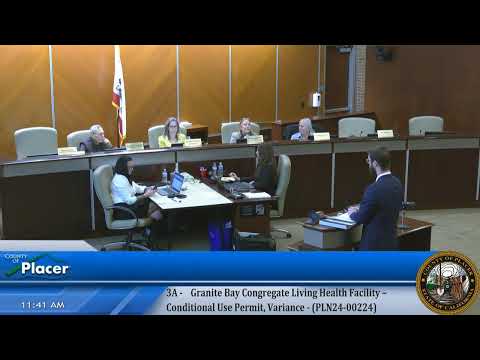
Placer County planning staff and the Placer Conservation Authority (PCA) presented an overview of the Placer County Conservation Program and responded to public questions Wednesday at the county Planning Commission hearing.
The presentation, delivered by Supervising Planner Rebecca Lillis and followed by remarks from PCA Executive Director Greg McKenzie, described the PCCP as a consolidated habitat and aquatic-resources conservation program covering roughly 201,000 acres of western Placer County. Lillis told commissioners the PCCP “strikes a balance between conservation and economic development by accommodating the anticipated growth in the region while streamlining the environmental regulatory permitting coverage required of covered activities.”
Commissioners and members of the public pressed staff on program details including which projects must enroll, how mitigation fees are calculated and adjusted, whether avoided riparian and oak woodland areas can be added to the PCA reserve system, and whether the program creates a conflict of interest because the county planning agency helped develop the PCCP.
Lillis summarized how the PCCP is structured: a combined Habitat Conservation Plan (HCP)/Natural Community Conservation Plan (NCCP) for 14 covered species, an Aquatic Resources Program (CARP) to address streams and wetlands, and an in-lieu fee program that funds mitigation and long-term management. She said PCCP fees are assessed when projects convert natural or semi‑natural lands to urban uses and that PCCP authorization is required “prior to any impact on aquatic resources within the plan area when subject to the PCCP as a covered activity.” Lillis noted the PCCP does not cover every species or plant types and that project CEQA documents must discuss PCCP conditions rather than merely referring readers to the PCCP mitigation requirements.
Greg McKenzie described how the JPA (Placer Conservation Authority) uses fees. McKenzie said fees are one‑time payments tied to land conversion and that PCA follows state “nexus” requirements in setting rates. He said fees cover not only land acquisition but the costs to design, restore, monitor and maintain mitigation lands, and that 7% of fee revenues are placed into a perpetual endowment to fund care beyond the program’s 50‑year performance period. McKenzie added that since implementation the PCA has leveraged federal and state grants — roughly $16 million — to acquire lands that advance the program’s reserve target of protecting 47,300 acres over 50 years.
Members of the public urged stronger protections, questioned whether past in‑lieu fees were too low, asked how the PCCP coordinates with local housing and annexation decisions, and asked what happens to sites with existing entitlements. Brian Meyer of Penryn said developers appear to have built into previously described riparian areas and asked whether that reflects PCCP enforcement. Shaheel Burkema of Granite Bay asked whether PCCP staff had influenced site selection for state housing sites. Caller Harry White asked for metrics comparing acres conserved for each acre developed and asked whether loopholes exist that allow developers to avoid PCCP mitigation.
Staff responded point‑by‑point: Lillis said the PCCP fee program applies to land conversions after the PCCP’s November 1, 2020 effective date but that projects with existing entitlements remain subject to the PCCP if they are modified in ways that increase impacts and trigger discretionary review. On in‑lieu fees Lillis and McKenzie said fees have been adjusted annually for inflation since adoption and that a five‑year nexus review is required; McKenzie said a new fee adjustment was pending Board consideration. On alleged conflicts of interest, County Counsel Clayton Cook and staff explained the PCCP is implemented by a separate joint powers authority (the PCA) and that land‑use authority remains with the county and the cities; PCA receives mitigation funds and carries out acquisitions and restoration separate from the county’s land‑use decision role.
Staff and PCA representatives also described the process for adding avoided riparian or oak woodland lands into the reserve system: a site must be demonstrably avoidable, have riparian or species value, and be suitable for long‑term conservation; the PCA board and state/federal regulatory partners must weigh in before acreage is accepted into the reserve. As an example, McKenzie said a proposal in the Dry Creek watershed that includes salmon and riparian oak woodland was on the PCA board agenda for consideration.
The presentation came after several recent project hearings in which PCCP applicability was raised; Planning Director Chris Pahulee said the briefing responded to a Commission request to clarify how PCCP interacts with CEQA, permits and ongoing projects. Lillis said PCA staff is training local biologists and updating application materials to help applicants integrate PCCP avoidance, minimization and mitigation into CEQA analyses. McKenzie said the consolidated PCCP process can reduce permitting timelines for major projects by “one to five years” compared with pursuing separate federal and state permits for each project.
The commissioners did not take formal action on the PCCP at the hearing; staff said it would continue outreach and return when specific policy or fee changes required Commission or Board recommendation.
Community members with concerns were advised to comment at upcoming PCA board and Board of Supervisors hearings when individual parcel decisions or fee adjustments are considered.