Get Full Government Meeting Transcripts, Videos, & Alerts Forever!
Get email alerts on the Legislation topic
No spam. Unsubscribe anytime.
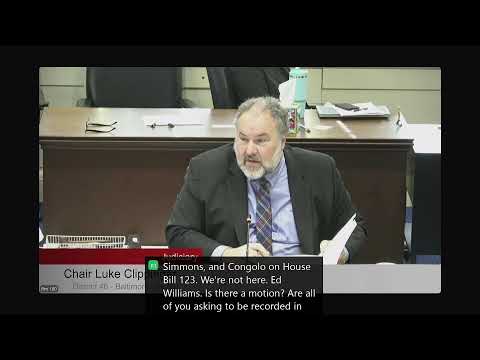
House Judiciary Committee advances bills on surveillance, CDL disqualification, emergency petitions and elder protections
Summary
An array of bills reached favorable committee votes at the House Judiciary Committee on Feb. 28, as members advanced proposals on visual surveillance and harassment, commercial driver disqualification, emergency civil-petition procedures and penalties for exploitation of vulnerable adults.
An array of bills reached favorable committee votes at the House Judiciary Committee on Feb. 28, as members advanced proposals on visual surveillance and harassment, commercial driver disqualification, emergency civil-petition procedures and penalties for exploitation of vulnerable adults.
Why it matters: several of the measures amend existing criminal or administrative rules with immediate operational consequences for law enforcement, motor-vehicle administration processes and prosecutors. Committee action means the bills will move toward floor consideration and, if passed, change how privacy, public-safety responses and elder-abuse prosecutions are handled in Maryland.
The committee amended and advanced a bill that inserts certain forms of visual surveillance into Maryland's harassment law. "By adding, conducting visual surveillance in an area of another's residence ... all 3 of those criteria now apply," Delegate Valentine said during the committee's discussion of the subcommittee amendments. The change moves intentional visual surveillance from a standalone provision into the harassment statute; sponsors told the committee that doing so requires proof of intent, a reasonable warning to stop and the lack of a legal purpose before the conduct can support a peace order or criminal charge. The committee adopted the amendment and voted the bill favorable as amended.
The panel also voted to align state rules for commercial driver disqualification with federal requirements. Holly, committee staff, told members the change "is putting us in compliance with the Federal motor carrier safety administration regulations. It's under 49 CFR section 383.51," and that federal regulations treat certain administrative-per-se findings as convictions for disqualification purposes. Holly said the Motor Vehicle Administration provided statistics showing roughly 168'—174 CDL holders per year had offenses that could be subject to disqualification under the standard described. Members discussed due-process and how the administrative hearing interacts with criminal proceedings; the committee moved the bill favorably.
A bill that clarifies what use of force officers may employ when serving emergency civil petitions also moved forward. Committee discussion focused on whether adding an explicit reference to Maryland's use-of-force statute would create appropriate statewide clarity without broadening police authority beyond statutory limits. "I will be a yes today because I took the time to call Delegate Allston," Delegate Williams said after describing discussions between the sponsor and disability advocates; Williams and others said the sponsor amended the bill last year and consulted advocacy groups before pressing it again. The committee voted the bill favorable as amended.
On protections for older and vulnerable adults, members adopted a rewrite of a proposed new offense to place the operative language within the existing exploitation-of-a-vulnerable-adult statute, and added provisions about restitution and concurrent sentencing. Supporters said the change was requested by the Attorney General's office so convictions would more clearly reflect the victim's status and help prevent convicted caregivers from easily gaining other caregiving jobs. "Under federal law they'd be disqualified," one member said during debate, referring to federal rules that can bar hiring in federally funded programs.
Other bills advanced without substantive floor debate included a task-force bill (membership clarifications added), a measure adding a forensic interviewer to certain child-witness procedures and several more that the committee listed and voted to move forward.
Votes at a glance: the committee recorded favorable actions on the bills discussed on the Feb. 28 docket including (committee notation of amendments where applicable): - House Bill 123: amendment adopted; bill favorable as amended (parole/probation representation amendment adopted and bill moved favorable as amended). - House Bill 189: favorable — aligns state CDL disqualification practice with federal requirements for certain BAC findings (discussion held; committee moved bill favorable). - House Bill 236: amendment adopted to add conducting visual surveillance into harassment statute; bill favorable as amended. - House Bill 315: task force bill; subcommittee amendments adopted; bill favorable as amended. - House Bill 442: added a forensic interviewer to certain child-witness provisions; bill favorable. - House Bill 468: emergency-petition bill clarifying use-of-force reference to Maryland's Public Safety use-of-force statute; amendments discussed and bill moved favorable as amended. - House Bill 604: rewrite relocating caregiver-theft provisions into the existing exploitation-of-vulnerable-adult statute; amendment to require concurrent sentences adopted; bill favorable as amended. - House Bill 675: (guardianship stay) amendment adopted clarifying beneficiary/party language; bill favorable as amended. - Several other bills on the docket were carried, held for amendment, withdrawn or postponed to align with companion Senate changes; committee staff gave members a list of next steps and schedules.
What supporters and critics said: supporters emphasized clarifying language and interbranch coordination with administrative agencies and advocacy groups. As Delegate Simpson explained of one child-witness measure, adding a forensic interviewer "lessens" the need for a child to testify multiple times. Members who raised concerns asked for follow-up information on administrative remedies (for example, how CDL administrative-per-se hearings intersect with criminal process) and sought assurances that statutory changes would not unintentionally broaden local agency discretion.
Next steps: the committee indicated it will carry some bills to give staff time to collect additional detail, will coordinate with Senate sponsors on companion measures, and expects several of the advanced bills to be scheduled for floor consideration in coming weeks.