Get Full Government Meeting Transcripts, Videos, & Alerts Forever!
Get email alerts on the Dda Budget topic
No spam. Unsubscribe anytime.
Advocates and providers urge restoration of Developmental Disabilities funding as DLS flags shortfalls
Summary
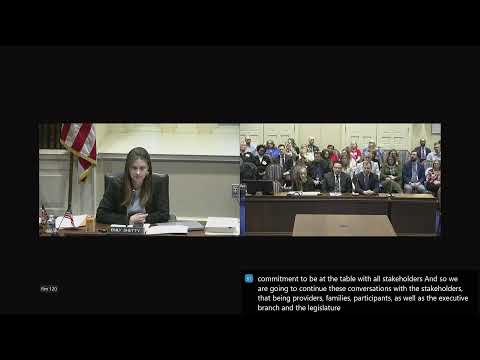
Chair Emily Shetty convened the Health and Social Services Subcommittee hearing on the Developmental Disabilities Administration budget with DLS reporting a $190 million decline in the fiscal 2026 allowance and warning of persistent spending growth that has repeatedly exceeded legislative appropriations.
Chair Emily Shetty convened the Health and Social Services Subcommittee hearing on the Developmental Disabilities Administration budget with Department of Legislative Services analyst Victoria Martinez presenting DLS’s review and recommendations. Martinez told the panel that “the fiscal 20 26 allowance decreases by $190,000,000 or 6.6% for a total of $2,700,000,000,” and detailed growth in community‑based spending that has repeatedly exceeded legislative appropriations.
The nut graf: The hearing centered on whether proposed fiscal 2026 cost‑containment measures and rate changes—most notably elimination of a geographic rate differential, changes to dedicated (1‑to‑1) hours policy, and reductions in self‑directed services compensation—would destabilize providers and force some Marylanders into institutional or crisis care. DLS and the Maryland Department of Health’s DDA exchanged technical and timing details about waiver amendments and reporting, while dozens of providers, direct support professionals and family members gave testimony about the real‑world consequences they say would follow the cuts.
DLS presentation and key fiscal findings
Victoria Martinez of DLS summarized the DDA analysis. DLS reported nearly $4,000 individuals on the community services waiting list in fiscal 2024, substantial enrollment in three DDA waivers, and the LTSS transition’s contribution to unusually rapid spending growth in 2023–24. Martinez said DDA provided $457,000,000 in bridge payments to providers and recouped about $346,000,000 of that amount. DLS recommended several restrictions and reporting requirements, including holding funds until the agency submits a fiscal year closeout report and monthly spending data tied to the monthly/quarterly forecasts.
DLS identified three cost‑containment items that are contingent on a waiver amendment and CMS approval (geographic differential elimination, a cap on individual and family‑directed goods and services, and changes tied to transitioning youth); DLS said the geographic differential elimination cannot take effect in FY 2025 until a waiver amendment is submitted and approved. DLS also recommended eliminating a proposed 1% provider rate increase in FY 2026 and flagged forecasting errors that produced a projected deficit of about $88.6 million in 2025 and $5.9 million in 2026.
Administration response and near‑term actions
Deputy Secretary Marlena Hutchinson, Developmental Disabilities Administration, acknowledged the fiscal constraints facing Maryland—“These are challenging times. Maryland is facing a $3,000,000,000 budget deficit,” she said—and emphasized ongoing engagement with families, providers and the legislature. Hutchinson said MDH/DDA no longer anticipates pursuing one proposed measure (limiting transitioning youth to the traditional provider model) because pending policy changes may make it unnecessary and that any actions requiring a waiver amendment will follow CMS timelines (30 days public comment then 90 days for CMS review).
Hutchinson confirmed DDA is working with the Department of Budget and Management to update cost projections and that DDA submitted the requested fiscal year 2025 year‑to‑date community services spending report on 02/18/2025. She asked for follow‑up with DLS on a $16.8 million discrepancy DLS had flagged in self‑directed services spending and agreed the department will provide additional scheduling and reporting information.
Providers, DSPs and family testimony
More than three dozen advocates, family members, direct support professionals (DSPs) and provider executives testified. Themes included:
- Workforce and pay: Providers and DSPs warned that eliminating the geographic differential and reducing self‑directed wages would force experienced staff to leave. Laura Howell (Maryland Association of Community Services) said eliminating the differential would effectively create a statewide rate that lowers pay in higher‑cost counties and jeopardize recruitment and retention. Rob Baynard (Opportunities, Inc.) and others said recent rate increases were tied largely to minimum‑wage adjustments and that undoing those gains would undo progress in reducing vacancy and turnover.
- Dedicated/1‑to‑1 supports: Family members and providers repeatedly described situations (epilepsy, seizure disorder, severe behavioral dysregulation, complex medical needs) where dedicated staff hours are credited with preventing hospitalizations and preserving community living. Parent Jane Plappinger testified, “I am terrified…David's group home could close if they lose the geographic reimbursement differential reimbursement rate and are unable to hold on to their staff.” Several speakers said recent denials or long delays in approving documentation for dedicated hours have already disrupted services.
- Self‑directed model concerns: Parents and recipients said self‑direction has allowed them to keep trusted caregivers and avoid institutional placement. Multiple speakers urged that cuts to self‑directed compensation or new caps on goods and services would produce staff turnover and force some families back into institutional care.
- Uncompensated care and billing delays: Providers described millions in unpaid services following waiver status changes and administrative billing problems; ARC Montgomery County said it had provided more than $5,000,000 in supports that were not yet paid.
Representative quotes from the hearing include: Victoria Martinez (DLS) describing the allowance change as “the fiscal 20 26 allowance decreases by $190,000,000 or 6.6% for a total of $2,700,000,000”; Deputy Secretary Marlena Hutchinson saying “These are challenging times. Maryland is facing a $3,000,000,000 budget deficit”; and People on the Go Maryland Executive Director Matt Rice urging lawmakers, “Please support the Developmental Disabilities Administration budget.”
Policy and implementation details raised
- Waiver amendments and CMS: Multiple potential cost containment items require a CMS waiver amendment and, per DDA, cannot be implemented until public comment and CMS review are complete.
- Reporting and oversight: DLS asked for monthly and quarterly spending reports and recommended restricting funds until DDA submits closeout documentation and corrective actions for repeat audit findings from the Office of Legislative Audits.
- Specific program notes: The Self Directed Services Manual (effective November 2024) introduced additional documentation requirements for accessing individual and family directed goods and services (IFDGS), including three months of personal bank documentation; DDA said the tools meet HIPAA requirements but DLS requested the department address privacy and administrative burdens.
What the hearing did not resolve
There were no formal votes at the hearing; subcommittee members asked DDA for additional detail and modelling. DDA agreed to provide updated cost projections, clarify the $16.8 million discrepancy DLS cited for self‑directed services, and to work with DLS to furnish numbers to the committee by the timeline requested during the hearing.
Why it matters and next steps
Subcommittee Chair Shetty, full committee Chair Ben Barnes and other Appropriations leaders said restoring as many DDA funding items as possible is a top priority for the Appropriations Committee amid the state’s broader budget work. The committee instructed subcommittees to look for savings elsewhere to enable restorations. DDA and DLS were asked to return with updated projections and documentation on waiver amendment timing, program impacts and monthly spending so legislators can weigh technical solutions against the potential impact on people who rely on DDA services.
Ending: The hearing closed after more than three hours of public testimony; committee leaders pledged continued engagement with families, providers and state agencies as FY 2026 budget work proceeds.