
St. Mary's College tells legislators enrollment has stabilized and audit fixes are underway as DLS recommends concurrence with FY26 allowance
Get AI-powered insights, summaries, and transcripts
Sign Up Free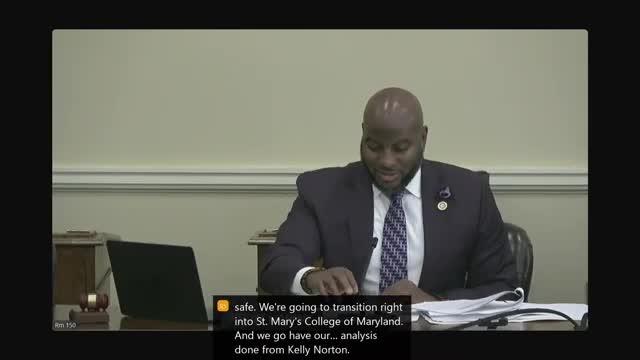
Summary
Analysts reported enrollment growth and an adjusted FY26 state allocation for St. Mary’s College of Maryland; the college described accounting classification corrections and actions to address repeat audit findings while seeking continued support under its statutory funding formula.
The Education and Economic Development Subcommittee heard that St. Mary’s College of Maryland’s enrollment has stabilized and that the college has taken corrective steps following a December 2024 Office of Legislative Audits report.
DLS analyst Kelly Norton told the committee that total undergraduate enrollment rose modestly from fall 2023 to fall 2024 and highlighted declines and recoveries across retention and graduation-rate metrics. Norton said the proposed fiscal 2026 budget includes a general fund increase of $700,000 after contingent adjustments and that total state-supported funding increases by about $2.2 million when accounting for FY25 salary increases. She noted language in the FY26 budget bill that would remove the statutory funding formula beginning in FY26 and that one contingent reduction of $416,847 is shown in the bill if that provision is enacted.
President Jordan (St. Mary’s College) told the committee the college has “not only stabilized our enrollment, but we have turned the corner back to growth,” and credited new majors, a core curriculum, marketing and retention efforts including a winter session and the Seahawks Success Network. Paula Collins, vice chair of the board of trustees, told legislators the board is highly engaged in the presidential transition and thanked the legislature for updating the college’s funding formula in 2017.
Norton reviewed the college’s December 2024 audit by the Office of Legislative Audits, which included three repeat findings: procurement and contract oversight concerns (finding 2), insufficient verification of residency changes (finding 6), and weaknesses in collections and segregation of duties (finding 7). Norton said OLA also identified possible ethics concerns involving a vendor that was a second employer of an employee involved in procurement. The transcript records the analyst’s request that the president comment on corrective actions; Jordan described personnel and policy changes, including appointment of experienced finance leadership, a new procurement officer and revised procedures for residency and cash handling.
Norton’s recommendation was to concur with the governor’s allowance for FY26. Committee members asked about vacancies and accounting discrepancies; Jordan said classification errors moved salary expenditures across program categories in DBM reports but that corrected figures have been shared with DBM and DLS and that an enterprise resource planning (ERP) implementation and newly hired staff should prevent future miscategorizations.
No formal votes were recorded before the subcommittee; DLS recommended concurrence with the allowance.