Get Full Government Meeting Transcripts, Videos, & Alerts Forever!
Get email alerts on the Housing Policy topic
No spam. Unsubscribe anytime.
Stockton staff brief planning commission on 2024 housing progress; city cites 837 permits and capacity for 22,999 units
Summary
City planners presented the 2024 general plan and housing element annual report, reporting 837 permits in 2024, including 253 very‑low‑income units from two subsidized projects, and saying Stockton has development capacity for 22,999 units while its RHNA share is 12,673 units.
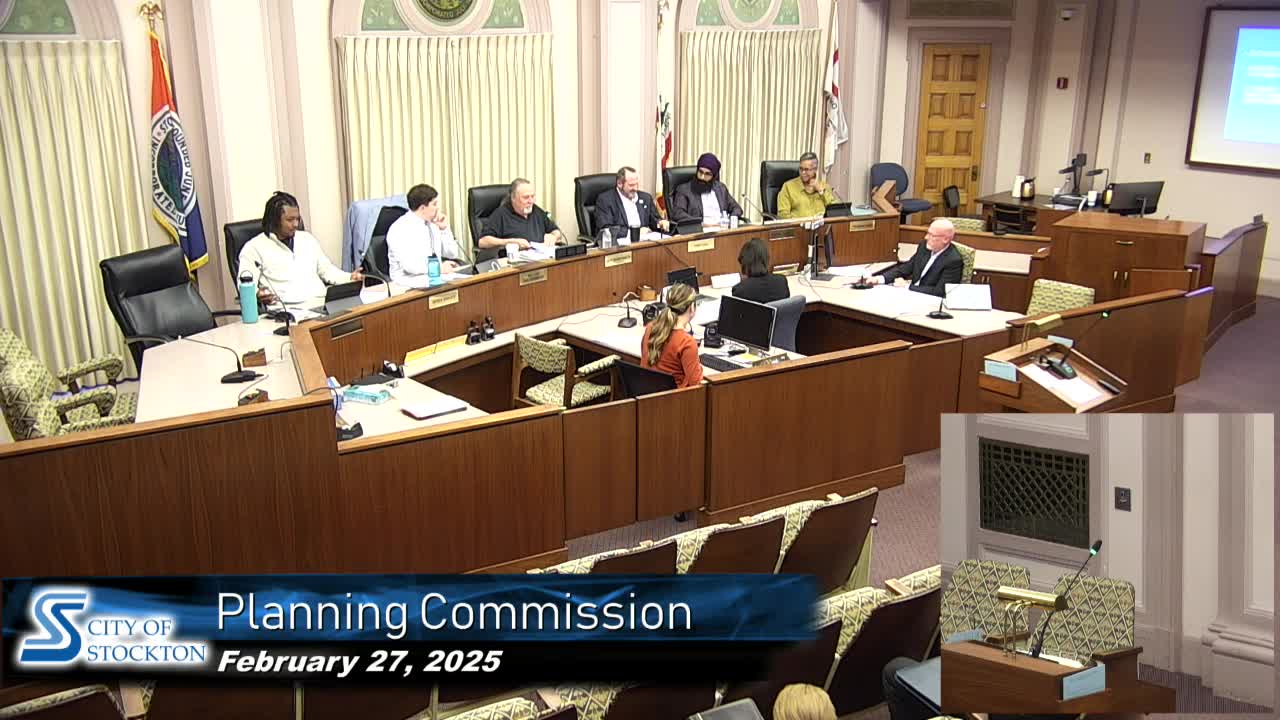
City staff presented the 2024 annual progress report for the general plan and housing element at a Stockton City Planning Commission informational session, summarizing housing production, capacity and next steps required by state law.
Senior planner Anson LaHosset told the commission that the Stockton housing element was certified by the state and approved by City Council in 2024, and that the housing element is the part of the general plan that state law requires be updated and monitored. LaHosset said the city’s role is to provide land and regulatory capacity; the city is not required to build units itself.
LaHosset reported key figures: San Joaquin County’s regional housing needs allocation (RHNA) for the current cycle is 52,719 units and Stockton’s share is 12,673 units. He said the city’s total development capacity is 22,999 units. For 2024, the city issued building permits for 837 new housing units. Of those permits, 253 were classified as very low income and came from two subsidized projects (Park Center Apartments and St. Mary’s Pathways). LaHosset also said 52 permits were accessory dwelling units (ADUs), and of those ADUs 31 were reported as affordable/low‑income units as allowed under state rules.
LaHosset noted the statutory reporting schedule: annual reports are presented in a public hearing and must be submitted to the state by April 1; staff will present the reports to City Council for acceptance in March before submission.
Commissioner questions and discussion. Commissioners asked for clarifications about capacity, housing types and the breakdown between ownership and rental units. LaHosset said the stated capacity of 22,999 refers to future capacity (opportunity sites and entitled parcels) rather than existing units. Commissioners and staff discussed how capacity is calculated — parcel‑by‑parcel approximations based on allowable densities and entitled but not yet built subdivisions — and that many entitled maps can remain unbuilt until market conditions change.
Panel and staff responses about constraints and incentives. During the conversation several commissioners and staff raised barriers to hitting RHNA targets, including market forces, construction costs, and land prices. An audience member and one commissioner emphasized that land cost is the primary variable developers use to decide whether projects “pencil out.” Community Development Director Stephanie Ocasio said Stockton has taken steps to encourage housing: the city has been designated a “pro housing jurisdiction” by the California Department of Housing and Community Development (HCD) and offers measures such as preapproved ADU plans, fee waivers for affordable projects and streamlined processes. Ocasio added that subsidized affordable projects typically rely on outside funding and prevailing wage or subsidy rules that increase construction costs.
Staff highlighted recent accomplishments and ongoing items: the new Stockton housing element (certified 2024); a Stockton Housing Action Plan with neighborhood action plans; an ongoing public facility fee nexus study; approval of construction plans for affordable projects (St. Mary’s Pathways and Park Center Apartments); and outreach on a draft development code anticipated to go to City Council later this year.
Production goals and outlook. LaHosset and staff noted Stockton needs to average roughly 1,584 new units per year to meet its RHNA share; in the previous cycle the city averaged about 545 units per year. Staff framed 2024 as the first year of a six‑year RHNA cycle and said many actions in the housing element are intended to incentivize or facilitate development (zoning changes, infrastructure, economic development incentives, grant pursuit and site assembly). Staff recommended commissioners and the public reach out to Community Development if they want additional parcel‑level breakdowns (for example number of units by density category or rental vs. ownership totals).
Transit, density and development code work. Commissioners also asked about locating higher‑density housing near transit and about forthcoming development code updates; staff said corridor and downtown areas, including the transit transfer station and Cabral Station area, are priorities for transit‑oriented and higher‑density development and that parking reductions and other incentives are available for projects near frequent transit.
Next steps. The annual report will be presented to City Council for acceptance and then submitted to the state by April 1 as required by law. Staff said the report is informational and no commission action was required at the meeting.