Get Full Government Meeting Transcripts, Videos, & Alerts Forever!
City staff outline $175 million 2025 general obligation bond plan; council criticizes lack of project detail
Summary
Albuquerque officials previewed the mayor's proposed $175 million general obligation bond program on Feb. 25, emphasizing rehabilitation of existing assets and the need to use bond proceeds as local match for federal grants, while several councilors criticized the budget for lacking named projects for voters to consider.
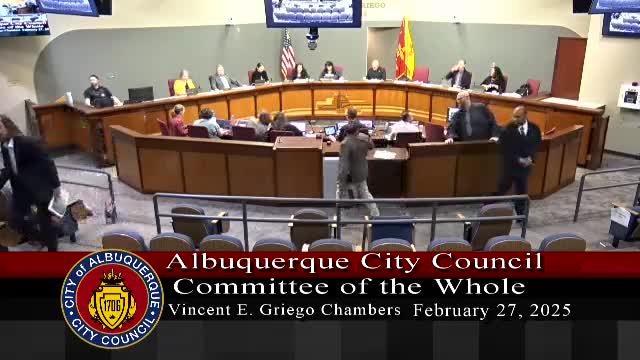
Albuquerque officials on Tuesday evening previewed the mayor's proposed 2025 general obligation bond program and decade capital plan, saying the administration plans a $175 million ballot question focused on rehabilitation of city assets while several councilors objected that the binder does not list specific projects for voters to review.
The Committee of the Whole heard an overview from Sean Maiden, the City's CIP official in the Department of Municipal Development, who said the bond package's guiding criteria (resolution R23-194) direct roughly 90% of the program toward rehabilitation and deficiency-correction projects and allocate about 55% of that share for rehabilitation specifically.
"The process began about a year ago with city council adoption of the criteria resolution R23-194," Maiden said. "Our financial advisors said we can bond to a capacity of $175,000,000." He and other presenters stressed the emphasis on maintaining existing assets rather than adding large new facilities.
Why it matters: City staff said the proposal intentionally concentrates on preservation of streets, drainage, buildings and other existing infrastructure to limit future capital escalation. Presentations also warned that recent construction-cost inflation and supply-chain challenges mean some projects will cost far more than they would have a few years ago.
What staff proposed and why
- Bond capacity and breakdown: Eric Harrigan of RBC Capital Markets, the city's municipal advisor, told the committee the city's current tax-base growth supports a $175 million GO capacity for this cycle. Maiden said the draft program divides the request among categories: about 58% for "basic services" (roughly $101 million), about 26.8% for community facilities (just under $47…
Already have an account? Log in
Subscribe to keep reading
Unlock the rest of this article — and every article on Citizen Portal.
- Unlimited articles
- AI-powered breakdowns of topics, speakers, decisions, and budgets
- Instant alerts when your location has a new meeting
- Follow topics and more locations
- 1,000 AI Insights / month, plus AI Chat