Get Full Government Meeting Transcripts, Videos, & Alerts Forever!
Get email alerts on the Go Bond Cip topic
No spam. Unsubscribe anytime.
City staff outline $175 million 2025 general obligation bond plan; council criticizes lack of project detail
Summary
Albuquerque officials previewed the mayor's proposed $175 million general obligation bond program on Feb. 25, emphasizing rehabilitation of existing assets and the need to use bond proceeds as local match for federal grants, while several councilors criticized the budget for lacking named projects for voters to consider.
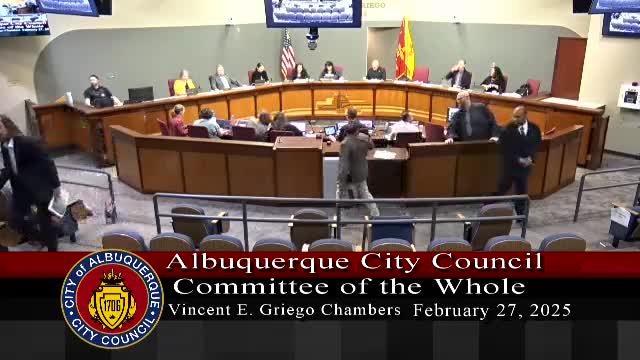
Albuquerque officials on Tuesday evening previewed the mayor's proposed 2025 general obligation bond program and decade capital plan, saying the administration plans a $175 million ballot question focused on rehabilitation of city assets while several councilors objected that the binder does not list specific projects for voters to review.
The Committee of the Whole heard an overview from Sean Maiden, the City's CIP official in the Department of Municipal Development, who said the bond package's guiding criteria (resolution R23-194) direct roughly 90% of the program toward rehabilitation and deficiency-correction projects and allocate about 55% of that share for rehabilitation specifically.
"The process began about a year ago with city council adoption of the criteria resolution R23-194," Maiden said. "Our financial advisors said we can bond to a capacity of $175,000,000." He and other presenters stressed the emphasis on maintaining existing assets rather than adding large new facilities.
Why it matters: City staff said the proposal intentionally concentrates on preservation of streets, drainage, buildings and other existing infrastructure to limit future capital escalation. Presentations also warned that recent construction-cost inflation and supply-chain challenges mean some projects will cost far more than they would have a few years ago.
What staff proposed and why
- Bond capacity and breakdown: Eric Harrigan of RBC Capital Markets, the city's municipal advisor, told the committee the city's current tax-base growth supports a $175 million GO capacity for this cycle. Maiden said the draft program divides the request among categories: about 58% for "basic services" (roughly $101 million), about 26.8% for community facilities (just under $47 million) and roughly 15.2% for mandated programs (about $26.6 million). Mandates spelled out by prior ordinance cycles include minimum set-asides for public art (raised to 1.5%) and open-space acquisition (3%), and a 5% streets set-aside that funds trails and bikeways.
- Cost escalation and program design: Director Jennifer Turner of the Department of Municipal Development told the council the administration consolidated many line-item projects into broader program buckets because construction costs have jumped: "materials have gone up almost 60% and installation costs well over 10% in the last few years," she said, adding that new construction estimates now run about $800 to $1,400 per square foot while rehab costs commonly run $300 to $600 per square foot depending on complexity.
- Department-level requests: Departments used the meeting to present their top priorities. Highlights included a $37.9 million streets program at DMD (with line items for sign replacement, paving and street lighting), $12 million for storm drainage and $3 million for roadway widening; a roughly $7.85 million package from Arts & Culture (library facilities and $3 million for library materials); Parks & Recreation requests focused on irrigation, playground and open-space work; Transit emphasized that GO bond proceeds are critical as local match for federal formula and competitive grants; Fire and APD described building and apparatus needs; and Albuquerque Community Safety requested facility upgrades and vehicles to support its specialized response teams.
Public comment and council concerns
Three public speakers urged support for libraries, affordable housing and the Albuquerque Community Safety (ACS) program. Janet Sayers, an advisory-board member, said she backed funding for library materials and branch renovations: "Here's my library card and I hope all of you have it along with the other 350,000 people in Albuquerque that have one," she said.
Council-level pushback centered on the administration's decision to present program-level buckets rather than a list of named projects. Councilor [Lewis] said the mayor's presentation looked like "asking the voters for a blank check," and urged the administration to provide specific project lists so voters can decide what they are approving in November.
Several councilors asked departments to provide much more granular follow-up information. Councilor Feibelkorn pressed DMD on how the city is using the Social Vulnerability Index to prioritize projects; Director Turner said the administration considers equity in the ranking process but that many program line items are citywide because needs exist across the city. Councilor Rogers asked DMD to show how investments will be distributed geographically, and other council members said they will seek a revised draft showing specific projects or district allocations before the council's next review.
Affordable housing and the Workforce Housing Trust Fund
Health, Housing and Homelessness Director Gilbert Ramirez presented a $10 million request for the Workforce Housing Trust Fund, the statutory account tied to GO bond cycles. Ramirez and his deputy emphasized that every dollar in the fund leverages multiple external financing sources and said $10 million under current market conditions will buy far fewer units than it would have a decade ago. Several councilors pushed for larger housing appropriations or for additional line items for affordable housing, and asked the administration and bond counsel whether CIP or other GO bond proceeds could be allocated elsewhere to boost housing production beyond the $10 million statutory cap for the trust fund.
Formal action taken
The committee voted to defer the resolution to the next Committee of the Whole meeting on March 6, when the council will consider amendments and a committee substitute; the mayor's capital budget as amended or substituted would then be sent to the full council on March 17 for adoption and placement on the November ballot. A motion to defer "R117, 2025 GO Bond program" to March 6 was offered and carried by voice vote.
What's next
- The administration will return March 6 with further detail, and the council expects amended language or project lists in advance of that meeting. The council also will receive follow-up information requested at Tuesday's hearing: itemized project scopes, where bond proceeds would be spent by district and the breakdowns departments said they will provide (for example DMD's request to show how much storm drainage funds will go to specific AMAFCA projects). - The capital package will move from the March 6 Committee of the Whole to the March 17 City Council meeting, where the council can adopt an amended capital plan for the ballot.
The Committee of the Whole hearing on the 2025 GO bond program ran nearly seven hours and brought detailed presentations from more than a dozen departments, alongside public comment pro and con. Staff and the council agreed on the overarching priority of preserving existing capital assets; they parted on how specific the ballot question should be and how granular the council wants the administration to make the project lists before the March 6 meeting.
(Reporting based on the Feb. 25 Committee of the Whole; council action: resolution deferred to March 6.)