Get Full Government Meeting Transcripts, Videos, & Alerts Forever!
Get email alerts on the Long Term Care Protections topic
No spam. Unsubscribe anytime.
State long-term care ombudsman backs stronger notice rules, emergency protections and senior bill of rights
Summary
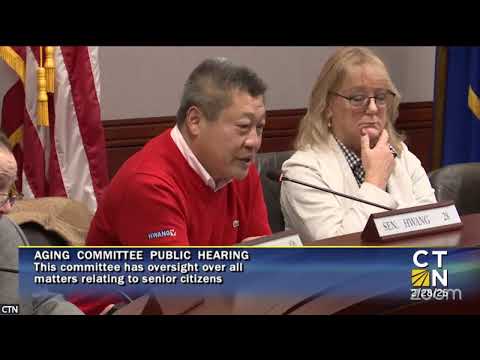
The state long-term care ombudsman told the Aging Committee on Feb. 28 that bills before the committee—covering involuntary transfers and discharges, abandonment, closures and a senior bill of rights—would protect residents, but implementation, staffing and enforcement gaps must be addressed.
Mairead Painter, the state long-term care ombudsman, told the Aging Committee on Feb. 28 that Connecticut needs clearer rules and better implementation to protect residents of nursing homes, residential care homes and other long‑term care settings.
Painter testified in support of several bills on the committee’s agenda, including HB 6972 (transfers and discharges in residential care homes), HB 6985 (nursing home and residential care home abandonment), HB 6986 (a senior citizens bill of rights) and HB 6987 (closures and evacuations for nursing homes and residential care homes). She said stronger notice and enforcement provisions would give her office and residents a realistic opportunity to appeal involuntary discharges and to secure placement and items when a facility closes or evacuates. “Strengthening notification requirements will ensure that my office is appropriately notified and that we have the opportunity during the limited window of time to file an appeal,” Painter said in her testimony.
Painter recommended clarifying when a notice “must come to my office timely,” so that failures to notify would be understood up front and could be remedied. On abandonment (HB 6985), she told the committee the bill’s classification of abandonment as a serious regulatory violation helps, but that in “cases where there's significant and serious harm or death, regulatory citations alone may not be enough” and urged the committee to consider whether criminal penalties should apply in willful or negligent abandonment.
On the proposed senior bill of rights (HB 6986), Painter said the measure “recognizes these rights for older adults,” including autonomy, dignity and the right to receive person‑centered care, and she urged that inclusivity be central to the bill. For emergency planning (HB 6987), Painter said explicit protocols for closures, evacuations and emergency transfers would reduce trauma and displacement, and protect residents’ access to family, familiar providers and personal items.
Painter also voiced support for HB 7006, which would allow nursing home residents to take online courses at community colleges with tuition waivers, calling access to learning “a holistic approach that supports individuals as they recover both physically and mentally.” She urged greater oversight and transparency for nursing homes owned by private equity and real estate investment trusts, saying their short‑term profit models can lead to cost cutting that harms resident care.
Multiple committee members asked Painter about youth volunteer programs in long‑term care settings (SB 1334). Painter said her office lacks the staff and funding to run the kind of statewide study the bill would require: her office has eight regional ombudsmen, two support staff, one administrative assistant and one community manager, and “we just don't have the bandwidth” to add a mandated study without new appropriations. Committee members asked whether streamlined certification or more funding could help create a youth pipeline; Painter said federal certification requirements (the Older Americans Act) set training hours and cannot be changed locally without federal action.
Other witnesses at the hearing echoed Painter’s concerns about implementation and funding. Cal Patel of the Connecticut Association of Residential Care Homes told the committee that Public Act 22-258 (the 2022 update to the residential care discharge statute) directed the Department of Public Health to create a uniform involuntary discharge form and process; Patel said the form has not yet been issued and that HB 6972’s new language could conflict with existing statute if the outstanding implementing work by DPH is not completed.
Advocates and legislators raised system‑level issues in questioning: the committee discussed the state’s certificate-of‑need (CON) process for bed changes and closures, the role of receivership when facilities become insolvent, and the long‑term care mutual aid program that helps locate beds in an evacuation. Painter noted past cases in which facilities were evacuated on short notice or owners left properties, leaving state and local officials to find placements and transportation for residents in a matter of hours.
Why it matters: The bills aim to close gaps that advocates say have left residents without timely notice, adequate placement options or accountability when facilities change ownership or close. Committee members pressed for clarity on who would pay for new duties and for timelines to implement statutory changes that have already been passed but not fully operationalized.
Key speakers: Mairead Painter, State Long Term Care Ombudsman; Cal (Kal) Patel, executive board member, Connecticut Association of Residential Care Homes. Painter’s testimony covered HB 6972, HB 6985, HB 6986, HB 6987 and HB 7006.
What’s next: The bills remain in the Aging Committee. Lawmakers and advocates signaled they will work on amendments clarifying notice requirements, implementation timelines for previously passed law and funding sources for new mandates.