Get Full Government Meeting Transcripts, Videos, & Alerts Forever!
Get email alerts on the School Based Mental Health topic
No spam. Unsubscribe anytime.
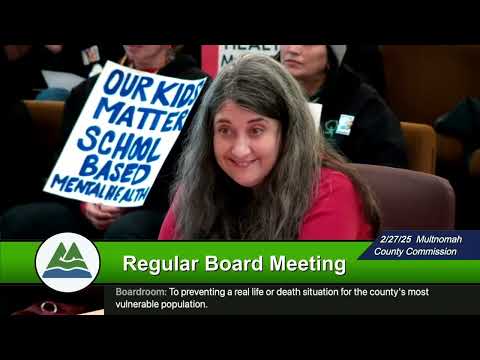
Clinicians, parents urge Multnomah County to reverse proposed cuts to school‑based mental health
Summary
At a Multnomah County Board meeting, school‑based clinicians and partners urged commissioners to restore proposed budget cuts that would eliminate the county's school‑based mental health program, warning the removal would leave uninsured and high‑risk youth without timely care.
At a Multnomah County Board of Commissioners meeting, clinicians and school health staff urged the board to reverse a proposal to eliminate the county's school‑based mental health services program.
Francis Flores Tapia, a clinician who identified herself as a clinician for the county's school‑based mental health program, told the board the proposal was “confusing and shocking” given the county's stated commitment to community mental health and recent recognition of Mental Health Awareness Month. She described the range of crisis work the program handles: screening for suicide risk, intervening for students who self‑harm, assisting youth who disclose abuse, and helping newly arrived immigrant students who are isolated and fearful of deportation.
The program serves 26 clinicians across six school districts, speakers said. Amanda Court, a nurse practitioner at the Franklin Student Health Center, described a patient she called “Erica” whose engagement with a school‑based clinician enabled her to accept ongoing counseling, access academic supports and sexual health care and “blossom into a confident, calm, and self‑possessed young woman.” Wendy Foster, who said she has nearly 20 years in the school‑based mental health program, recounted a student who attributed her survival to rapid intervention, quoting the student: “If you hadn't been there that morning, I'm not sure I would still be here.”
Speakers emphasized two themes: the program's role as a rapid safety net for students who lack other access to care and the program's culturally specific staffing. Flores Tapia said about 60% of the team provides culturally specific services and warned of “catastrophic ripple effects” if the program is eliminated, including loss of services to uninsured and undocumented students.
None of the speakers proposed an alternate funding source at the meeting; they urged the board to reconsider cuts and to preserve the county clinicians who coordinate closely with school counselors and social workers. Commissioners acknowledged the testimony during the public comment period; no board action on the program was taken at this meeting.
Ending: Board members and speakers said they expect the program and budget to be part of upcoming budget deliberations. Commissioners noted the county budget process is ongoing and invited further information from staff and community partners as the board develops its final budget recommendations.