Get Full Government Meeting Transcripts, Videos, & Alerts Forever!
Get email alerts on the Jail‑planning topic
No spam. Unsubscribe anytime.
Sacramento supervisors pause jail intake project after third‑party peer review; vote 4‑1 to pursue broader planning
Summary
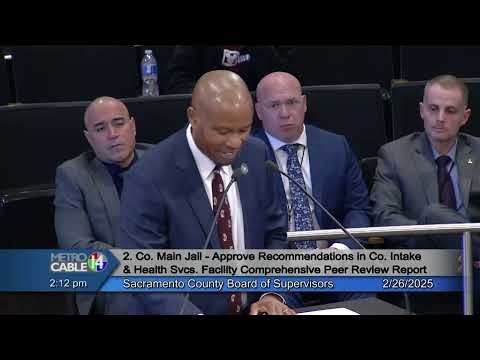
The Board of Supervisors voted 4‑1 on Feb. 26 to adopt recommendations from a third‑party peer review of the proposed Intake and Health Services Facility, pausing the current design/build effort and directing county staff to undertake a broader jail system planning process and additional studies before resuming construction plans.
The Sacramento County Board of Supervisors voted 4‑1 Wednesday to accept recommendations from a third‑party peer review of the proposed Intake and Health Services Facility (IHSF), suspending the current design‑and‑build path and directing staff to commission a jail system master plan and related studies.
The motion, moved by Supervisor Hume and later adopted by the board, implements CGL Companies’ core recommendation that the county pause the current IHSF project and commission additional planning work — including a population analysis, operational analysis, facility condition assessments and a more fully scoped space program — before advancing construction. Chief Deputy Robles, speaking for the sheriff’s office, said the sheriff’s office agreed “with the CGL recommendation to suspend the current IHSF project.”
Why it matters: the IHSF was proposed as a primary county effort to achieve compliance with the Mays consent decree, the court‑ordered framework governing health and intake services at county jails. The peer review by CGL found the conceptual program and schematic designs presented to date had shortfalls relative to some expert findings on the consent decree and recommended a wider planning effort to avoid costly, irreversible choices. With the board’s action, the county will pause the current project scope and pursue a committee‑driven master planning process intended to identify options, costs and financing strategies.
CGL’s review and the board response
CGL Companies, the firm contracted for a third‑party peer review, told the board that its review focused on six questions outlined in the county’s scope of work, including whether the draft program meets the Mays consent decree requirements, whether it exceeded those requirements, and whether less costly alternatives were explored. Brian Lee, vice president with CGL, told supervisors the firm reviewed the draft program and conceptual plans, interviewed more than 40 stakeholders and conducted site visits to the Rio Cosumnes Correctional Center and the downtown main jail.
CGL concluded the conceptual design "fell short of achieving compliance with the Mays consent decree in some specific areas," citing court‑appointed experts’ concerns about space for some medical and mental‑health functions. At the same time, CGL reported that the design included some staff support and circulation space not explicitly required by the consent decree and said it was unclear from the materials it reviewed whether lower‑cost options had been considered. The firm recommended suspending the current design/build path and contracting a jail system master plan that would present ranked options, timelines and cost modeling.
County staff framed the vote as a pause to enable more inclusive planning rather than a full cancellation. Deputy County Executive Sylvester Fadal told the board that the county had asked for an independent peer review and that CGL’s work, while advisory, should inform the next steps. Eric Jones, Deputy County Executive for Public Safety and Justice, said county staff already created an internal oversight structure — a policy group focused on jail improvement — and identified several existing advisory bodies (the Public Safety and Justice Advisory Committee, the Sheriff’s Community Review Commission and the Community Corrections Advisory Board) that could be leveraged for public engagement.
Public comments and community concerns
More than 50 residents, clinicians, advocates and formerly incarcerated people spoke in the public comment period. Speakers repeatedly urged the board to cancel the proposed expansion entirely and to reallocate funds to community‑based mental‑health services, addiction treatment, housing and diversion programs.
Multiple speakers cited data and local models: Susan House asked the board to consider the Yolo County Restorative Justice Partnership as an existing diversion model; Alana Marcucci Morris, vice president of the National Union of Healthcare Workers, urged investment in behavioral health; and several public speakers and clinicians described medical neglect, delays in medication and other custody‑related failures they said would not be solved by a new building.
Several people referenced costs and past spending during testimony: Dr. Corinne McIntosh Sacco said at least $1,500,000 has been spent on design reports, and multiple speakers cited a projected $2 billion lifecycle cost for the annex quoted in prior materials. CGL and county staff noted that the peer review did not include a detailed backfill cost estimate for renovating vacated space in the main jail, and the consultant warned that backfill could represent a substantial additional expense.
What the board directed
By adopting CGL’s recommendations, the board directed staff to: - Suspend the current IHSF design‑build path (the action was described in the motion and in CGL’s final recommendations) while continuing other consent‑decree work already underway. County staff emphasized existing efforts will continue, including policy changes, staffing and programmatic improvements tied to the Mays consent decree. - Establish or formalize a jail‑system planning and compliance oversight committee that includes criminal‑justice stakeholders and a clear charter. - Commission a jail system master plan that would include facility condition assessments, a robust population analysis, operational analysis, updated space programming and cost modeling of multiple options (renovation, new construction at alternative sites, or combinations). - Prepare options with ranked recommendations and financing strategies for future board consideration; staff estimated the contracting and studies could take on the order of months to about 18 months to complete, depending on procurement timelines.
Formal action and vote
The board adopted the resolution to follow CGL’s recommendations by a 4‑1 vote. The motion was moved by Supervisor Hume; the record does not identify a named second in the public transcript. The clerk reported the item passed "4 to 1." County counsel said plaintiff’s counsel in the Mays litigation had previously expressed concern about pausing the project but had not indicated immediate legal action in response to a temporary suspension.
Context and next steps
CGL’s presentation emphasized this was an early‑phase (conceptual design) review and that some items the firm flagged as issues might be resolved later in a typical design process, including through consultation with court‑appointed experts. The consultants recommended a more comprehensive population analysis that tests multiple scenarios (e.g., legislative changes, local population trends) to better inform the county’s needs assessment.
County staff said work on other consent‑decree obligations — policy changes, staffing improvements, certain renovations and program expansions — will continue while the master planning work is completed. Staff also told the board they plan more public engagement and to use existing criminal‑justice advisory bodies to solicit broader community input.
The board’s action pauses the current design/build path for the IHSF and opens a multi‑month planning process that staff and consultants say will surface alternatives, detailed costs (including backfill costs for vacated space), and financing options for the board to consider before any new construction is restarted. The board will receive follow‑up reports and options when the contracted planning work and analyses are complete.
Ending
The vote did not cancel the county’s obligations under the Mays consent decree, and county staff reiterated the board’s work to comply with the decree is ongoing. Supervisors and staff said they expect to bring back findings and options derived from the recommended master plan, population analysis and facility assessments for future board deliberation.