Get Full Government Meeting Transcripts, Videos, & Alerts Forever!
Get email alerts on the Air Quality topic
No spam. Unsubscribe anytime.
Sacramento County-funded vehicle emissions study finds localized pollution hotspots, strong community concern
Summary
A two-year county-sponsored project combining community surveys and mobile monitoring found generally low pollutant levels overall but identified hotspots for NOx, PM2.5 and airborne metals in specific neighborhoods and widespread community interest in air-quality information and remedies.
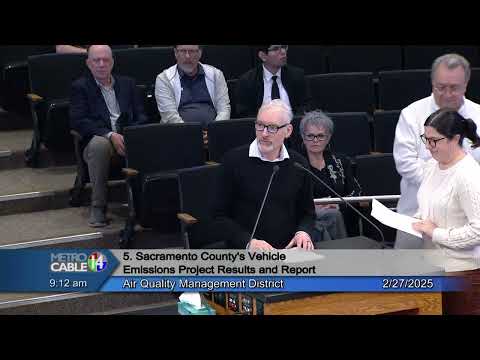
The Sacramento Metropolitan Air Quality Management District on March 2 heard results from a Sacramento County–funded Sacramento Vehicle Emissions Project that paired community surveys with mobile air monitoring and outreach in five priority environmental justice neighborhoods.
Project leaders said the two‑and‑a‑half year effort combined community-based monitoring, education and health surveys focused in North Vineyard, West Arden‑Arcade, North Sacramento, South Sacramento and Gardenland‑Northgate. Richard Falcone of United Latinos, who introduced partners at the March meeting, said the project sought to engage residents directly and make local data available to communities and government.
The project team reported surveying more than 1,200 residents overall, with roughly 500 responses from the four focused EJ neighborhoods. Elizabeth Savin of SAC Breathe summarized county‑level survey findings and said about half of respondents wanted to learn more or take action on air pollution; roughly 20 percent reported an emergency‑room visit in the past year for allergy or asthma symptoms and about 30 percent reported clinic or doctor visits for similar symptoms. Savin read a participant anecdote: “I have asthma, really bad asthma. I needed this so much but the air purifiers are so expensive … I will breathe better in my home.”
Wayne Linklauder, who led the mobile monitoring work for Sacramento State, said teams of trained undergraduates used distributed sensors and a toxic‑metal aerosol real‑time analyzer to collect 20– to 30‑minute samples at hundreds of sites. He cautioned the mobile sampling was designed to detect spatial variation, not to reproduce regulatory ambient‑air standard monitoring. “We did not measure to air quality standards,” Linklauder told the board; the objective was to identify areas warranting further attention.
Linklauder summarized pollutant patterns: black carbon and carbon monoxide were generally low in most samples; nitrogen oxides (NOx) and PM2.5 routinely exceeded values associated with annual or one‑hour benchmarks at some locations; and airborne heavy metals — including chromium, manganese, magnesium, zinc and copper — were comparatively elevated in parts of North Highlands and West Arden‑Arcade. He recommended continued focus on NOx and PM2.5 and further investigation of airborne metals.
Board members asked questions about scale and messaging. Director Serna and others noted the difference between short‑term mobile sampling and long‑term regulatory network assessments, cautioning that localized “low” readings in short campaigns can be misunderstood when compared with annual nonattainment designations. Director Guerra and others praised the project’s community engagement and emphasized mobile sources remain a major emission contributor. Director Dickinson asked about outreach to neighborhood associations in North Sacramento; project staff said partners such as the Mutual Assistance Network and the Health Education Council supported outreach and offered to provide more specific contact details.
Project partners said they published an executive summary and a journal article and made community reports available online and at events where they distributed air purifiers and other incentives. Presenters urged the board to view the work as a complement to regulatory monitoring — a way to “democratize” local data and to raise community awareness and capacity for future action.
Board members did not take formal action on the project at the meeting.