Get Full Government Meeting Transcripts, Videos, & Alerts Forever!
Get email alerts on the Housing Access Voucher topic
No spam. Unsubscribe anytime.
Advocates press for statewide Housing Access Voucher Program to prevent homelessness and reduce costs
Summary
Multiple homelessness, housing and service organizations urged the legislature to create and fund a statewide voucher program (HAVP/HABP) in the FY2026 budget, saying vouchers would prevent evictions, reduce child poverty, and save state costs tied to emergency shelter and services.
Representatives from policy groups, service providers and people with lived experience urged the joint legislative committees to adopt and fund a statewide Housing Access Voucher Program (HAVP or HABP) in the state’s 2026 budget.
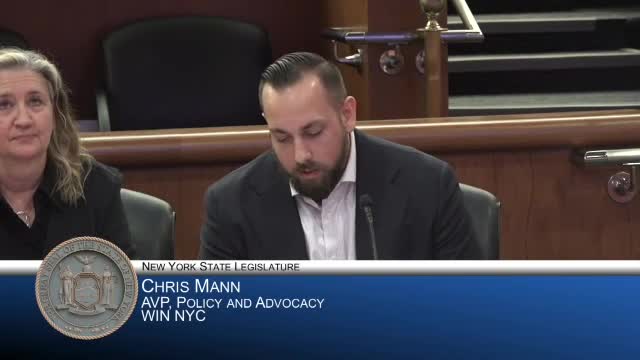
Speakers from Win (a large shelter and supportive housing provider), Enterprise Community Partners, Rochester Monroe Anti‑Poverty Initiative (RMAPI), Community Voices Heard and the National Union of the Homeless described the voucher proposal as a section‑8‑style rental assistance program administered by the state that would be available to households ineligible for city vouchers or lacking local voucher access.
Advocates emphasized three impacts: (1) immediate prevention of evictions and rapid exits from shelter, (2) long‑term housing stability for families and individuals, and (3) cost savings compared with shelter and emergency services. New Economy Project testimony referenced an analysis (by Robin Hood and others cited in testimony) and the Child Poverty Reduction Advisory Council’s recommendation that a statewide rental assistance tool would reduce child poverty and homelessness.
Speakers proposed a $250 million initial appropriation as a phased start (figures discussed in testimony), with arguments that the program could be scaled and paired with housing navigation supports and arrears funds. Several witnesses and legislators argued HABP would be particularly critical if federal funding streams face uncertainty; they cited the sheer volume of demand when New York City briefly reopened its Section 8 waitlist and former recipients’ inability to find units without additional search assistance.
People with lived experience described long waits for public housing lists, compounding health and financial crises. Advocates and providers requested funding not only for vouchers but also for associated supports: housing navigation, eviction‑arrears programs, and additional capacity for fair‑housing testing and tenant legal assistance.
Why it matters: Advocates argued a state‑level voucher program would target the documented and rising homelessness crisis — including recent spikes in family and child homelessness — and provide a statewide, flexible policy tool to stabilize households. Legislative sponsors and committee members noted support, and advocates urged the executive branch to include HAVP/HABP dollars in any final budget agreement.
Evidence and requests: Testimony repeatedly referenced state comptroller and advocacy data showing rising homelessness, a Win analysis that $250 million could provide roughly 13,000 households with vouchers, and the Child Poverty Reduction Advisory Council’s endorsement of a voucher tool.