Get Full Government Meeting Transcripts, Videos, & Alerts Forever!
Get email alerts on the State Budget Housing Package topic
No spam. Unsubscribe anytime.
HCR lays out city-and-state housing packages including $1 billion for New York City and new mixed‑income loan fund
Summary
Ruth Ann Visnauskas, commissioner and CEO of New York State Homes and Community Renewal, described a multi‑pronged housing package in Governor Kathy Hochul’s 2026 executive budget that includes a $1 billion state commitment for New York City, a proposed mixed‑income revolving loan fund to spur construction outside the city, and targeted programs for modular housing, preservation and homeowner support.
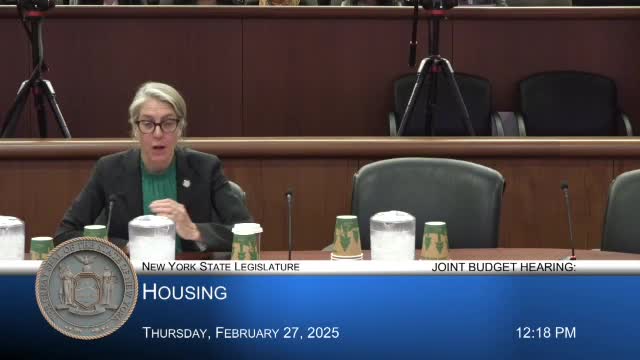
Ruth Ann Visnauskas, commissioner and chief executive of New York State Homes and Community Renewal (HCR), told the joint Assembly Ways and Means and Senate Finance committees that Governor Kathy Hochul’s executive budget proposal for fiscal 2026 focuses on expanding affordable housing production, preservation and homeowner assistance across the state.
Visnauskas outlined a package that includes a $1 billion state commitment to support New York City’s “City of YES” program; new financing tools for projects outside the city such as a proposed mixed‑income revolving loan fund to bridge construction gaps; expansion of the state low‑income housing tax credit; and $50 million to spur modular and starter homes. She also highlighted continuing programs from the state’s five‑year housing plan, noting that the plan has passed its halfway point and has created or preserved tens of thousands of homes.
On the City of YES fund, Visnauskas said state dollars would be used for new construction, homeownership, and preservation — including Mitchell‑Lama and public housing — and would be administered through HCR’s existing program channels. Regarding the revolving loan fund, she described it as a second‑mortgage construction loan intended to help mixed‑income projects “pencil out” in high‑cost and high‑interest environments; HCR expects a multi‑month startup and roughly a two‑year construction‑to‑repayment cycle for revolving funds to return to the pool.
Visnauskas also mentioned policy proposals contained in the executive budget: limits on institutional investor purchases of single‑ and two‑family homes (a 75‑day wait period before some institutional offers can be made), new tax incentives and down‑payment assistance to promote homeownership, extensions to security deposit protections, and proposed legislation to ban rent‑fixing collusion. She described additional targeted dollars for resiliency retrofit programs, $40 million for a vacant rental improvement program, and expanded funding to certified pro‑housing communities.
Lawmakers pressed Visnauskas for detail during questions. Members sought specifics about allocation rules for the City of YES money, the revolving loan fund’s timeline and scale, implementation details for the modular housing pilot, and whether the state would attach affordability or long‑term regulatory requirements to projects funded through the $1 billion allocation. Visnauskas said the state would apply HCR’s existing term sheets and regulatory frameworks to ensure long‑term affordability and would work closely with New York City officials to set spending priorities.
Several committee members also raised oversight and operational issues: how HCR will deploy funds for Mitchell‑Lama rehab and preservation; whether HCR could expand technical assistance for localities seeking pro‑housing certification; how HCR will track and support projects funded through the revolving loan fund; and how HCR will coordinate with federal programs that underwrite supportive housing.
Visnauskas acknowledged insurer market pressures and recommended exploration of captive insurance models — noting a newly formed captive in New York City and asking for further study and possible limited state seed support — while stressing HCR aims to keep operations and program delivery stable under any federal funding changes.
Visnauskas’ full remarks stressed balance: “We are primed for growth and prepared to battle headwinds,” she said, adding that the administration would coordinate closely with local officials, developers and advocates to move funds into production.
Why it matters: The package mixes targeted state investments to catalyze production (the revolving loan fund and modular housing pilot) with a large, flexible commitment for New York City. If passed, the City of YES funding would represent a major dedicated state allocation for urban affordable housing while the revolving fund and tax incentives are aimed at unlocking stalled projects outside the city. Lawmakers’ follow‑up questions signaled appetite for more detail, particularly about allocation rules, timelines and measurable outcomes.
What’s next: The proposed measures are part of the governor’s executive budget and will be negotiated during the budget process. Committee members signaled they would seek additional specificity and possible expansions or clarifications as budget negotiations proceed.