Get Full Government Meeting Transcripts, Videos, & Alerts Forever!
Get email alerts on the Tax Policy Budget 2025 topic
No spam. Unsubscribe anytime.
Hochul budget proposes $3 billion sales-tax rebate, middle‑class rate cuts and larger child credit
Summary
In a Joint Fiscal Committee hearing, the state tax commissioner described Governor Hochul's executive budget tax package: a $3 billion one‑time sales‑tax rebate, phased-in cuts to lower‑ and middle‑income personal income tax rates and a substantial expansion and decoupling of the Empire State Child Credit.
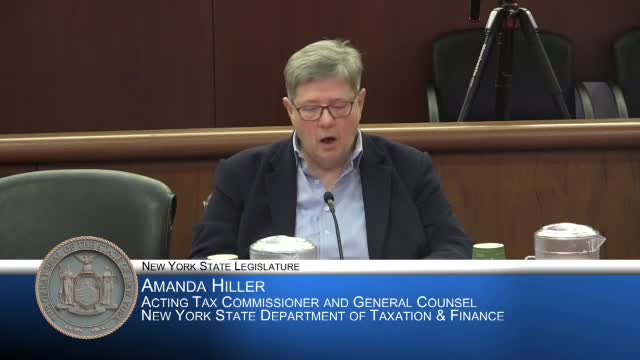
Acting Commissioner Ball, Acting Commissioner, New York State Department of Taxation and Finance, told the Legislature the governor's tax package would return $3,000,000,000 to New Yorkers as a one‑time sales tax rebate and provide recurring rate reductions for low‑ and middle‑income taxpayers.
"Under this proposal, the tax department would deliver rebate payments to 8,600,000 households this year," Acting Commissioner Ball said during testimony about the executive budget. She described the proposal as part of a three‑pronged affordability agenda that also cuts lower rate brackets and expands the state child tax credit.
The executive budget would phase in reductions that the department estimates will produce about $1,000,000,000 in recurring tax relief for roughly 8,300,000 taxpayers when fully implemented. At the same time, the proposal keeps the state's top three income tax brackets in place for an additional five years to preserve stability for higher earners, the commissioner said.
On the child tax credit, Acting Commissioner Ball said the plan would "decouple the state credit from the federal child credit" and raise maximums to $500 for children ages 4 to 16 and $1,000 for children under 4. The proposal would also eliminate the state's minimum earned income requirement and change phase‑out rules at higher incomes to reach more families.
Ball said the administration expects to send rebate checks later this year and described the child tax credit changes as aligning with recommendations from the Child Poverty Reduction Advisory Council. She added that the state is working to make refundable credits easier to claim through technology and outreach.
Legislators pressed the commissioner on the fiscal risks of the proposals and on the underlying revenue assumptions. Several members cited uncertainties at the federal level and asked how long the proposed rate changes would last and how the rebate timing would interact with other credit mailings. Ball said the rebate would be timed to fit around STAR mailings and other statutory timing obligations.
The hearing included queries about distributional impacts: lawmakers asked who would be excluded from the cuts, how checks would be delivered, and what recourse taxpayers would have if they did not receive a payment. Ball responded that the rebate is structured as an income tax credit and that taxpayers would have the usual administrative remedies for personal income tax issues.
The committee also heard advocacy testimony urging a larger child tax credit that would further reduce child poverty; advocates pointed to prior federal expansions that sharply reduced child poverty when paid monthly.
The tax package remains a subject for budget negotiations; the administration described its elements as one part of a broader affordability and modernization agenda that includes investment in tax filing technology and other programs.