Get Full Government Meeting Transcripts, Videos, & Alerts Forever!
Get email alerts on the Commerce Decade Act topic
No spam. Unsubscribe anytime.
Commerce secretary pitches DECADE Act, targets ‘lighthouse’ industries and regional investment
Summary
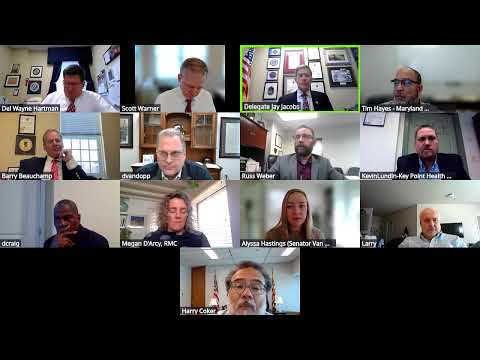
Maryland Department of Commerce Secretary Harry Coker Jr. described the DECADE Act’s priorities for targeted industry investment, proposed program reorganization and specific funding amounts for workforce, small business and tourism programs to the Eastern Shore delegation.
Maryland Department of Commerce Secretary Harry Coker Jr. told Eastern Shore legislators that the administration’s DECADE Act and budget proposals emphasize targeted investments in technology, manufacturing and regional infrastructure to spur long-term growth.
“My question at every meeting is: how can the Department of Commerce become a better partner?” Secretary Coker said, adding that the administration wants to leverage state assets — from military installations to universities — to grow “lighthouse sectors” such as advanced air mobility and quantum computing.
Coker outlined specific spending proposals in the governor’s plan, including $6,000,000 for the Maryland Manufacturing 4.0 program, $10,000,000 for the Build Our Future grants (for innovation infrastructure such as wet labs and prototype centers), $11,000,000 for the Maryland Small Business Development Financing Authority, an estimated $20,000,000 for small minority- and women-owned business accounts, $22,500,000 for tourism development, and $31,300,000 for the Maryland State Arts Council.
Coker said the DECADE Act also proposes structural changes, including moving some infrastructure-focused programs (for example Build Our Future and the RISE zones program) from the Department of Commerce to “Medco” (the state’s economic development corporation), and strengthening Advantage Maryland incentives by increasing the cap from $5 million to $7.5 million and removing the local 10% match requirement.
“We want to ensure our resources and tools are aligned with our long-term economic development goals,” Coker said. He described the administration’s approach as focusing investment on activities that offer measurable returns in jobs retained or created, businesses retained and startups launched.
Delegate Wayne Hartman and others asked about competitiveness with neighboring states on corporate tax rates and tourism funding. Coker said Commerce will conduct a comparative analysis of peer-state incentives and tax regimes and will make recommendations based on that review. On proposed tourism budget reductions recommended by the Department of Legislative Services, Coker said Commerce disagrees with those cuts and will continue to push back in hearings.
Carl Anderson, director of rural economic strategy at Commerce, told the delegation he is traveling across the Shore to coordinate spaceport, manufacturing and workforce efforts and encouraged local officials to contact Commerce about agency delays or barriers to projects.
Ending: Coker asked for ongoing, year-round dialogue with county and municipal partners and said Commerce would provide analyses and follow-up on comparative tax competitiveness and proposed program changes to assist local officials.