Get Full Government Meeting Transcripts, Videos, & Alerts Forever!
Get email alerts on the Annexation topic
No spam. Unsubscribe anytime.
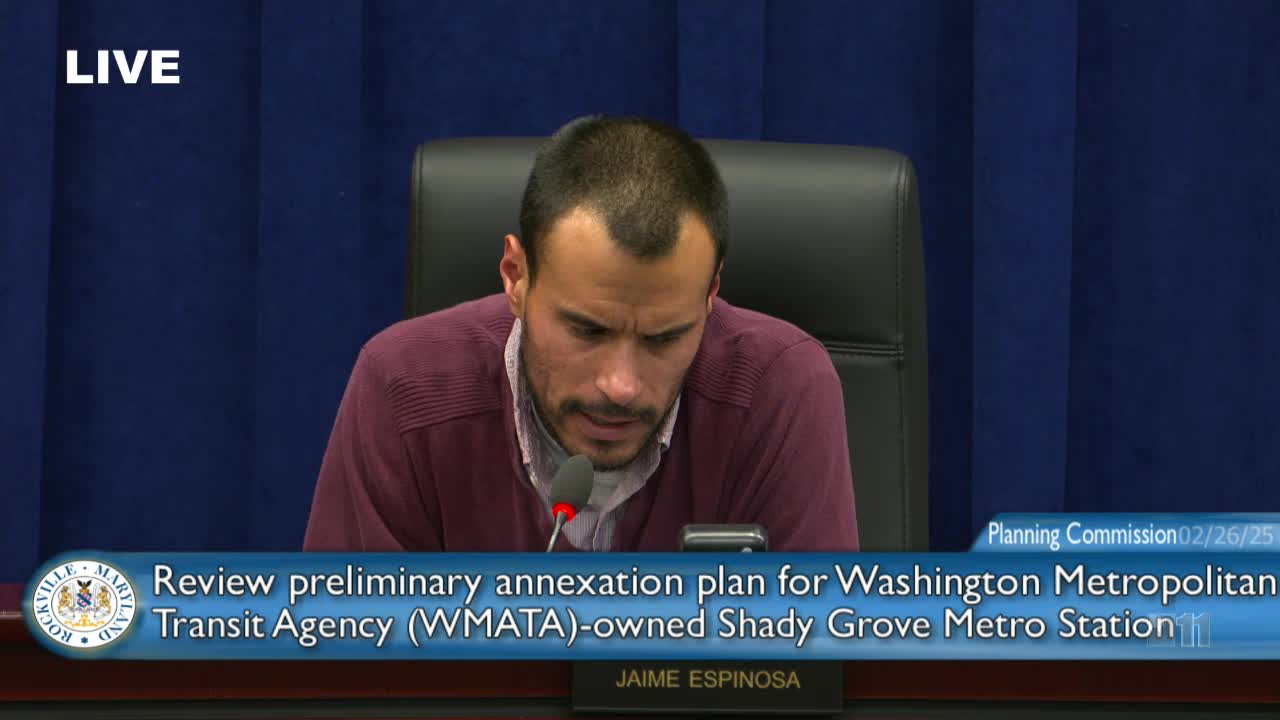
Planning Commission approves preliminary annexation plan for WMATA Shady Grove property, schedules March 26 public hearing
Summary
The Rockville Planning Commission approved a preliminary annexation plan for approximately 109 acres of WMATA Shady Grove Metro property and an adjacent CSX right‑of‑way and set a public hearing for March 26, 2025.
The Rockville Planning Commission on Feb. 26 approved a preliminary annexation plan to bring approximately 109 acres of WMATA‑owned Shady Grove Metro properties and an adjacent CSX right‑of‑way into the city’s corporate limits, and set a planning commission public hearing for March 26, 2025.
Manisha Tewari, planning and research manager and author of the annexation plan, told commissioners the annexation follows the municipal growth element of Rockville’s 2021 comprehensive plan and that the mayor and council previously directed staff to initiate annexation for the Shady Grove properties. Tewari said the City included the CSX right‑of‑way in the surveyed area and obtained CSX’s written consent; WMATA is a tax‑exempt owner and, under Maryland law and court precedent, a municipality may initiate annexation of tax‑exempt land without the usual consent thresholds.
The draft annexation plan recommends MXTD (Mixed Use Transit District) zoning for the properties. Tewari said the county’s Shady Grove master plan had already identified the metro properties for the highest densities and that the county had rezoned the parcels under county CR zoning with development rights. The city plan's recommendation seeks to align future development with Rockville’s vision for transit‑adjacent, mixed‑use development and identifies roughly 40 acres of land that could be developed as mixed‑use in the future.
Staff noted potential service impacts and next steps: the city would evaluate public‑safety needs (police), and other infrastructure impacts would be assessed when development proposals are submitted. Jim Lapping, engineering supervisor in Public Works, told the commission that water and sewer upgrades required by future development would normally be the developer’s responsibility, including hydraulic planning analysis and any necessary upgrades through WSSC review.
The annexation plan lists pros (consistency with the city comprehensive plan; potential tax revenue and development opportunities; branding and transit access) and a principal con (added city service costs if development does not occur promptly). Tewari said the mayor and council have requested a fiscal impact analysis that will be reviewed by the council when they consider adoption.
Commissioners discussed the long‑term strategy and risk: annexing an adjacent, tax‑exempt metro property presents a strategic opportunity to control future development and secure potential tax base, but the timeline for WMATA or other parties to pursue development is uncertain. Some commissioners observed that development buildout in the area has occurred in phases and could take decades.
After discussion, the commission voted unanimously to approve the preliminary annexation plan and set March 26 as the public hearing date. The plan and hearing notice will be transmitted to state, county and regional agencies as required; the mayor and council will receive the planning commission’s recommendation and hold their own hearings before deciding whether to adopt an annexation resolution.