Get Full Government Meeting Transcripts, Videos, & Alerts Forever!
City departments present $175 million Geo‑Bond program; council defers final action to March 6
Summary
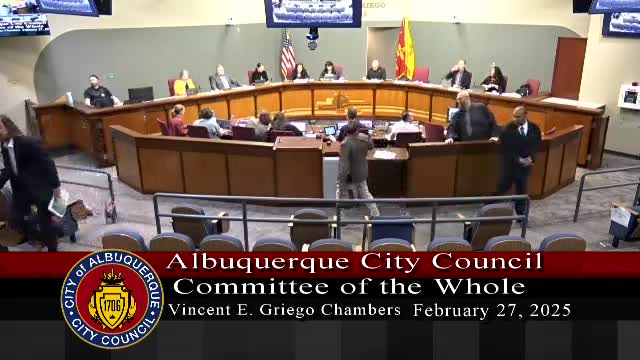
City staff and department directors presented Mayor Keller’s proposed 2025 General Obligation Bond Program and decade capital plan to a Committee of the Whole; municipal advisors estimated bonding capacity of roughly $175 million, and after long departmental presentations the committee voted to defer final action on the ordinance to March 6.
The Albuquerque City Council’s Committee of the Whole heard department-by-department presentations on Mayor Keller’s proposed 2025 General Obligation Bond Program and decade capital plan on Feb. 24, with staff saying the city’s municipal advisors estimate bonding capacity of roughly $175,000,000 for this cycle.
The meeting focused on broad program priorities — preserving, rehabilitating and correcting deficiencies in existing city assets — and on the specific capital requests departments brought forward. After several hours of presentations and public comment, the committee voted to defer formal action on R‑117, the ordinance that would program the bond funds, to a continuation meeting on March 6. The chair moved the deferral; the motion passed by voice/hand vote (tally not recorded in the transcript).
Why it matters
City staff framed the 2025 Geo program as a limited pool of money that must stretch across many departments while construction costs and supply‑chain pressures remain high. RBC Capital Markets, the city’s municipal advisor, told the committee the recommended authorization is roughly $175 million and warned of potential future downside to the tax base from recently passed state constitutional changes increasing certain veteran property tax exemptions.
What staff and departments told the committee
- Bond capacity and program structure: Eric Harrigan of RBC Capital Markets said the program’s estimated size was increased to $175 million because of growth in the tax base but noted two New Mexico constitutional amendments passed in November could reduce taxable value in future years.
- Program breakdown: CIP staff said the proposed program groups allocate roughly 58% to “basic services” (about $101 million), 26.8% to community facilities (about $47 million), and 15.2% to mandated programs (about $26.6 million). Staff also noted city mandates set public art to 1.5% and open‑space acquisition to 3% under recent ordinance changes. A separate 5% mandated set‑aside for trails and bikeways within the streets category was highlighted.
- Department asks and key details: - Department of Municipal Development (DMD): DMD officials presented the largest single chunk of line‑item detail, including a $12,000,000 request for storm‑drainage (NPDES/MS4 compliance), $9,500,000 for hydrology/flood mitigation, and a multi‑line streets package. Street‑program requests included $2,500,000 for mandatory traffic sign replacement and pavement markings, $3,000,000 for roadway…
Already have an account? Log in
Subscribe to keep reading
Unlock the rest of this article — and every article on Citizen Portal.
- Unlimited articles
- AI-powered breakdowns of topics, speakers, decisions, and budgets
- Instant alerts when your location has a new meeting
- Follow topics and more locations
- 1,000 AI Insights / month, plus AI Chat