Get Full Government Meeting Transcripts, Videos, & Alerts Forever!
Get email alerts on the 2025 General Obligation Bond Program topic
No spam. Unsubscribe anytime.
City departments present $175 million Geo‑Bond program; council defers final action to March 6
Summary
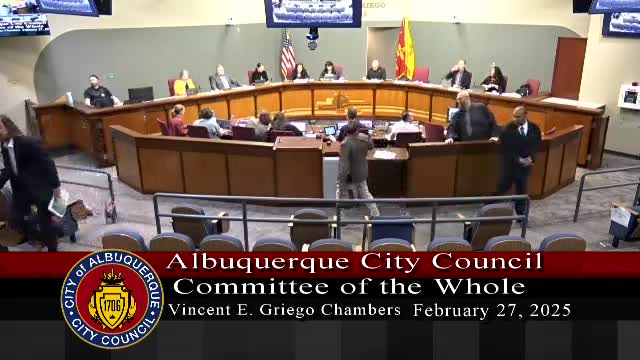
City staff and department directors presented Mayor Keller’s proposed 2025 General Obligation Bond Program and decade capital plan to a Committee of the Whole; municipal advisors estimated bonding capacity of roughly $175 million, and after long departmental presentations the committee voted to defer final action on the ordinance to March 6.
The Albuquerque City Council’s Committee of the Whole heard department-by-department presentations on Mayor Keller’s proposed 2025 General Obligation Bond Program and decade capital plan on Feb. 24, with staff saying the city’s municipal advisors estimate bonding capacity of roughly $175,000,000 for this cycle.
The meeting focused on broad program priorities — preserving, rehabilitating and correcting deficiencies in existing city assets — and on the specific capital requests departments brought forward. After several hours of presentations and public comment, the committee voted to defer formal action on R‑117, the ordinance that would program the bond funds, to a continuation meeting on March 6. The chair moved the deferral; the motion passed by voice/hand vote (tally not recorded in the transcript).
Why it matters
City staff framed the 2025 Geo program as a limited pool of money that must stretch across many departments while construction costs and supply‑chain pressures remain high. RBC Capital Markets, the city’s municipal advisor, told the committee the recommended authorization is roughly $175 million and warned of potential future downside to the tax base from recently passed state constitutional changes increasing certain veteran property tax exemptions.
What staff and departments told the committee
- Bond capacity and program structure: Eric Harrigan of RBC Capital Markets said the program’s estimated size was increased to $175 million because of growth in the tax base but noted two New Mexico constitutional amendments passed in November could reduce taxable value in future years.
- Program breakdown: CIP staff said the proposed program groups allocate roughly 58% to “basic services” (about $101 million), 26.8% to community facilities (about $47 million), and 15.2% to mandated programs (about $26.6 million). Staff also noted city mandates set public art to 1.5% and open‑space acquisition to 3% under recent ordinance changes. A separate 5% mandated set‑aside for trails and bikeways within the streets category was highlighted.
- Department asks and key details: - Department of Municipal Development (DMD): DMD officials presented the largest single chunk of line‑item detail, including a $12,000,000 request for storm‑drainage (NPDES/MS4 compliance), $9,500,000 for hydrology/flood mitigation, and a multi‑line streets package. Street‑program requests included $2,500,000 for mandatory traffic sign replacement and pavement markings, $3,000,000 for roadway widening (Paseo cited as an example), $4,325,000 for intersection improvements, $8,556,000 for street rehab/reconstruction, $5,100,000 for street facilities planning and maintenance, $4,300,000 for sidewalks and medians, $6,000,000 for street lighting, $2,150,000 for essential street maintenance equipment, and the mandatory $1,925,000 set‑aside for trails and bikeways. Director Jennifer Turner said the department is shifting toward broader category funding rather than dozens of small line items because of construction cost escalation and unpredictability in bids. - Parks & Recreation: Director David Simon described a parks program that combines rehabilitation, open‑space acquisition and water‑conservation projects. He said the department spends Geo bond proceeds to leverage grants and operates many aging facilities; he cited priorities such as irrigation and water conservation to reduce operating costs. (No single, firm dollar total for parks was presented in committee slides during the session.) - Albuquerque Community Safety (ACS): Director Jody Esquivel described ACS’s operational growth and its request for facility renovations to house specialty teams (the TRC, a trauma‑informed center at 5006 Gibson) and for additional response vehicles. Esquivel said ACS has expanded to respond to roughly 3,000 calls per month and is at a vacancy rate lower than earlier in the program’s life; the TRC request was described as for modest renovations to occupy the building for outreach, training and specialty teams. - Transit (ABQ RIDE): Transit requested $1,750,000 in Geo funds as a local match to federal grants — roughly $875,000 for vehicles, $750,000 for facility rehab (Ken Sanchez facility HVAC/roof), and about $124,250 for technology improvements. Transit staff told the committee that diminished local bond match in recent cycles forced the department to use general fund dollars to protect federal formula funding and that the department faces an estimated multiyear local‑match shortfall of several million dollars if the city is to draw down all available federal formula and discretionary grants. - Fire (AFR): AFR requested funds for apparatus replacement and for station rehab and maintenance. Chief staff described apparatus costs that have risen sharply in recent cycles (examples cited: engines increasing from about $750,000 in 2023 to over $1.1 million now; ladder trucks approaching $1.9 million). AFR’s geobond ask included roughly $2,000,000 for apparatus replacement and $2,500,000 for facility rehab/renovations of aging stations. - APD: APD leaders summarized facility and fleet needs and reiterated a prior department request that was larger than the mayor’s proposed allocation. APD directors said they requested a larger amount earlier in the planning process (~$8,000,000) but was recommended for $5,000,000 in the mayor’s proposed program. Committee members pressed the administration on how those decisions were made. - Health, Housing and Homelessness (HHH): HHH officials described a two‑part request. By ordinance the Workforce Housing Trust Fund is capped at $10,000,000 per GEO cycle; HHH requested the $10 million allotment to leverage affordable housing developments and told the committee that each dollar from the city can bring roughly 4 dollars of outside financing to projects. HHH also described capital maintenance needs across the Gateway campus and its tenant facilities and provided an estimate of roughly $3.4 million in identified repairs at its four neighborhood health and social service centers. HHH told the committee that an additional rough shortfall of about $12 million exists for some major Gateway campus upgrades identified in staff materials. - Metropolitan Redevelopment Agency (MRA) and planning: MRA asked for $5,000,000 in flexible funds to support public improvements, land acquisition and plan/design work in the city’s 22 redevelopment areas. Planning requested modest technology and equipment funds (about $934,000) to support the department and implementation of ABQ Plan. - Senior Affairs: The department said it requested about $5,500,000 overall (roughly $4.5 million for center facilities and $1.0 million for wellness/fitness spaces and equipment) and emphasized repair needs for older senior centers and growing demand for programs and home‑delivered meals.
Public comment and committee concerns
Public commenters and councilors praised some line items (library materials and affordable housing) and raised concerns over perceived underfunding of certain departments (Albuquerque Community Safety, the aquatic program, and affordable‑housing production). Several councilors repeatedly pressed the administration and department staff for project‑level specificity rather than broad budget categories; several said voters deserve to know the projects linked to bond funds rather than a “blank check.” Council members also pressed staff on how the Social Vulnerability Index and the council’s capital criteria were used when selecting priorities; DMD and other departments said they prioritize by technical need (end‑of‑life systems, safety, condition scores) and by “forward‑facing” service obligations, and that some program categories are intentionally citywide because needs exist across all districts.
Construction market context and labor issues
CIP staff and DMD directors described construction‑cost escalation (materials up substantially and installation labor also increased), long lead times for signal cabinets and electrical equipment, and workforce shortages. DMD staff said the department is bidding large projects (Paseo widening was the cited example) and noted a debate over project labor agreements (PLAs): Councilor Lewis pressed that PLAs had delayed bids on a major Paseo widening package in a prior cycle, and DMD staff said they had reissued bids after receiving requests for more time and hoped to start construction this summer if bids are responsive.
Formal action
At the end of the session the committee considered R‑117 (the ordinance programming the 2025 Geo bond funds and the decade plan). Committee leadership moved to defer R‑117 to the second Committee of the Whole on March 6, at which time the council will consider amendments and committee substitutes; the motion passed on a voice/hand vote and R‑117 will be considered again March 6. The March 6 meeting will accept written public comment only; public comment on the bond adoption will be taken at the full council meeting scheduled for March 17.
What the committee will see next
Staff told the committee they will return March 6 with departmental follow‑ups (examples identified during Q&A included detailed lists of projects tied to each department’s citywide asks and a breakdown of DMD’s work with neighborhood partners). Staff also noted that some funding choices were designed to act as local match for federal discretionary grants that will be submitted in the coming months, and that some departments are dependent on state capital outlay or other grants to complete projects proposed in the decade plan.
Ending
Committee members warned staff and the administration that the council expects more geographically and programmatically specific information before final adoption — and that any council vote will reflect that expectation. The March 6 meeting is set to consider committee substitutes and amendments; any amended capital plan would then be transmitted to the full council for adoption on March 17.