Get Full Government Meeting Transcripts, Videos, & Alerts Forever!
Get email alerts on the Emergency Powers topic
No spam. Unsubscribe anytime.
Minnesota House adopts amendments to limit governor emergency powers, then tables House File 21
Summary
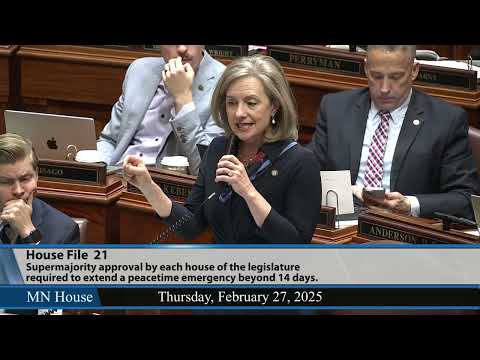
The Minnesota House debated House File 21, which would require a three-fifths vote of both chambers to extend a governor's peacetime emergency beyond 14 days. Several floor amendments were adopted, but the bill failed a final tally after a member changed a vote; the House later voted to reconsider and then laid the bill on the table.
The Minnesota House debated House File 21 on the floor, a Republican-sponsored measure that would automatically end a governor’s peacetime emergency after 14 days unless extended by a three-fifths vote of both the House and Senate. Lawmakers adopted multiple amendments on the floor but, after a final roll call and a subsequent change in a member’s vote that left the tally against the bill, the House ultimately laid the bill on the table.
House File 21 was introduced by Representative Kris Robbins, who said the bill “would fundamentally change the orientation of the governor's emergency powers.” Robbins told the chamber the proposal preserves the governor’s authority to declare an emergency but would require bipartisan supermajorities to keep an emergency in effect beyond two weeks.
Supporters said the bill is needed to prevent what they described as long-running, unilateral emergency declarations. Representative Nadine Altendorf, sponsor of a floor amendment (A6), invoked the pandemic experience and urged colleagues to back language that would add enumerated protections and shorten the initial automatic expiration to 10 days in one version of the amendment, saying, “Never again, folks. Never again.” Majority Leader [Representative] Niska argued the underlying bill restores legislative balance, saying it “makes sure that emergency powers expire after 14 days unless there is buy in from a super majority of the people's elected representatives.”
Opponents warned that the measure would hamstring the state’s ability to respond rapidly to large-scale threats. Representative Tufton Liebling said the bill “takes a chainsaw to the governor's ability to keep Minnesotans safe in an emergency,” and Representative Freiberg cited COVID-19 mortality figures and other emergency responses to argue that an elected executive must retain tools to coordinate rapid action.
Cybersecurity concerns surfaced repeatedly during debate. Representative Bonner emphasized the scale and speed of cyberattacks and warned that some incidents “are an emergency” whose effects can persist well beyond two weeks, urging members to oppose a restrictive automatic expiration.
Floor action and votes: the House adopted a series of amendments and then proceeded to third reading. The clerk recorded the following floor actions and outcomes during the session:
- Amendment A1 (Robbins): Adopted. Roll-call announced as 67 ayes, 66 nays and the amendment was adopted.
- Amendment A6 (Altendorf), divided by the sponsor for separate votes: the first portion (lines 1.02–1.16) was adopted (reported as 127 ayes, 6 nays). The second portion (lines 1.17–1.20) was adopted (reported as 67 ayes, 66 nays).
- Amendment DE1 (Long), which would have substituted a different, broader text (House File 26) on the floor, prompted a point-of-order on germaneness. The speaker’s ruling on the point of order was appealed; the House voted to uphold the speaker’s ruling by roll call (announced as 67 ayes, 66 nays), allowing further floor action to proceed.
On third reading, a roll call initially produced what was announced as a favorable tally, but the clerk then reported that Representative Niska (listed in the clerk’s announcement as Nyska) changed his vote from ‘aye’ to ‘nay.’ After that change the clerk announced the bill did not pass because the final tally became 67 nays to 66 ayes. Representative Niska then moved to reconsider; the House recorded a roll-call result of 67 ayes and 66 nays on the motion to reconsider, which prevailed. Following that, Representative Niska moved to lay House File 21 on the table; the motion (a nondebatable voice motion) prevailed and the clerk announced the motion to table occurred and the bill was laid on the table.
Discussion on the floor ranged from accounts of personal hardship during the COVID-19 emergency to hypothetical future threats (including cyberattacks and infectious disease outbreaks). Supporters framed the proposal as restoring the legislature’s role and preventing unilateral, long-term emergency rule; opponents said the bill would create an impractically high threshold for extensions and could impede timely crisis response.
With the bill laid on the table, House File 21 is not advancing at this time. The record shows multiple adopted floor amendments but no enacted statute from this session on this measure; the decision to table leaves the matter without a final legislative disposition.