Get Full Government Meeting Transcripts, Videos, & Alerts Forever!
Get email alerts on the Campus Safety topic
No spam. Unsubscribe anytime.
University of Minnesota details $10 million safety investments, will extend Dinkytown patrol pilot
Summary
University of Minnesota police described upgrades funded with state appropriations — ongoing maintenance dollars and one-time projects — and said a Dinkytown off‑campus patrol pilot will continue for another year after reported drops in theft and auto theft in the patrol area.
The University of Minnesota told the House Higher Education Finance and Policy Committee that state appropriations have funded campus security upgrades and an off‑campus patrol pilot that the university will extend through March 2026.
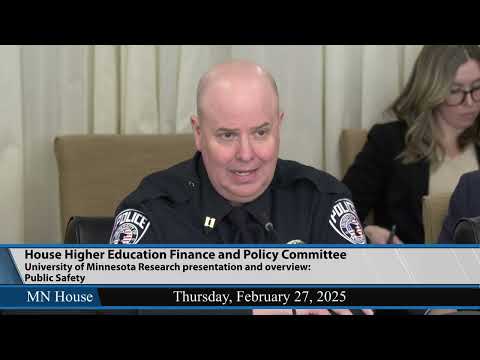
Interim Chief Eric Swanson of the University of Minnesota Police Department told the committee the university uses a $1,000,000 ongoing appropriation for systemwide staffing and to maintain security infrastructure, and used $4,000,000 in one‑time FY2024 and another $4,000,000 in FY2025 for urgent upgrades and projects. “Some of this is being kept as an end‑of‑life fund,” Swanson said of the ongoing appropriation, noting analog cameras were replaced with digital units that support analytics, and that the university hired a security infrastructure manager to track equipment lifecycles.
Swanson described one‑time purchases and projects funded by the nonrecurring appropriations: replacement of decades‑old card access systems on some campuses; installation of about 1,100 cameras systemwide (including replacement of approximately 700 analog cameras); installation of “Code Blue” emergency phones that also include cameras and lights; and creation of a strategic operations center on the Twin Cities campus that centralizes camera monitoring, card access control, and a 24‑hour dispatch center. The strategic operations center, Swanson said, allows remote locking and real‑time camera access across multiple campuses and some off‑campus university facilities.
Swanson also described an off‑campus pilot in Minneapolis in which university police agreed to patrol and investigate calls in a defined area to supplement Minneapolis Police Department resources. The pilot covers roughly I‑35W to Oak Street and University Avenue to 4th Street; Swanson said the university will continue the pilot for another year and reassess in March 2026 in consultation with the city. “We've seen decreases in crime in that area,” he said, citing a university crime analyst’s figures that thefts fell by about 41% and auto thefts by about 43% in the expansion zone since the pilot began.
Swanson described the university’s off‑campus safety center in Dinkytown as a staffed, card‑access space where students may study, attend self‑defense workshops and meet with security staff. He said the university now staffs uniformed security officers and offers regular patrols in Dinkytown. “We can remotely lock a facility … our dispatchers can go to those cameras. They can see what's going on real time,” Swanson said.
Committee members asked about making the pilot permanent, coordination with neighborhood groups, patrol coverage of the West Bank and Como neighborhoods, the university’s ability to remotely lock lecture halls, and recruitment and retention at the University of Minnesota Police Department. Swanson said the university plans to wait and review the pilot's results in March 2026; he said there is ongoing coordination with the Dinkytown District Group and community organizations such as Somali Youth Link, which the university has contracted to support outreach and safety work. On staffing, Swanson said recruitment and retention have been strong and that the university has used retention incentives.
The committee also took a procedural vote at the meeting’s start to approve minutes from Feb. 25; Representative Robbins moved approval and the committee approved the minutes by voice vote.
Why it matters: The appropriations discussed are intended to fund equipment replacement, staffing and new operational capacity that university officials say extend monitoring and response off campus as well as on. Committee members asked how the investments affect neighborhoods near campus and whether the pilot should be made permanent.