Get Full Government Meeting Transcripts, Videos, & Alerts Forever!
Get email alerts on the Urban Forest Plan topic
No spam. Unsubscribe anytime.
Providence presenters outline tree equity plan; committee asks for council endorsement
Summary
Presenters detailed the Providence tree plan, highlighting survey results that showed nearly universal public support for more trees, inequitable canopy distribution, and a goal to add roughly 30,000 trees over the next decade; the committee asked presenters to provide a draft resolution for council consideration.
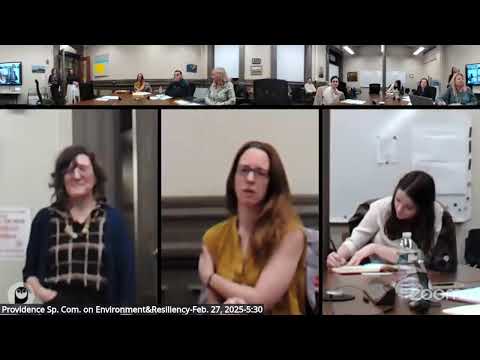
Presenters and community partners on Feb. 27 shared Providence's urban-forest plan with a city committee, outlining the plan's goals, community survey results and initial implementation steps.
The plan's proponents said the tree plan aims to correct historic inequities in tree canopy, support maintenance and workforce development, and prioritize plantings in "tree equity focus areas." Cassie Tharinger, introduced as executive director of the Providence neighborhood planting program (PNPP), and Toni Gudet Irvin, described as a Providence resident and professional arborist, joined other presenters to describe the plan and the partners involved.
Why it matters: Presenters said uneven tree distribution correlates with historic disinvestment and heat-vulnerability, and that expanding and caring for the urban forest delivers health, stormwater and cooling benefits. The group emphasized that planting alone is not sufficient: trees require ongoing maintenance and neighborhood support to deliver long-term benefits.
Key findings and targets cited by presenters included: 848 responses to a community survey, with 59% of respondents from high-priority (low-canopy, high-heat) neighborhoods and 20% of responses in Spanish; 1.5% of respondents said their neighborhoods had enough trees; more than 98% supported increased investment in Providence's trees. The presenters said the plan includes a citywide vision and a goal of planting roughly 30,000 additional trees over the next decade focused in equity areas while maintaining canopy in other parts of the city.
Current activity and capacity: Presenters said the city and PNPP partnership currently plants about 700 trees per year on average. The city's last comprehensive street-tree inventory (2017) listed about 27,000 street trees; presenters said the municipal tree population is a small portion of an estimated 400,000 total trees across the city. Presenters also described coordination with the mayor's office, the Department of Inspections and Standards (DIS), community organizations such as Groundwork, and the city forestry division.
Funding and pilots: Presenters said they recently secured a grant from the Department of Environmental Management described in the presentation as a "G equity grant" to support plantings on neighborhood sites and schools; details and formal grant name were not specified on the record. They described pilot efforts including sidewalk-tree conflict solutions, depaving opportunities, community orchards and a workforce model that trains residents to care for young trees and storm drains.
Public comment and concerns: Members of the public praised the plan and urged focused plantings in neighborhoods that lack shade. Some speakers raised questions about litter enforcement and whether waste-hauler contracts contribute to litter; others urged citywide leaf-collection and composting systems and asked about agroforestry and food-bearing tree projects. Greg Barrett said he supported the project but warned that raising fines for litter without robust enforcement could be inequitable; another commenter, Andrea, asked specifically whether the plan targets areas that have been stripped of trees.
Committee response and next steps: Committee members expressed support and asked presenters to draft a resolution or recommendation that the council could endorse. The presenters agreed to provide materials and the committee voted to accept the presentation and requested the draft resolution be sent to the full City Council for consideration.
Ending: Presenters urged a multi-year implementation approach that pairs planting with maintenance, community leadership, workforce development and coordinated city policy changes. Committee members said they would work with presenters on a recommended resolution and consider budget and ordinance changes in upcoming council business.