Get Full Government Meeting Transcripts, Videos, & Alerts Forever!
Get email alerts on the Land Use Business Regulation topic
No spam. Unsubscribe anytime.
Planning commission recommends new massage-establishment rules, adds adult-entertainment permitting changes
Summary
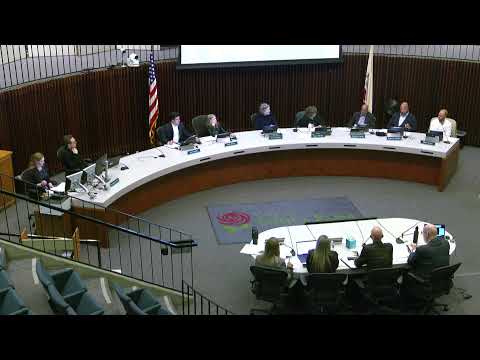
The Santa Rosa Planning Commission on Feb. 27 recommended a package of zoning and municipal code amendments that would create a city certification and permitting path for massage establishments and clarify permitting for adult-entertainment businesses; the commission approved two resolutions and forwarded the draft ordinance to the City Council.
The Santa Rosa Planning Commission on Feb. 27 voted unanimously to recommend that the City Council adopt a new municipal ordinance creating a city certification and registration process for massage establishments and to amend zoning permit requirements for adult-entertainment businesses.
Staff said the changes aim to reduce illicit massage activity while providing a path for legitimate massage businesses to register and comply. Gabe Osborne, director of planning and economic development, told the commission the proposed regulations “focus[] on the illicit nature that can occur in massage establishments” and are intended to give enforcement tools while allowing legitimate operators to comply and continue to operate.
The draft ordinance would move massage regulations from the current chapter in Title 6 into a new chapter (proposed Chapter 20-49) in the zoning code and land-use tables and would require establishment certification and CAMTC (California Massage Therapy Council) certification for therapists under current state law. Lou Kurt, assistant chief building official, described the proposal’s primary elements: state registration of therapists, a required city certification for establishments, operational standards and inspections, administrative adjustments at the director level, and a graduated enforcement structure ranging from warnings to certificate revocation.
Public commenters who identified themselves as local massage professionals and as neighbors of massage businesses supported action but urged staff and commissioners to tighten parts of the draft. Mike Cook, a local business owner and massage therapist, said enforcement and a permit path were appropriate and asked the commission to shorten allowable late hours, saying “10 p.m. is far too late to be open if you’re a legitimate massage business.” Curtis Bennett, who has led community advocacy on illicit massage businesses (IMBs), urged the commission not to vote on the draft without further consultation with the California Massage Therapy Council and to close perceived loopholes. Jessie Spearings, a certified massage therapist, urged stronger consequences for landlords who knowingly lease to illicit operations and asked for a clear reporting contact for suspected illicit activity.
Commissioner discussion focused on three main adjustments before forwarding the items: narrowing hours of operation, clarifying the CAMTC or state-designated equivalent language, and tightening enforcement thresholds. Commissioners agreed to change hours of operation from the draft’s 7 a.m.–10 p.m. to 7 a.m.–8 p.m., with patients required to vacate by 8:30 p.m. Staff explained the CAMTC reference is necessary under current California Business and Professions Code Section 4600 et seq., but recommended language that would allow the city to recognize a state-designated certifying body if state law changes. Staff also explained that the ordinance differentiates between “procedural” violations (administrative noncompliance) and “gross” violations (conduct linked to illicit activity), and that any single gross violation could trigger revocation while procedural violations are treated as escalating enforcement matters.
After deliberation the commission moved and approved: (1) a resolution recommending the proposed Title 6/Title 20 changes that create Chapter 20-49 (massage regulation and establishment registration) and related zoning amendments; and (2) a second resolution specifically amending permitting requirements for adult-entertainment businesses in the land-use tables. Both resolutions passed on recorded roll-call votes, 7–0. Commissioners also asked staff to forward the revised draft and the redline to the City Council; staff said the item is scheduled for City Council review on March 4 and a second reading on March 18, with a 30-day effective date after adoption and a 180-day compliance period for establishments to come into compliance.
The ordinance package includes definitions, operational requirements, limitations on neon signage, background checks for owners and therapists, and a director-level administrative-adjustment process to allow limited waivers for specific requirements. Staff estimated roughly 130 massage businesses operate within city limits and said the ordinance is intended to identify legitimate providers and to prevent conversion of space to illicit uses. Daniella Debaca, senior code enforcement officer, noted inspection and enforcement work had already identified multiple noncompliant sites.
Votes at a glance: - Motion: Recommend adoption of amendments creating Chapter 20-49 (massage regulation), repealing Chapter 6-32, and related zoning code edits; Moved: Vice Chair Duggan; Second: Commissioner Sisco; Vote: Carter—yes, Sisco—yes, Horton—yes, Pardoe—yes, Sanders—yes, Duggan—yes, Weeks (chair)—yes; Outcome: approved (7–0). - Motion: Recommend adoption of zoning permitting amendments for adult-entertainment businesses (amend sections 20-23.03 and 20-24.03); Moved: Commissioner Sanders; Second: Commissioner Carter; Vote: Carter—yes, Sisco—yes, Horton—yes, Pardoe—yes, Sanders—yes, Duggan—yes, Weeks—yes; Outcome: approved (7–0).
What happens next: Staff said the revised draft and errata will be posted and that the City Council will consider the ordinance package on March 4, with a second reading March 18. If adopted, massage establishments would have 180 days from the ordinance effective date to achieve compliance; staff also said the city will use an education-first approach during the compliance period and will conduct outreach and targeted inspections to identify noncompliant establishments.
Speakers quoted in this article are identified in the meeting record and in the speakers list below. This article includes the commission’s recorded votes and summarizes key clarifications raised during public comment and by staff.