Get Full Government Meeting Transcripts, Videos, & Alerts Forever!
Get email alerts on the Police Complaints Investigations topic
No spam. Unsubscribe anytime.
Police annual report: 16 complaints in 2024, three sustained and training hours increase
Summary
Santa Barbara Police Department commanders briefed the Fire and Police Commission on 2024 complaint and investigation data, reporting 16 total complaints (five unfounded, two not sustained, three sustained, six still open), 53,715 calls for service and increased training activity including more than 7,600 POST-credit training hours.
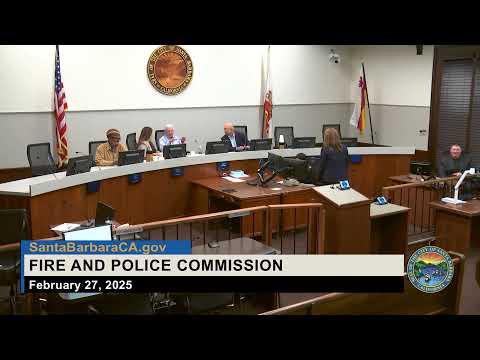
Chief Kelly and Commander Charlie Kasapis presented the Santa Barbara Police Department's annual report on complaints and investigations to the Fire and Police Commission on Feb. 27.
Kasapis described the department's complaint intake and investigative process and said the goal is to minimize barriers to reporting. He said the department handles two complaint types: administrative complaints generated internally and citizen complaints filed by members of the public. "An administrative complaint is a complaint or investigation that is internally generated," Kasapis explained.
For 2024, Kasapis said the department received 16 total complaints. He gave the disposition counts in the presentation: five unfounded, zero exonerated, two not sustained, three sustained, and six still open and active. Kasapis said that as cases remain active they are added to the open category and that internal rules allow one year to complete an investigation, with an internal goal of 90 days.
Kasapis reported operational contact volumes alongside complaints. He said officers handled 53,715 calls for service in 2024, made 4,050 arrests, initiated 4,634 traffic stops, and logged 4,068 self-initiated pedestrian contacts. He noted that the number of citizen complaints compared to total contacts is small: "In all those 53,715 calls for service, we received 8 citizen complaints," he said, adding the remainder of the complaint total include administrative investigations.
On dispositions and discipline Kasapis explained typical corrective outcomes and the department's progressive-discipline framework, which ranges from corrective counseling and written reprimands up to suspension, demotion or termination. Of the three sustained complaints in 2024, two resulted in corrective counseling and one resulted in termination, he said.
Kasapis reviewed policy areas investigated in 2024, noting allegations included prohibited discriminatory conduct, rude or discourteous treatment, failure to take action, use of force, search and seizure, firearms handling and other categories. He also summarized reporting obligations under state law (citing Senate Bill 2 and POST certification requirements): Kasapis said five of the 16 complaints were reported to POST under the SB2 categories and explained the department uploads case files and follows POST's review process.
Kasapis described training activity and organizational changes intended to align training with accountability work. He said training was moved under community accountability to better link complaint/use-of-force data with training priorities. He identified Jay Duffy as the department's new training officer and reported the agency recorded about 7,641 POST-credit training hours in 2024. Kasapis highlighted collateral specialized teams'the Crisis Negotiation/Response Team (CRT) and the SWAT team'that logged substantial additional training hours (CRT: 960 hours; SWAT: 3,240 hours) and described those teams as collateral assignments carried out in addition to officers' primary roles.
Kasapis and Chief Kelly answered commissioner questions about anonymous or whistleblower-style internal reporting (Kasapis said anonymous tips and reports are accepted and investigated when possible but that internal employee-on-employee administrative complaints are not investigated anonymously because the department must be able to identify parties to stop misconduct). Kasapis said the department will use outside investigators for some internal cases when warranted and coordinates with HR and legal staff.
The presentation was informational and required no motion by the commission.