Get Full Government Meeting Transcripts, Videos, & Alerts Forever!
Get email alerts on the Fire Department Annual Report topic
No spam. Unsubscribe anytime.
Santa Barbara Fire Department reports steady call growth, moves to new national records system
Summary
Fire Chief Chris Veil and Fire Marshal Ryan De Giulio presented the department's 2024 annual data, showing roughly 12,100 calls for service, rising response volumes, detailed response-time metrics, expanded training and community outreach, and plans to adopt a new national records system the chief described as "NARES/NHERES."
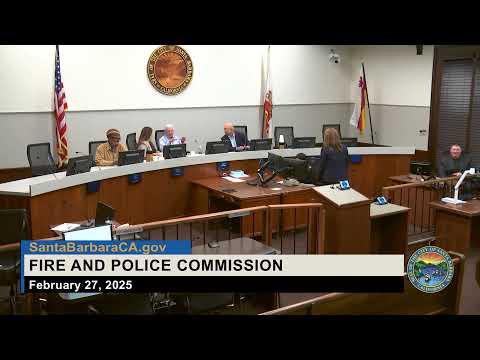
Santa Barbara Fire Chief Chris Veil presented the department's 2024 annual report to the Fire and Police Commission on Feb. 27, saying the department responded to roughly 12,100 calls for service in 2024, up from 11,560 in 2023.
Veil said fires accounted for 1.66% of calls while medical and rescue calls made up about 72% of the department's workload. "When our fire apparatus show up, they have a fire. They have to pull off a hose line or at minimum an extinguisher and extinguish a fire," Veil said, distinguishing working fires from minor smoke or nuisance calls.
The report emphasized response-time performance and how the department measures it. Veil described total response time as the interval from 911 call pickup to units on scene and gave the department's 2024 annual average total response time as 7 minutes and 2 seconds. He reported call-processing time across all incidents at 1 minute and 9 seconds, turnout time (time from lights on to wheels rolling) at roughly 8090 seconds, and travel time just under five minutes. Veil noted these are annual averages across all call types and that more serious calls are dispatched faster.
Veil told commissioners the department will transition from the National Fire Incident Reporting System (NFIRS) to a new national records platform he referred to as "NARES" or "NHERES," which he said stands for "National Emergency Reporting Information System." He said the platform is being rolled out nationally and will allow more granular, live data analysis, including by specific incident types such as lithium-ion battery fires.
The presentation also covered recurring operational topics. Veil reported 1,434 incidents in 2024 involving people experiencing homelessness (up slightly from 1,397 in 2023) and cautioned that that field is not always a mandatory, standard field in current reporting and therefore may be undercounted. He said naloxone (Narcan) was administered in 183 incidents in 2024 (the figure counts patients treated, not vials used).
Veil described training and mutual-aid activity: a seven-person academy contributed just under 3,000 hours of training; overall departmental training totaled about 17,000 hours across the organization, he said. He reported mutual-aid reimbursement for personnel and other costs topped $1.4 million for the year, and that mutual-aid billings for January and February of the current year had already approached $500,000, largely for incidents in the Los Angeles region.
Fire Marshal Ryan De Giulio reviewed the Fire Prevention Bureau's work, including inspections, fire investigations and vegetation management. De Giulio said his unit has four state-certified fire investigators; in 2024 the department completed 32 fire investigations and made two court appearances related to investigations. He said structure-fire dollar-loss estimates for 2024 totaled a little over $1 million and vehicle-fire losses a little over $500,000 using the department's formula and valuation references.
De Giulio described prevention and outreach programs: engine-company inspections aimed at visiting every business on a two-year cycle (about 3,000 inspections total), with roughly 1,400 completed so far; bilingual CERT programming and community outreach that reached about 2,000 people; and vegetation management and road-clearance work such as annual road clearance in The Riviera.
Veil and De Giulio answered commissioners' questions about whether investigators are armed (De Giulio said they are not and the department relies on police partners when needed), how business inspections are scheduled (some are mandated annually and scheduled, some are conducted without advance notice), and how hospital and licensed-care inspections fit into the broader licensing process.
The department concluded by telling commissioners the new records system should allow more precise, incident-level analytics when the city adopts the platform in the coming implementation window that Veil described.