Get email alerts on the Dfcs Corrective Action Plan topic
No spam. Unsubscribe anytime.
DFCS reports progress on corrective action plan: safety-plan audit tool, training dashboard and new CQI measures
Summary
Department of Family and Children Services told the committee it has developed a safety-plan audit tool, expanded training for staff and is building multiple CQI tools to track corrective action plan progress; the committee received the report and asked for a future CAN center briefing.
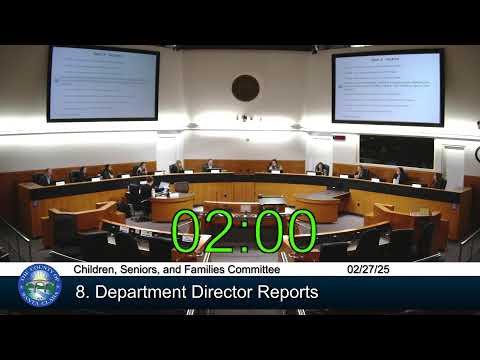
Department of Family and Children Services staff reported Feb. 27 that they have developed a safety-plan audit tool, expanded training for supervisors and managers, and are building multiple continuous quality-improvement (CQI) tools as part of the county's corrective action plan (CAP) with the California Department of Social Services (CDSS).
DFCS said the safety-plan audit tool is in final production and will be used to review whether safety plans identify protective adults, address safety threats and are appropriately signed and executed. The department said supervisors and managers will pull random cases monthly to review active safety plans and that technology is being developed to capture the data and display it in a dashboard for managers.
DFCS also reported it has delivered numerous trainings on safety planning and legal consultation and will incorporate the material into the agency's ongoing academy for new hires. Agency staff said roughly 17 trainings have been completed and that about 30 to 40 staff remain to be trained on safety planning; the department plans additional one-on-one and unit-level trainings in March.
The department listed additional CQI tools under development to measure practice in core mandated areas: a child-and-family teaming (CFT) tool to evaluate who participates in treatment-team meetings; a structured decision-making (SDM) safety-assessment review; an SDM risk-assessment review; and a visits CQI tool to evaluate in-person contacts. DFCS said it is developing those tools with its internal CQI team, UC Berkeley, the state CQI team and Evident Change, the vendor the state has approved to work with confidential child-welfare records.
DFCS staff and the CAPC president discussed a key trade-off: existing CAPC meetings are Brown Act-protected in-person membership meetings, which create legal and logistical constraints that could limit participation by people with lived experience. That concern helped shape the committee's direction to form a new administrative roundtable while continuing CAPC conversations.
Several public commenters urged more immediate action on individual cases and criticized DFCS leadership; county staff responded that California law restricts public discussion of details in active investigations and that CDSS requires cross-reporting to law enforcement and district attorneys when abuse is suspected.
Action: the committee voted to receive the DFCS corrective action report and instructed staff to return with follow-up materials. Vice Chairperson Young moved the action and Chairperson Arenas seconded. The committee also approved a request that the CAN (Child Abuse & Neglect) hotline/center be scheduled for a future committee briefing on operational issues such as call-routing, clerical screening versus social-worker callbacks, and callback timeliness.
DFCS said it will bring a training dashboard to the next update showing training completions by unit and remaining staff to be trained, and it will attach finalized CQI tools to future reports as they are completed.
AI generated
The text on this page is AI generated. Summaries, highlights, analysis, and video transcripts are all produced from the original source material.
AI can make mistakes, so if you spot one, and we will fix it for everyone.
Note: the source content is unaltered by us. Any content source we link to, be it a video, an audio recording, or a document, is presented exactly as its publisher released it. That publisher is usually a government body, sometimes an individual official or another organisation.