Get Full Government Meeting Transcripts, Videos, & Alerts Forever!
Get email alerts on the Child Welfare Roundtable topic
No spam. Unsubscribe anytime.
Committee directs county to form community roundtable to advise child-welfare reforms
Summary
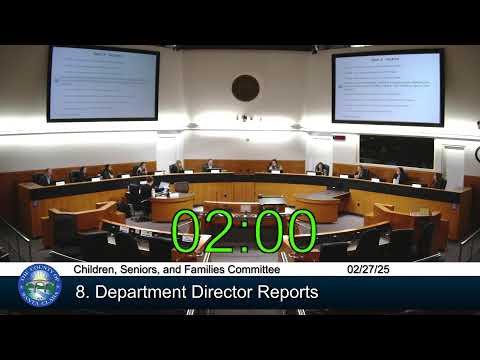
The Santa Clara County Children, Seniors and Families Committee voted Feb. 27 to pursue a community roundtable of stakeholders to advise child-welfare reform efforts, favoring a newly formed forum while continuing talks about folding the group into the existing Child Abuse Prevention Council.
On Feb. 27 the Santa Clara County Children, Seniors and Families Committee voted to receive a report from the Department of Family and Children Services and directed administration to pursue a community roundtable to consolidate stakeholder input on child-welfare reform, with a plan to return to the committee with refined recommendations.
Committee Chairperson Arenas and Vice Chairperson Young said the roundtable is intended to align separate, overlapping stakeholder efforts and to feed community feedback into the county's corrective action plan and strategic improvement plan. Chairperson Arenas said the primary deliverable she expects is "feedback coming in from those groups" to inform the county's reform tools.
DFCS presented three options for the roundtable: (1) designate the existing Child Abuse Prevention Council (CAPC) as the roundtable, which would leverage an established, Brown Act-protected body of 23 members but require bylaw changes and in-person participation; (2) create a new administrative forum of roughly 15 to 20 participants drawn from community-based organizations and DFCS affinity groups; or (3) repurpose DFCS's quarterly community forum, which currently reaches about 200 participants but is largely presentation-focused.
James Shapiro Givens, president of the Child Abuse Prevention Council, cautioned the committee that "the Child Abuse Prevention Council and its subcommittees are Brown Act bodies," noting that under county rules CAPC membership meetings must be held in person. He said that requirement can increase consistency but may limit participation by people with lived experience.
Supervisors and staff emphasized a hybrid approach: begin with Option 2 (a newly formed roundtable) to quickly gather and center voices the stakeholders have requested, while continuing discussions with CAPC about whether and how CAPC might incorporate or absorb the roundtable's work later. Committee members also asked DFCS to ensure the roundtable includes representatives selected through an equity lens, including BIPOC and transgender community members and organizations such as Project Phoenix and the Children of Color work group.
Public commenters criticized county child-welfare leadership and urged immediate changes. One resident called for removal of specific DFCS leaders and said the community and news outlets are "calling for the replacement of these people." DFCS and county staff reiterated that statutory limits restrict public discussion of active child-abuse investigations.
The motion the committee approved directs administration to pursue Option 2 (create a child-welfare community roundtable), informed by concurrent conversations with CAPC and other stakeholders, and to return to the committee with a refined recommendation. The motion was moved by Vice Chairperson Young, seconded by Chairperson Arenas, and carried on a recorded vote of 2-0.
Next steps: DFCS will reach out to the groups identified in the report, perform targeted outreach to stakeholders not yet represented (including Project Phoenix), and return to the Children, Seniors and Families Committee with a recommended structure, membership list and any necessary board actions.