Get Full Government Meeting Transcripts, Videos, & Alerts Forever!
Get email alerts on the Use Variance School topic
No spam. Unsubscribe anytime.
BZA grants appeal: Buckingham Browne & Nichols' 30 Jerry's Landing variance found not lapsed; case continued so ISD can process permits
Summary
The Cambridge Board of Zoning Appeals on Feb. 27 found that a 2020 use variance for Buckingham Browne & Nichols at 30 Jerry’s Landing was exercised within the one‑year lapse period and therefore remains valid, granting the petitioner’s appeal 4–1.
The Cambridge Board of Zoning Appeals on Feb. 27 granted an appeal by Buckingham Browne & Nichols (BBN), ruling that a use variance the board issued in 2020 for educational uses at 30 Jerry’s Landing did not lapse for nonuse and therefore remains valid.
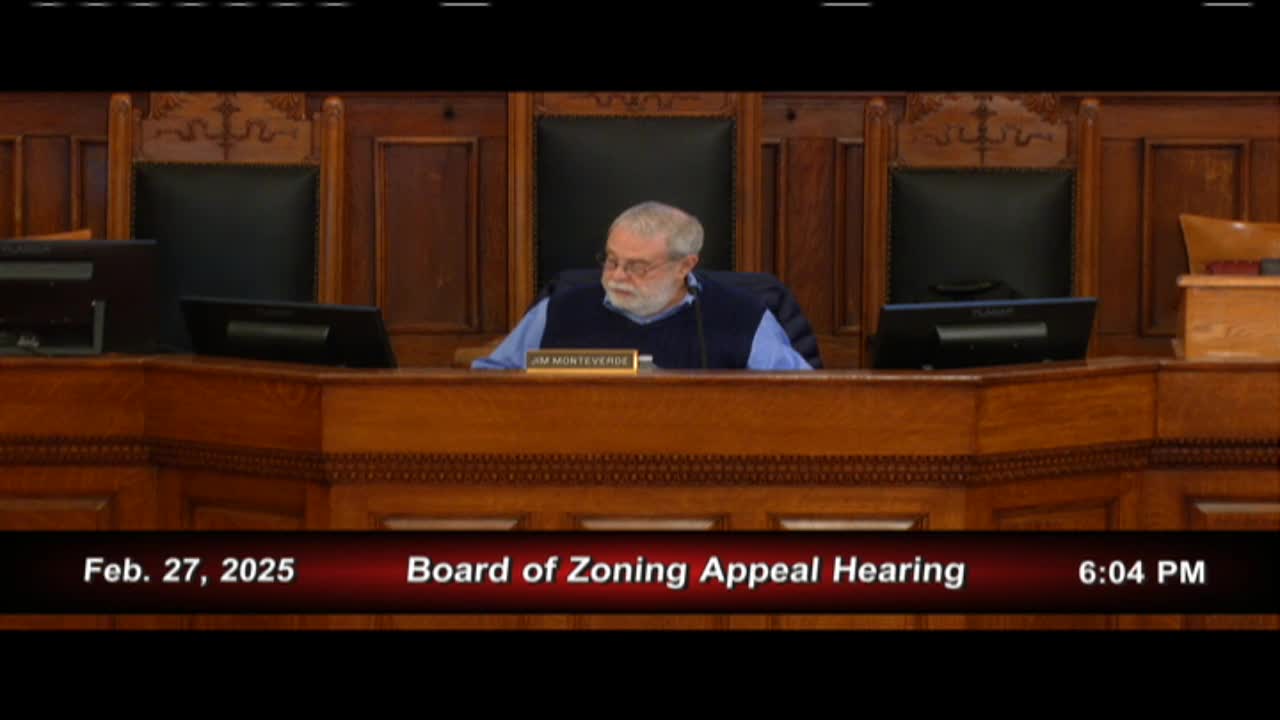
The board’s decision reverses a determination by the city’s Inspectional Services Department (ISD) that the variance had lapsed; the vote was 4 in favor, 1 opposed. Chair Jim Monteverde cast the lone opposing vote. The board also continued the related variance application to May 8, 2025, with conditions to allow ISD time to process any building-permit or certificate-of-occupancy filings if no appeal is filed.
BBN’s attorney, Tad Heuer of Foley Hoag, told the board the legal question hinges on Chapter 40A, Section 10 of the Massachusetts General Laws, which provides that rights granted by a variance lapse if not exercised within one year of the grant. Heuer said BBN recorded the variance on Aug. 25, 2020, and that activities within the subsequent year—Aug. 2020 to Aug. 2021—constituted exercise of the variance rights. Heuer summarized the record and affidavit submitted by BBN, saying the school used the property for storing classroom furniture, held outdoor English and photography classes, student theater rehearsals and productions, trustee meetings, team events and other educational activities during that period.
Heuer argued those steps—recording the variance and submitting a sworn affidavit documenting activities and reliance—match the Appeals Court’s guidance in Greene (cited to the board) that evidence of use within one year can be sufficient to avoid lapse for a use variance. Heuer said the activities were taken in direct reliance on the variance and consistent with its scope.
The building commissioner had informed BBN in a Nov. 18, 2024 letter that no certificate of occupancy had been applied for and that ISD considered the property ineligible for building permits until the rights under the prior BZA case were reestablished after notice and hearing under the Cambridge Zoning Ordinance section 10.3 and state law. Heuer told the board that municipal certificate-of-occupancy procedures are separate from the state lapse analysis under Chapter 40A; failure to secure a municipal certificate does not, he said, nullify exercise of the variance under Section 10.
Board members who spoke in favor—Daniel Hidalgo, Steven Ng, Zaria Miranda and Virginia Keesler—said the affidavit and submitted evidence were persuasive. Hidalgo said the combination of COVID-era operations and the documented outdoor educational uses “struck me as educational” and supportive of the appeal. Keesler noted the Greene case and the factual record’s consistency with that decision. Monteverde said he accepted the commissioner’s view and opposed the appeal.
The board recorded two formal actions: a motion to grant the appeal under the ordinance provisions cited by the chair (including institutional-use and appeal provisions) passed 4–1; and a motion to continue the related variance application to May 8, 2025, passed unanimously with conditions requiring updated public posting, a signed waiver of certain statutory timing requirements and timely submission of any new materials.
Neighbor Catherine Gardner spoke during public comment, noting that the property’s historical address uses “Jerry’s Landing” rather than “Jerry’s Landing Road” and that some map labels were inconsistent. Heather Hoffman questioned whether recent multi‑family zoning changes affected institutional-use regulations; staff and members said those questions involve separate legal and ordinance analysis.
If an appeal of the BZA decision is filed, state law provides the statutory appeal period; the board allowed the continuation date to accommodate the possible appeal and to permit ISD to process filings quickly if no appeal is taken.
Votes and next steps: the appeal was granted 4–1; the related variance hearing was continued to May 8, 2025. The board attached standard conditions for continuances and asked petitioners to coordinate promptly with ISD to obtain any building permits or certificates of occupancy.
The board’s order and the continuation conditions were entered on the record; ISD and the petitioner expect to take further administrative steps in the weeks after the meeting.