Get Full Government Meeting Transcripts, Videos, & Alerts Forever!
Get email alerts on the Municipal Budget topic
No spam. Unsubscribe anytime.
San Marcos council sets parameters for FY26 budget: tax-rate range, debt split and targeted reserves
Summary
San Marcos City Council provided staff with formal budget parameters for fiscal 2026 on Tuesday, directing staff to present tax-rate scenarios between the current rate and the voter-approval rate, to allow the debt component of the tax rate to rise to as much as 30% over time, and to pursue higher utility reserves and conservative rate modeling.
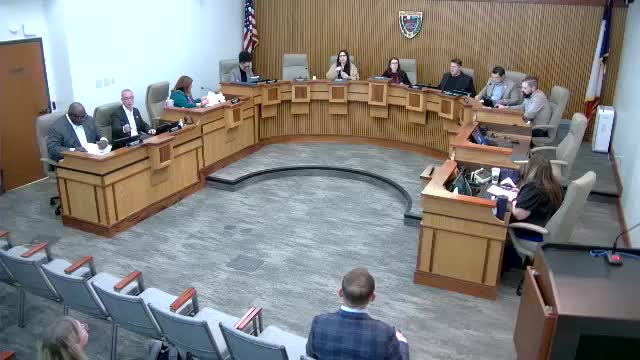
SAN MARCOS, Texas — The San Marcos City Council on Tuesday provided staff with budget-policy direction for fiscal 2026 that preserves a range for the property tax rate, widens the allowable share of the tax rate devoted to debt and sets reserve and funding priorities across city enterprise and special-revenue funds.
City finance staff briefed the council on assumptions behind the proposed FY26 budget and recommended guardrails for the city manager as staff prepares a proposed budget for August. Finance Director John Locke said the council’s guidance will be used to build scenarios for council consideration ahead of the formal budget adoption process.
Why it matters: Council’s choices now will determine whether the city increases operating or capital investments, and how much pressure is placed on ratepayers. The city faces an estimated FY26 shortfall under one forecast that staff said declined from roughly $5 million at visioning to about $2.5 million after updated revenue estimates and changes to assumptions.
What the council decided
- Tax-rate range: Council agreed to give staff direction to present budgets assuming a tax rate between the current rate (60.3 cents per $100 valuation) and the voter-approval (bond) rate (about 61.54 cents). Councilmembers expressed varying preferences within that range; several members said they wanted scenarios showing outcomes at intermediate rates.
- Debt-component cap: Council authorized staff to plan with the debt component of the tax rate allowed to increase to up to 30 percent of the total rate over a multiyear period (from an estimated roughly 25–26% now). Finance staff said that shift would be phased and would help fund planned capital improvement and equipment-replacement programs while preserving operating capacity.
- Reserve targets: For the electric enterprise the council supported the staff target of increasing cash-on-hand toward 180 days over the forecast horizon; staff will continue to pursue a debt-service coverage goal of about 1.4 for utilities (the legal minimum coverage is about 1.2). For other funds council directed staff to maintain fund-balance policies (for example, a 25% recurring operating requirement for the general fund).
- Stormwater funding: Council agreed to a hybrid approach for stormwater capital projects in which up to $5 million would be funded from the stormwater fund and additional stormwater capital needs would come from the general fund as capacity allows. Staff described the stormwater fund as not yet strong enough to carry all planned projects alone.
- Utilities and rate modeling: Council endorsed continuing an incremental approach to utility-rate adjustments rather than large, infrequent increases. On the specific question of whether late-payment penalties should be counted as recurring revenue in rate models, council signaled that staff should not rely on late fees in setting long-term rate assumptions; any late-fee collections would be treated conservatively and could be earmarked as one-time resources rather than ongoing revenue.
- Public-safety staffing and equipment: Council approved staff plans to continue planning for public-safety staffing increases where supported by independent staffing studies. The council supported setting aside roughly one-third of the estimated long-term personnel cost (about $700,000 total annual cost for the proposed 15 firefighters tied to a possible SAFER grant) so the city could fund new positions if federal grant applications are unsuccessful; fire staff said a SAFER grant would fund 100% of the new firefighter hires for three years if awarded.
- Community services and grants: Council discussed increasing the Human Services Advisory Board allocation (currently $550,000). Several councilmembers supported raising the annual HSAB allocation to $750,000 and indexing it with modest annual increases (councilmembers suggested 2.5–3 percent annually); council members asked staff to return budget scenarios showing capacity to fund that increase and, if necessary, a smaller step (several members suggested at least $50,000 additional this year if funds allow).
- Community enhancement and hotel-occupancy funds: Council confirmed continued use of the community enhancement and hotel-occupancy funds for the purposes allowed by state law (tourism promotion and community beautification), asked staff to return details on proposed intersection plantings and gateway monuments (including maintenance costs), and approved proceeding with an historic-preservation grant process; staff said an application process will be published for the newly allocated historic-preservation pool (about $400,000 allocated under current hotel-occupancy assumptions).
- Other enterprise fund guidance: Council accepted staff projections for electric, water/wastewater, stormwater, resource recovery (solid waste), airport and transit funds and directed staff to bring rate-model scenarios and proposed utility rate adjustments consistent with the council’s choices on reserves, debt coverage and whether penalties are treated as ongoing revenue.
What staff emphasized
Miss Reyes, a senior staff presenter, told the council the budget process is dynamic and that state-level proposals and sales-tax volatility complicate revenue estimates: “We have a very deliberate budget process that is outlined by city charter,” she said, and additions to the proposed budget will be shown in August with public hearings scheduled before adoption.
Locke walked council through tax increment financing (TIF/Transportation Reinvestment Zone) and Chapter 380 economic-development agreements and explained how those agreements affect available property-tax revenue for operations. He said one TRZ tied to Loop 110 had been structured so 50% of incremental tax revenue goes to the zone and 50% to the city and that the city will have substantially met its city payment commitment for that zone in the current fiscal year, which could free up roughly $5 million in FY26 if county negotiations conclude as expected.
Chief Les Stevens described the SAFER grant strategy for hiring 15 firefighters and said the city will reapply; he told council the 15 firefighters are intended to provide minimum daily staffing plus a relief factor to control overtime.
Votes at a glance (directional outcomes recorded at the workshop)
- Range for FY26 tax rate: Keep between current rate (60.3¢) and the voter-approval/bond rate (≈61.54¢). Outcome: Council consensus to direct staff to present scenarios (direction).
- Debt-component allowance: Allow debt portion of tax rate to increase up to 30% over time to fund CIP and equipment replacement. Outcome: Council consensus (direction).
- General-fund balance policy: Maintain a 25% recurring operating reserve; continue to split excess year-end fund balance toward one-time needs and City Hall savings. Outcome: Council consensus (direction).
- Stormwater CIP funding: Use hybrid approach — up to $5M from stormwater fund, remainder from general fund as capacity allows. Outcome: Council consensus (direction).
- Utility rate modeling: Continue incremental rate approach; do not rely on late-payment penalty revenue as recurring income in models. Outcome: Council consensus (direction).
- Electric fund reserves and coverage: Target higher reserves (work toward ~180 days cash on hand) and a debt-service coverage goal around 1.4. Outcome: Council consensus (direction).
- HSAB funding: Council asked staff to prepare scenarios for increasing HSAB from $550,000 to $750,000 and for modest annual indexing (2.5–3%); no formal adoption at workshop. Outcome: Direction to prepare scenarios (staff follow-up).
Evidence and next steps
Staff will return draft budget policy language for formal adoption on March 18 and bring public hearings, neighborhood presentations and rate-model options later in the spring. Staff emphasized the preliminary tax roll (April 30) and the certified roll (mid-August) as key dates that determine final revenue capacity.
Ending
Councilmembers requested additional briefings and supporting documents — including the enterprise vehicle-lease analysis, the staffing-study timelines for police and other departments, and a written grant application process for historic-preservation funding — before formal adoption of the FY26 budget policy.
(Reporter’s note: Article is based on the Feb. budget-policy workshop presentation and recorded council direction.)