Get Full Government Meeting Transcripts, Videos, & Alerts Forever!
Get email alerts on the Climate Planning topic
No spam. Unsubscribe anytime.
State Commerce outlines new climate‑planning requirements, tools and grants for Spokane Valley
Summary
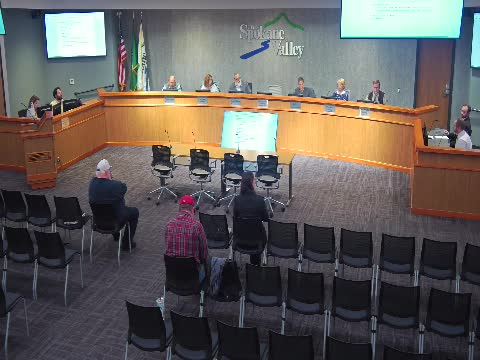
At a Spokane Valley Planning Commission meeting, Washington State Department of Commerce staff reviewed House Bill 1181 requirements for climate elements in comprehensive plans, described Commerce guidance and tools (including a Climate Policy Explorer), and noted available Climate Commitment Act grant funding for Spokane Valley.
The Washington State Department of Commerce told the Spokane Valley Planning Commission that House Bill 1181 requires jurisdictions updating comprehensive plans to add climate-related elements and offered guidance, technical tools and grant funding to help meet the new requirements.
Commerce senior planner Pranjali Rai said the 2023 law adds climate planning as a Growth Management Act goal and requires a climate-resilient subelement in all fully planning jurisdictions, with a companion greenhouse‑gas reduction subelement required for Washington’s largest and fastest growing counties and their cities. "The aim of this law is to ensure that comprehensive plans adapt to and mitigate the effects of changing climate," Rai said.
Why it matters: the new requirements change what must be included in Spokane Valley’s comprehensive plan update, create options for how jurisdictions measure emissions, and can affect the city’s access to state grant funds. Commerce staff also described tools to help jurisdictions pick goals and policies and quantified funding already awarded to Spokane Valley.
Commerce outlined two subelements the law anticipates: a resilient subelement addressing hazards and adaptation measures, and, where required, a greenhouse‑gas reduction subelement that sets emissions‑reduction goals and policies. Michael Burnham, climate policy program manager at Commerce, told commissioners the greenhouse‑gas guidance is framed around an overall target consistent with state policy: reaching net‑zero greenhouse gas emissions by 2050. The guidance recommends measures across transportation, buildings and energy, and zoning and development.
Commerce presented three “pathways” for jurisdictions to estimate and manage emissions. Pathway 1 uses simplified estimates; Pathway 2 focuses on measuring and reducing per‑capita vehicle miles traveled; and Pathway 3 creates a multi‑sector emissions inventory and is the most comprehensive. Commerce staff recommended that larger counties and their cities pursue Pathway 3 or use an inventory supplied by Commerce.
The agency also demonstrated a new Climate Policy Explorer dashboard and a menu of more than 200 model measures — sample goals, policies and implementation ideas cities can adopt or adapt. The dashboard highlights high‑priority measures and allows users to download fact sheets for stakeholder meetings.
Commerce staff described additional resources in development, including an 11‑county greenhouse‑gas inventory to be posted in spring, a web tool to estimate emissions reductions planned for early 2026, and an interactive story map expected with updated guidance in fall 2025.
On funding, the presenters said Spokane Valley is currently under contract for $490,000 in Climate Commitment Act grant funds for climate planning and is eligible to apply for up to an additional $210,000. "There are grants and technical assistance available to counties, cities, and tribes to promote smart community planning," Pranjali Rai said.
Commissioners asked several implementation and scope questions. Commissioner Kelly asked whether climate elements are merely aspirational; Commerce staff responded that the climate element is a mandatory part of the comprehensive plan under the Growth Management Act, though many goals are qualitative and are implemented through policies and projects. Commerce staff noted that if a jurisdiction does not adopt required elements by the statutory deadlines, it could be found out of compliance and face hearings‑board actions or lose eligibility for some state funds.
Commissioners also questioned definitions and tools for environmental justice and overburdened communities. Michael Burnham defined environmental‑justice approaches as prioritizing actions that mitigate historical inequities — for example, increasing tree canopy in neighborhoods that face disproportionate air pollution and heat impacts — and pointed commissioners to the Department of Health’s environmental health disparities index as an available mapping resource.
On resilience planning, Commerce recommended starting with the University of Washington’s Climate Mapping for Resilient Washington to identify how climate change is likely to alter local hazards (heat waves, drought, altered precipitation and flooding). Staff noted jurisdictions may adopt or reference an existing FEMA‑aligned hazard mitigation plan to meet parts of the resilience requirement.
Commissioners raised tradeoffs they expect in Spokane Valley: packing more housing into urban areas to reduce driving and emissions versus preserving farmland and tree canopy. Commerce staff suggested infill, mixed‑use development, low‑impact development techniques and compensatory tree‑planting as ways to balance housing and climate goals.
Commerce staff outlined timing and compliance: HB 1181 applies first to jurisdictions with 2025 comprehensive‑plan update due dates; some jurisdictions have later deadlines. Commerce said it has limited approval authority if a jurisdiction voluntarily submits a greenhouse‑gas reduction subelement: if Commerce approves it, the department may defend that decision before the Growth Management Hearing Board. Staff also said the agency is preparing to update its guidance through an upcoming state rulemaking process.
Next steps for Spokane Valley staff: planning staff said they will return with a schedule for the comprehensive‑plan update and more detail on upcoming items. Planning Manager Steve Roberge told the commission the next meeting will include a study session on a street vacation application and the commission will see the land capacity analysis and comp‑plan schedule.
Sources and next actions: Commerce staff encouraged coalitions among neighboring jurisdictions, early and equitable public engagement, and specific, measurable goals (for example percent tree canopy or identified cooling centers) to improve implementation and eligibility for future grants.
The presentation and a question‑and‑answer period concluded with commissioners saying they expect significant public outreach and debate as the planning process continues.