Get Full Government Meeting Transcripts, Videos, & Alerts Forever!
Get email alerts on the Land Use Pud6 topic
No spam. Unsubscribe anytime.
Irving staff seek council consensus to create high-intensity mixed-use zoning for PUD 6, including optional 'destination resort' standard
Summary
City staff presented draft amendments to PUD 6 to create a high-intensity mixed-use district for Tracks A sectors 1 and 2, add a defined "destination resort" use and require council approval of development standards and regulating plans; council gave consensus to continue the process and directed work on development standards and outreach.
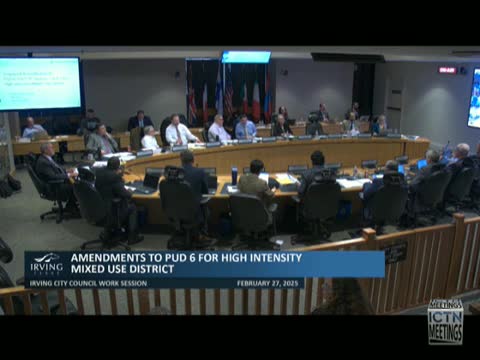
City planning staff told the Irving City Council they have drafted amendments to the PUD 6 zoning and exhibit documents to reassign Tract A Sectors 1 and 2 to a new "high-intensity mixed use" district designed to enable large-scale, transit‑oriented redevelopment on the former Texas Stadium site.
Assistant City Manager Philip Sanders said the proposed changes are limited to the pink-highlighted area of PUD 6 and are intended to clarify permitted and prohibited uses, allow higher nonresidential density, and establish an administrative process and council review for "regulating plans" and development standards. "The zoning that you have before you is only applicable to Tract A sectors 1 and 2," Sanders said.
A new defined use in the draft is "destination resort." The ordinance draft sets a minimum scale for that use — at least 1,750 hotel rooms, at least 500,000 square feet of convention/exhibition space, and either an arena of at least 15,000 seats or an indoor theater of at least 4,000 seats. Sanders said casino gaming would be permitted within a destination resort only if "authorized by the constitution and laws of the state of Texas" and only within a destination resort that meets the minimum elements; the draft also calls for minimum gross square footage if gaming is included (draft cited 4,000,000 square feet as a threshold in scenarios that include gaming).
Sanders emphasized the ordinance creates a process: no development would proceed on the track until the city council had approved detailed development standards and any regulating plan for the property. He said the draft would cap residential units at the existing 3,750 units in the PUD and remove prior nonresidential square-footage caps so nonresidential density could be higher under the regulated standards.
Council discussion focused on process, public outreach and timing. Multiple council members called the project "transformational" and urged careful drafting, robust public engagement and use of outside counsel and industry consultants. Councilmembers also asked that staff ensure the planning-and-zoning commission have adequate time to review materials; Assistant City Manager Sanders said staff will work with P&Z scheduling. Several members urged town halls and public presentations; one councilmember requested additional time for P&Z staff to review before the first work session.
No final zoning ordinance was adopted at the meeting. By consensus the council directed staff to continue working with the applicant and property owners on development standards, return development‑standards language for council review, and engage outside counsel and consultants as needed. Staff proposed a schedule that could bring a P&Z work session and later votes in March, with a council public hearing and potential vote on March 20 if the schedule holds.
Ending: Staff said next steps include drafting the detailed development standards (a form-based approach was discussed), coordinating outreach and town halls, bringing materials to planning and zoning for a work session and returning to council for formal action once standards and regulating-plan procedures are in place.