Get Full Government Meeting Transcripts, Videos, & Alerts Forever!
Get email alerts on the Transit Dart topic
No spam. Unsubscribe anytime.
DART officials tell Irving leaders they are studying governance changes and local investment tools
Summary
Dallas Area Rapid Transit leaders updated the Irving City Council on a multi-city outreach to expand local service, explore use of sales-tax increment for economic development, and consider governance changes including board-seat allocation and supermajority voting rules.
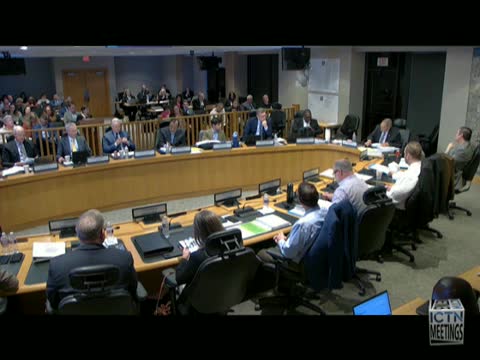
Dallas Area Rapid Transit (DART) officials told the Irving City Council they have been meeting with member cities to identify service improvements, governance changes and ways to use DART resources for local economic development.
The update, presented by DART board members and senior staff including Chair Gary Slagle, Nadine Lee and Mark Enoch, said DART staff visited the 13 service-area cities four times since October to collect feedback and test ideas. "Generally, the cities have said, if you're going to give money back to one city, you need to give money back to all cities," Slagle said, describing one recurring theme.
DART said its planning work emphasizes two near-term service elements: fixed-route circulators to move people across neighborhoods and expanded microtransit (on-demand) zones to improve first- and last-mile connections. Officials also described efforts to increase ridership following a COVID-era decline; system ridership is "back up to about 83 percent of pre-COVID numbers," Slagle said.
On economic development, DART staff described work to define parameters that would let cities use a share of DART sales-tax increments inside tax-increment reinvestment zones, an approach mayors and city managers have urged so sales-tax growth generated by new projects can be reinvested locally. Nadine Lee said a city-managers subcommittee is drafting language and expects to bring proposed interlocal agreement (ILA) language and deal points to the DART board in May.
Board governance was a second major topic. DART leaders said cities have expressed concern about representation: some smaller cities feel underrepresented because board members represent roughly equal population bands and some seats are split between multiple cities. Options under discussion include letting cities choose how to pair for representation, reallocating seats and using supermajority vote rules on certain items. Mark Enoch said he did not vote for a recent proposal requiring a two-thirds vote for some budget items because he believed passage would be unlikely, but supported continuing the governance conversation.
Irving Mayor Rick Stover and council members expressed support for DART participation in local economic tools and for expanded microtransit and circulator services. Several council members pressed for predictable, equitable processes and urged quick movement on the ILA and PTI (public transit improvement) funds. Councilmember comments acknowledged the tradeoff between regional obligations (rail, TRE) and locally directed service funding.
No formal action or vote by the Irving City Council occurred during the presentation. DART officials said work on the governance MOU and on preliminary engineering for the Loop 12 (Loop 12/old Cowboys stadium) Orange Line station continues.
Ending: DART officials said they will continue meetings with city managers and councils and return with more-detailed language for an ILA and governance memorandum of understanding; Irving staff signaled they will continue to participate in those conversations.