Houston 311 director details call volumes, app relaunch and plans to move contact center into enterprise fund
Loading...
Summary
Deputy Director Charles W. Jackson told the Service Delivery Committee that Houston 311 handled roughly 1.1 million calls in fiscal 2024, is relaunching technology and a parent-child case workflow, and is pursuing a shift from general‑fund support to an enterprise‑fund model to finance upgrades.
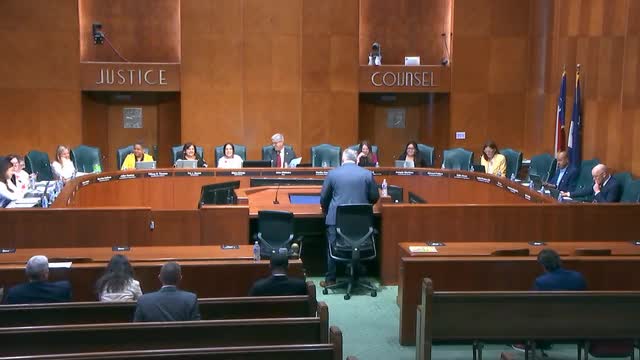
Deputy Director Charles W. Jackson, director of Houston 311, told the Houston City Council Service Delivery Committee that Houston 311 handled about 1,100,000 calls and created roughly 488,000 service requests in fiscal 2024, and outlined technology, staffing and funding changes intended to improve customer transparency and emergency response.
Jackson told the committee that "Houston 311 does not close service requests," saying departments — not the 311 contact center — make closure decisions and that the 311 team is a "solution center for the city of Houston." He described a recently relaunched mobile app, a parent-child case project that will keep a single case number when a request is reclassified, and a plan to merge 311 with utility billing contact operations as a step toward placing 311 into an enterprise fund.
The updates aim to reduce public confusion about case status and give customers more visibility. Jackson said the relaunched SeeClickFix-based mobile app (released February 2023) has about 38,000 downloads and has produced 57,690 service requests since the relaunch; the app now shows the city service request number, department assignment and closure reason. Jackson also described an integration that will include the department name in the case-creation email sent to customers.
Committee members pressed Jackson on performance metrics and operational details. Jackson said roughly one-third of incoming calls generate a service request and two-thirds are informational only. He reported an average speed of answer of about 145 seconds in FY24 and an FY24 answered‑calls rate of about 85%. For FY25 he said average speed of answer had risen to about 198 seconds and the answered rate had fallen to about 83%; he attributed spikes in calls during early FY25 to a weather event he called "hurricane barrel," when daily call volume briefly reached about 4,400 calls.
Jackson described 311 staffing as about 74 full‑time employees with roughly 60 agent positions (he provided both "74 full time employees" and a breakdown of agent roles during the presentation). He noted agents support callers in dozens of languages through LanguageLine and sign‑language interpretation, and said 311 handled several hundred urgent rides during a recent freeze — "750 Z trips" — that he characterized as life‑saving responses. He also emphasized that 311 agents operate as a mobile workforce and will staff alternate sites or work remotely during severe weather.
On organizational change, Jackson said the 311 contact center and customer account services (utility billing) merged on Jan. 8 and that the city planned to move 311 into the CUS enterprise fund to secure larger, dedicated funding for technology and staffing. He and committee members discussed an enterprise funding estimate Jackson cited as roughly $14.6 million to $14.8 million for future enhancements; Jackson said the FY26 budget would reflect a single enterprise fund budget for those operations.
Committee members asked about call transfers and departmental access to case systems. Jackson said 311 still transfers certain calls (for example, animal control/ BAR T and health‑department contact centers) when callers ask to be connected directly. He said most leads and supervisors have read‑only access to the Infor system and that expanding read‑only access for frontline agents is under consideration. Members also raised the 311 email/web portal character limit and the 150‑character limit on the online web portal; Jackson acknowledged the complaint and said the team would review it.
Council members and staff suggested operational and user‑experience fixes: giving clearer closure wording rather than a single "service completed" default, ensuring closure notes include the name of the person or unit that closed a case, and providing more training or standardized guidance to departments about available closure codes. Jackson said some nomenclature is constrained by Microsoft Dynamics and said he would provide definitive answers about whether closure labels can be changed.
Jackson also previewed future technology: a CitiBot AI chatbot available in multiple languages (not yet deployed), a more robust IVR that could accept natural language inputs, and parent‑child case handling that will maintain a single service request number even after reclassification. He framed those changes as ways to lower repeat escalations: in FY24 311 created 10,111 escalated service requests, which Jackson noted was under 3% of total service requests and under 1% of total calls.
Council member Amy Peck and others praised the presentation and the app relaunch. Peck said the 311 contact is "sometimes the only interaction that [constituents] have with the city of Houston at all." Multiple members asked that 311 return with additional performance measures tying calls to outcomes (for example, how many cases resulted in completed work versus closed for other reasons).
Jackson closed by urging committee members to support outreach and by describing recruitment and retention pressures: 311 has high turnover and spends months training new agents. He said cross‑training with utility billing staff is intended to broaden employee opportunity, improve retention and create surge capacity during emergencies. The committee set no formal action or vote; Jackson and staff agreed to follow up on the items discussed and to provide additional details on enterprise fund budgeting, closure labels, and system access.
The Service Delivery Committee will meet next on March 26 at 2 p.m., the chair reminded the room at adjournment.