Get Full Government Meeting Transcripts, Videos, & Alerts Forever!
Get email alerts on the Parks Enterprise topic
No spam. Unsubscribe anytime.
Park board outlines Seawolf Park business plan; city weighs enterprise parks, competition and oversight
Summary
The Galveston Park Board presented a business plan for Seawolf Park including potential RV, boat ramp and museum uses. City staff told council it is evaluating enterprise parks, whether city tax dollars should underwrite businesses that might compete with private operators, and whether management of enterprise parks should shift to the city.
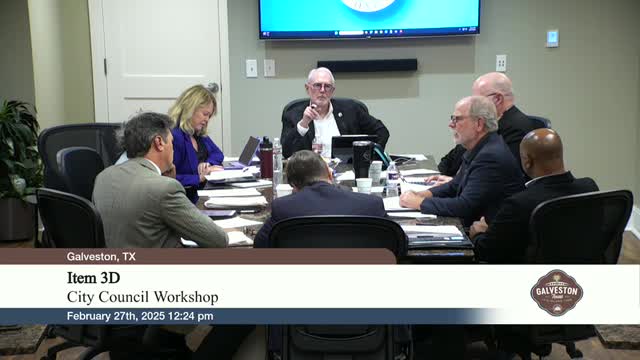
The Galveston Park Board presented a business plan for Seawolf Park during the Feb. 27 workshop; Park Board and city staff said council must first decide whether the city should use public land and tax dollars to support enterprise-style operations that could compete with private businesses.
Vince (Park Board representative) and park board members summarised a plan that explored revenue-producing options at Seawolf Park — including an RV park, an expanded boat ramp, museum uses and facility upgrades. The park board said it had identified potential revenue streams and scenarios intended to make Seawolf more financially self-sustaining and to contribute to the city’s budget.
City Manager Brian Maxwell and Parks Director Barbara Robinson told council enterprise parks are currently managed under an interlocal-type relationship with the Park Board. Staff recommended that council clarify whether city-owned parks that operate like businesses should continue under the Park Board’s management or be returned to direct city operation, where duplicative administration might be reduced and the city would retain direct financial control.
Council members raised multiple concerns: would creating or expanding an RV park or commercial boat ramp at Seawolf require use of city funds, might those operations compete with private local businesses, and would the city remain responsible for capital and ongoing maintenance? Bob Linden, speaking for council, noted previous demolitions, lien procedures and the difference between parkland conveyed as a public benefit and parkland operated as a commercial enterprise.
Park Board chair Vince said the board had tested a range of options and brought a plan to council for feedback; he recommended pausing new decisions on structural changes until council provides policy direction. Councilmember David suggested staff compare options: if the city directly operates enterprise parks, what would costs, staffing and revenue look like versus the Park Board continuing operations under a management agreement?
City staff recommended details the council should ask for before changing management or approving commercial reuses: a clear business model showing capital and operating costs, ownership/lease terms, funding sources (grants, donations, private financing), and a timeline with accountability and performance metrics. Staff also noted legal questions about whether municipal land designated as parkland can be converted to commercial use without voter approval in some circumstances.
What’s next: Council asked staff to return with a comparative analysis — cost to the city, revenue scenarios, and legal implications — and to develop performance metrics and a timeline if management is to change. The Park Board agreed to pause new commitments while council and staff refine policy direction.