Get Full Government Meeting Transcripts, Videos, & Alerts Forever!
Get email alerts on the Short Term Rentals topic
No spam. Unsubscribe anytime.
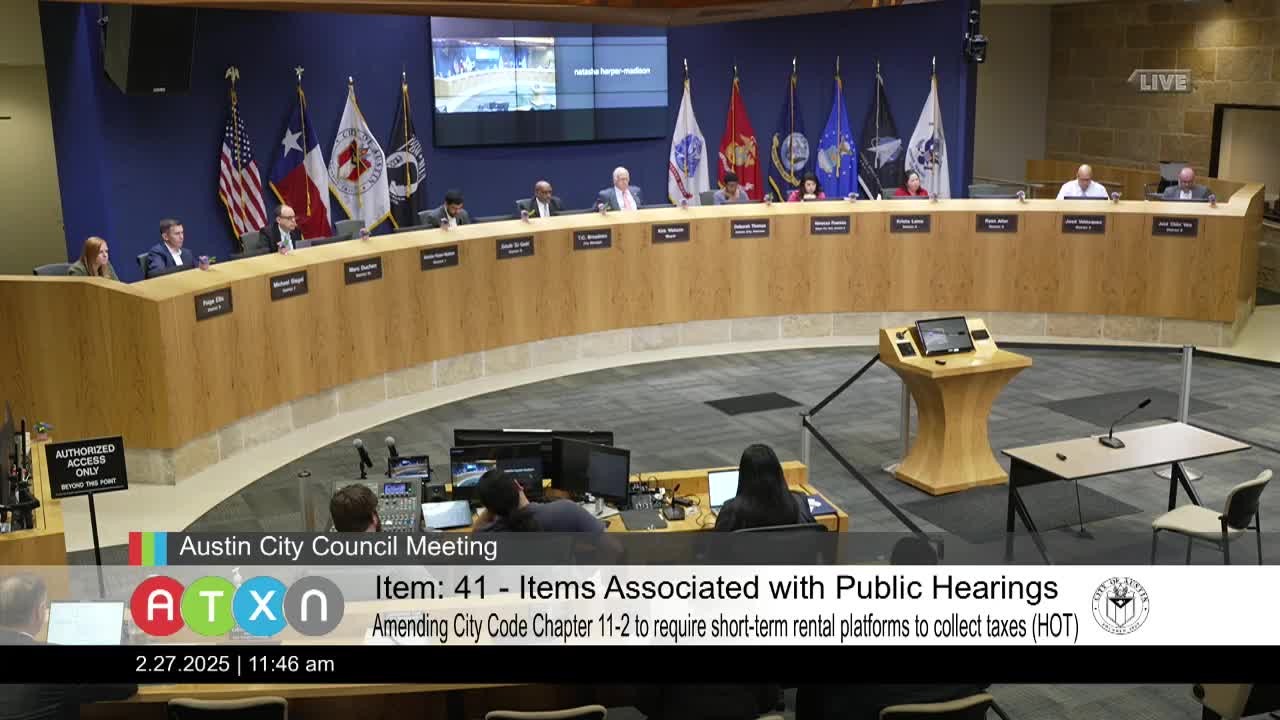
Austin council approves new short‑term rental code changes, delays implementation and orders enforcement software; hotel tax collection set for April 1
Summary
The Austin City Council on Feb. 27 approved reorganizing short‑term rental rules — moving land‑use eligibility into the Land Development Code and operational rules into business licensing — delayed full implementation until staff can stand up new enforcement systems and set platform hotel‑tax remittance to begin April 1, 2025.
The Austin City Council on Feb. 27 approved a reorganization and set of amendments to short‑term rental (STR) rules that move land‑use eligibility into the Land Development Code and the licensing, enforcement and business rules into the city's business/Title 4 code, while delaying full implementation to allow new enforcement systems to be procured and brought online.
Council members, staff and dozens of residents traded more than three hours of testimony and debate about the effect STRs have on housing supply, neighborhood quality of life and enforcement capacity. Council voted to delay effective dates for the land‑use and licensing changes until Oct. 1, 2025, and to set hotel‑occupancy‑tax (HOT) remittance by platforms to begin April 1, 2025, while directing staff to expedite purchasing one or more software products to support licensing and enforcement.
Why it matters: Residents and housing advocates argued at the public hearing that unrestricted STR growth reduces the stock of long‑term housing and contributes to displacement; businesses and some council members focused on transparency, tax compliance and workable enforcement. The council's actions attempt to balance those goals by creating an enforceable licensing framework, requiring platforms to remit HOT, and buying software to scale enforcement — but delaying many substantive new constraints until staff systems are in place.
What the council approved and how it will work
- Land use vs. business licensing: The council adopted an ordinance (item 39, alternate version) that makes STR use an eligible accessory land use when a property holds a required STR license, shifting the primary legal limiter from parcel zoning to ownership/licensing conditions. That ordinance was approved as amended and will become effective Oct. 1, 2025.
- Licensing, enforcement and tax collection: The council adopted an ordinance moving STR operational rules from Title 25 (LDC) to Title 4 (business regulations) (item 40, alternate version) and adopted a companion HOT collection ordinance (item 41) that requires platforms to remit hotel‑occupancy taxes. Council set the platform HOT remittance effective date to April 1, 2025.
- Software and enforcement staffing: The council adopted a motion directing the city manager to expedite solicitations and purchase of one or more off‑the‑shelf software programs to support licensing, compliance monitoring and enforcement. The mayor pro tem framed the software procurement as the single most urgent enforcement action.
Public hearing and concerns raised
Residents, neighborhood groups and housing advocates urged stronger caps on STRs, argued the proposed changes would encourage investor conversions of housing into rentals, and said enforcement capacity is currently insufficient. Speakers cited geographic concentrations (e.g., ZIP code 78702) and urged the council to limit future conversions, tighten spacing rules, and require platforms to validate license numbers and remit taxes.
Industry and staff responses
Representatives from major platforms told council they could implement HOT collection but requested time to complete technical quality checks and to notify hosts; one industry representative said platforms typically prefer month‑start reporting and asked for more than the minimum 10‑day ordinance effective period. City law and staff said the adopted schedule balances the need for urgent tax collection with implementation realities; staff confirmed platforms would remit HOT for transactions even where a local license did not exist.
Votes and motions
- Item 39 (land‑use move / alternate version): Motion to adopt alternate version (mover: Council Member Ryan Alter; second: Council Member Jose Velasquez). Adopted as amended; effective date moved to Oct. 1, 2025 by amendment (Velasquez). Outcome: approved.
- Item 40 (Title 4 licensing move / alternate version): Motion to adopt alternate version (mover: Council Member Cadrey/seconded by Alter). Adopted as amended; effective date aligned with item 39 (Oct. 1, 2025) and council directed expedited procurement of short‑term rental licensing/enforcement software (mayor pro tem motion). Outcome: approved.
- Item 41 (hotel occupancy tax / collection): Adopted as amended; council struck a subsection (mayor pro tem amendment) and then adopted an amendment setting HOT remittance by platforms to start April 1, 2025 (Council Member Ryan Alter's amendment). Outcome: approved.
Discussion vs. decisions
Council clearly separated discussion from direction and decision: the public hearing informed council deliberations; council then gave explicit direction to staff (procure software, coordinate implementation) and took formal votes to adopt ordinances with specified effective dates.
Speakers (selection)
- Kirk Watson, Mayor (government) - Vanessa Fuentes, Mayor Pro Tem (government) - Ryan Alter, Council Member (government) - Jose Velasquez, Council Member (government) - Michael Curry (attorney; resident speaker) (citizen) - Colin McNamara (resident/homeowner) (citizen) - Monica Guzman, Policy Director, GAVA (nonprofit) - Michael Whelan, representative for Expedia/VRBO (business)
Clarifying details and staff direction
- Effective dates: Oct. 1, 2025 for land‑use/licensing code moves (items 39 & 40); April 1, 2025 for platform HOT remittance (item 41). - Software procurement: council directed the manager to expedite solicitations and acquisition of 1+ software systems to support licensing, compliance monitoring and enforcement; staff said the intention is to use off‑the‑shelf products where possible to shorten implementation time. - Platforms: staff and an industry representative said platforms will remit HOT on all transactions they process; council directed staff to require platform validation of license numbers where feasible.
Provenance
Topic introduction (public hearing opens): "The public hearing is now open." (transcript excerpt) Topic finish (adoption of HOT collection ordinance): "Without objection, item number 41 as amended is adopted." (transcript excerpt)
Ending
Council members said they expect to return to STR policy refinements after the Texas legislative session and after staff reports on data and the results of the newly procured enforcement software. The adopted package reorders how the city regulates STRs (land use vs. licensing) and sets an implementation roadmap that prioritizes tax collection and enforcement capability before additional substantive restrictions take effect.