Get Full Government Meeting Transcripts, Videos, & Alerts Forever!
Get email alerts on the Prop98 Budget topic
No spam. Unsubscribe anytime.
Budget analysts urge caution as governor proposes delayed Prop.98 "settle up" to manage revenue volatility
Summary
Department of Finance and Legislative Analyst Office described Proposition 98 calculations and a governor proposal to delay $1.6 billion of 2024‑25 Prop.98 settle‑up into 2025‑26. Analysts outlined alternatives and warned of high sensitivity of the guarantee to revenue swings.
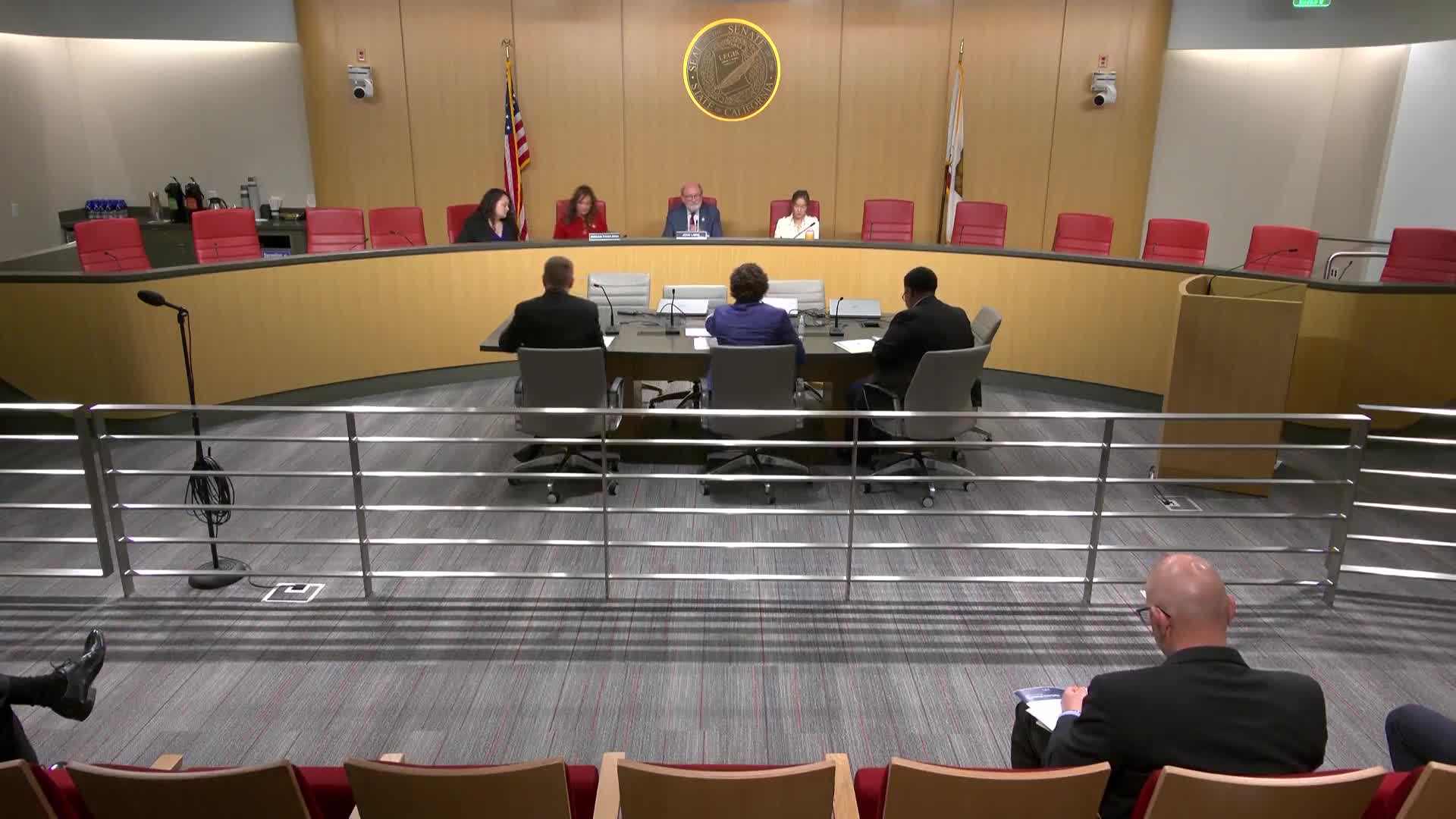
The Senate Budget Subcommittee No. 1 on Education reviewed the state’s Proposition 98 forecast and policy options on March 13, with Department of Finance (DOF) and Legislative Analyst’s Office (LAO) officials warning that volatile revenue sources make 2024‑25 funding decisions unusually risky.
DOF overview and figures
Alex Shope of the Department of Finance told the subcommittee the governor’s budget projects the Proposition 98 guarantee for fiscal year 2025‑26 at about $118.9 billion and shows roughly $7.5 billion of growth across 2024‑25 and 2025‑26 compared with the current‑year enacted budget. Shope said the administration proposes treating about $1.6 billion of 2024‑25 settle‑up as a timing item intended to avoid over‑appropriation should revenue soften between the governor’s January proposal and the May revision.
“The 1.6 billion is an estimate that reflects uncertainty in revenue estimates and could be revised at the May revision,” DOF staff told the committee.
LAO perspective and alternatives
Ken Kappan (Legislative Analyst’s Office) told the committee the governor’s revenue assumptions are reasonable given strong tax collections but stressed large upside and downside risks tied to unusually high stock prices and tax‑deadline extensions in Los Angeles County. The LAO highlighted a technical point: in 2024‑25, the Proposition 98 guarantee is unusually sensitive to revenue changes—about $0.95 change in the guarantee for every $1 change in state revenue—because of the particular configuration of tests and maintenance‑factor payments.
Kappan outlined three alternatives to the governor’s approach: 1) make a discretionary deposit of $1.6 billion into the Proposition 98 reserve (Public School System Stabilization Account) now and rescind it if revenues fall short; 2) appropriate the funds now but delay disbursement to districts until June 2026, making the appropriation contingent on revenues; or 3) suspend Proposition 98 (requires a two‑thirds vote) and create maintenance factor to accelerate funding later. The LAO said a reserve deposit may be the most compelling because it addresses volatility without creating a large near‑term payment cliff in 2026.
Policy tradeoffs
DOF and LAO officials agreed the state’s options differ mostly in timing rather than total cost: if revenue ultimately reaches the governor’s forecast, the state will owe the $1.6 billion either now or later. The tradeoffs include short‑term opportunity costs for non‑education programs if the state funds the 1.6 billion now, versus a potentially steeper budget challenge in 2026 if the state delays the payment and revenues decline.
Spending priorities in the governor’s plan
Shope summarized the governor’s K–12 and community college proposals that would be paid from the Proposition 98 guarantee, including a $2.5 billion ongoing LCFF (Local Control Funding Formula) increase for a 2.43% COLA and enrollment adjustments, $1.8 billion ongoing for TK expansion and ratio reduction, and roughly $1.8 billion one‑time for a student support and professional development discretionary block grant. The budget also includes one‑time deferral pay‑offs for LCFF and the Student Centered Funding Formula.
What committee members asked
Members pressed both agencies on revenue sensitivity, timing of tax‑payment deadlines in Los Angeles County, and the implications for K–14 and non‑education programs. Several committee members said they were concerned about how a possible federal funding shock or tax‑revenue reversal could complicate restoration of delayed payments.
Next steps
The LAO and DOF said they will refine estimates ahead of the May revision. The subcommittee will continue to hear related budget items in subsequent hearings and members signaled they may press for alternatives that protect districts from funding cliffs while preserving flexibility in a volatile revenue environment.