Get Full Government Meeting Transcripts, Videos, & Alerts Forever!
Minnesota agencies report early progress and rising complaints after 2024 misclassification law
Summary
A five-agency partnership created by 2024 law reported rising misclassification complaints, coordinated investigations, outreach to more than 11,000 people and early enforcement results, and requested modest additional staffing in the governor's budget.
Senate Labor Committee Chair Claire McEwen convened a briefing Feb. 27 where Minnesota agencies that form the new Intergovernmental Misclassification Enforcement and Education Partnership reviewed work since the law took effect July 1, 2024.
The partnership, created by 2024 legislation, combines the Minnesota Department of Labor and Industry (DLI), Department of Revenue, Department of Employment and Economic Development (DEED), Department of Commerce, and the Attorney General's Office to coordinate investigations, share data and lead outreach intended to detect and reduce worker misclassification.
Nicole Lisonbee, commissioner of the Minnesota Department of Labor and Industry, told the committee that misclassification occurs when “somebody who should be treated as an employee with all of the rights and responsibilities that come with that is treated as something other than an employee,” and that the 2024 law strengthened tools for enforcement and education. She said the partnership has established four work groups: investigation and enforcement; education and outreach; data sharing; and data collection, reporting and analytics.
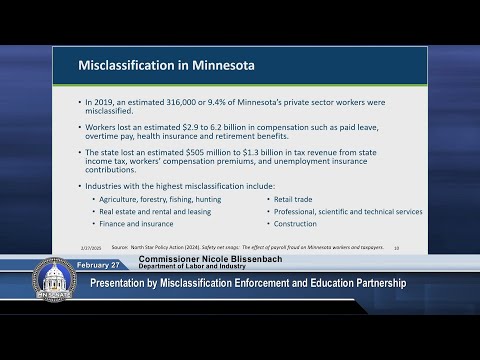
Why it matters: state and outside studies cited at the hearing indicate large economic and worker-protection risks from misclassification. The Economic Policy Institute has estimated annual losses to misclassified workers of roughly $4,558 to $18,000 per worker, depending on assumptions. A North Star Policy Action study cited by presenters estimated about 316,000 misclassified workers in Minnesota as of early 2019 (about 9.4% of the private-sector workforce). Presenters said misclassification can reduce wage and benefit access for workers while shifting costs away from employers who follow the law, and it reduces state revenue tied to taxes, unemployment insurance and workers' compensation.
What the agencies…
Already have an account? Log in
Subscribe to keep reading
Unlock the rest of this article — and every article on Citizen Portal.
- Unlimited articles
- AI-powered breakdowns of topics, speakers, decisions, and budgets
- Instant alerts when your location has a new meeting
- Follow topics and more locations
- 1,000 AI Insights / month, plus AI Chat