Get Full Government Meeting Transcripts, Videos, & Alerts Forever!
Get email alerts on the Worker Misclassification topic
No spam. Unsubscribe anytime.
Minnesota agencies report early progress and rising complaints after 2024 misclassification law
Summary
A five-agency partnership created by 2024 law reported rising misclassification complaints, coordinated investigations, outreach to more than 11,000 people and early enforcement results, and requested modest additional staffing in the governor's budget.
Senate Labor Committee Chair Claire McEwen convened a briefing Feb. 27 where Minnesota agencies that form the new Intergovernmental Misclassification Enforcement and Education Partnership reviewed work since the law took effect July 1, 2024.
The partnership, created by 2024 legislation, combines the Minnesota Department of Labor and Industry (DLI), Department of Revenue, Department of Employment and Economic Development (DEED), Department of Commerce, and the Attorney General's Office to coordinate investigations, share data and lead outreach intended to detect and reduce worker misclassification.
Nicole Lisonbee, commissioner of the Minnesota Department of Labor and Industry, told the committee that misclassification occurs when “somebody who should be treated as an employee with all of the rights and responsibilities that come with that is treated as something other than an employee,” and that the 2024 law strengthened tools for enforcement and education. She said the partnership has established four work groups: investigation and enforcement; education and outreach; data sharing; and data collection, reporting and analytics.
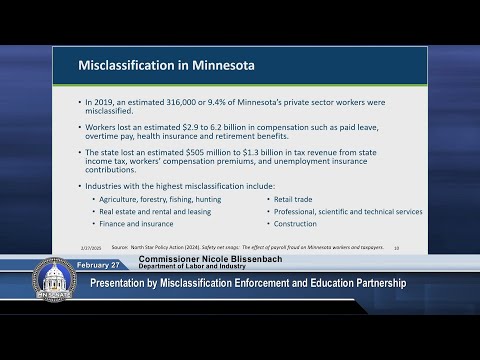
Why it matters: state and outside studies cited at the hearing indicate large economic and worker-protection risks from misclassification. The Economic Policy Institute has estimated annual losses to misclassified workers of roughly $4,558 to $18,000 per worker, depending on assumptions. A North Star Policy Action study cited by presenters estimated about 316,000 misclassified workers in Minnesota as of early 2019 (about 9.4% of the private-sector workforce). Presenters said misclassification can reduce wage and benefit access for workers while shifting costs away from employers who follow the law, and it reduces state revenue tied to taxes, unemployment insurance and workers' compensation.
What the agencies reported: DLI said it has increased focus on quicker, lower-resource resolutions for many intakes through wage-claim and "inform and educate" letters while keeping full investigations for more complex or egregious cases. Commissioner Lisonbee said DLI received 99 misclassification-related intakes in calendar year 2023 and, for the seven months after the partnership began on July 1 through Jan. 31, had already logged an additional roughly comparable number of intakes indicating an increase in reporting. DLI also reported outreach activity that reached more than 11,000 people through presentations, seminars and events.
Evan Roe, deputy commissioner at DEED, described the unemployment insurance (UI) audit program and staffing changes used to detect misclassification. Roe said the state completed nearly 1,400 employer audits in the previous fiscal year and aims for roughly 1,500 a year. He said the U.S. Department of Labor now allows virtual audits, which DEED has used to increase throughput and efficiency. Roe said the UI unit increased full-time auditors by five in the last fiscal year and plans to add five more in SFY 2025; those auditors are federally funded in connection with UI administration.
Dan Getchell, director of individual income taxes and withholding at the Department of Revenue, said his team has conducted 242 audits that resulted in worker-classification determinations since February 2022 and that about 70% of their classification audits identify misclassification. Getchell said Revenue applies the IRS common-law test (focusing on behavioral and financial control) when determining whether workers are employees for withholding purposes.
Leah Tapu, wage-theft manager at the Minnesota Attorney General's Office, said the office received 696 wage-theft complaints in 2024 and that about 22% (roughly 150) related to misclassification. The attorney general's office brings civil lawsuits when businesses will not remedy violations, Tapu said, and that litigation is resource intensive; roughly 47% of staff time in her division was devoted to misclassification in 2024. Tapu described a December settlement in a misclassification case involving a gig company that returned about $300,000 to roughly 300 Minnesota workers.
Coordination and data sharing: presenters said the partnership is drafting interagency data-sharing agreements and holding biweekly enforcement coordination meetings. DLI reported an existing data-sharing agreement with the Attorney General's Office and that it is drafting an agreement with Revenue, which presenters called more complex because of Revenue's tax data. The partnership said it plans both reactive data sharing (complaint-driven referrals) and proactive industry-targeted work in sectors that research and intake patterns indicate as high-risk, such as construction, transportation, health care and certain gig-economy work.
Enforcement and education strategy: presenters repeatedly emphasized pairing enforcement with outreach. "Education and outreach will always be a priority for the partnership," Commissioner Lisonbee said, adding that many businesses are responsive to information and will correct classification errors when contacted with clear guidance. DEED and DLI said they are cross-training staff so investigators and auditors can better identify when referrals to other agencies are appropriate.
Staffing and budget: DLI said the agency has proposed additional funding in the governor's budget to add 2.5 full-time equivalents focused on misclassification enforcement. DEED said its recent and planned auditor increases are funded through UI federal grant dollars, not state general funds.
Limits and measurement: presenters acknowledged estimating the full scope and fiscal impact of misclassification is difficult because many instances involve incomplete or no employment records. The partnership said it will devote a work group to data collection, analytics and the development of baseline metrics to measure progress over time.
Law and appeals: presenters described multiple legal tests and enforcement tracks. Revenue uses the IRS common-law test for tax withholdings; DEED follows federal-state UI audit standards; DLI enforces wage-and-hour and misclassification rules administratively and uses contested-case hearings at the Office of Administrative Hearings when compliance orders are challenged; the Attorney General's Office can file civil suits when businesses do not remedy violations.
What the committee heard from law enforcement representatives: Drew Evans of the Minnesota Bureau of Criminal Apprehension said a newly combined Commerce Fraud Bureau and the BCA Financial Crimes Section are beginning to coordinate on fraud, financial crimes and wage-theft issues, but had not yet seen an increase in misclassification cases referred to them.
Committee reaction and next steps: senators on the committee praised the partnership's early outreach and enforcement coordination and asked presenters to return with follow-up reports on the effect of a new construction-specific independent-contractor test that takes effect in two days and on the partnership's metrics for measuring impact. The partnership confirmed it would provide the committee with the statutorily required report and links to the external studies cited.
Ending note: officials said the work is in early stages but that increased reporting and interagency coordination is already changing how intakes are handled. The partnership emphasized a combined approach of targeted enforcement and expanded education as its primary strategy going forward.