Get Full Government Meeting Transcripts, Videos, & Alerts Forever!
Get email alerts on the Ethics Revolving Door topic
No spam. Unsubscribe anytime.
Committee debates cooling‑off period for former officials; SF567 laid over
Summary
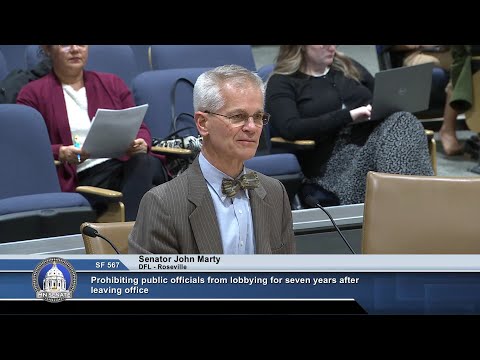
Senate File 567, offered by Sen. John Marty, would restrict former legislators and certain high‑level officials from lobbying state government for a period after leaving office. Supporters argued the ban reduces conflicts of interest; opponents questioned scope and enforceability. The committee laid the bill over for possible inclusion in the omn
Senate File 567, introduced by Sen. John Marty on Feb. 27, would restrict a former legislator or certain high‑level appointed officials from acting as a lobbyist before state legislative or administrative bodies for a cooling‑off period (Marty proposed seven years; other sponsors later proposed a two‑year alternative). The Senate Elections Committee heard proponents and opponents, discussed possible penalties and definitions, and laid the measure over for possible inclusion in an omnibus bill.
Why it matters: Supporters said immediate transition from public office into paid lobbying erodes public confidence and creates conflicts of interest; opponents argued the proposal could sweep in citizen volunteers and limit employment options, and questioned whether criminal penalties or civil fines would be workable or enforceable.
Sen. Marty framed the bill as a measure to “put some time restriction” between public service and lobbying, saying he preferred a longer period (five to seven years) but was open to negotiation. He told the committee he had two potential amendments: one (A1) combining a civil penalty and a misdemeanor and another (AE3) with different enforcement language; he did not move either amendment at the hearing.
Pro‑reform witnesses included Anastasia Belladonna of Common Cause Minnesota, who cited a member survey showing preferences for four‑ to six‑year cooling‑off periods, and Elili Abe Bissell of Clean Elections Minnesota, who said 37 states and territories require waiting periods and pointed to Florida’s six‑year prohibition adopted by ballot measure. Both witnesses urged the committee to adopt a waiting period to reduce undue influence from insiders.
Opponents and questions from the committee focused on scope and enforcement. Campaign Finance and Public Disclosure Board staff told the committee that roughly 1,475 lobbyists are registered in Minnesota and that about 44 former legislators are currently registered as lobbyists. Senators asked whether the proposal would unintentionally include unpaid citizen lobbyists, how “legislative or administrative action” is defined (staff cited Minn. Stat. ch. 10A definitions for administrative action), and whether a civil fine or criminal misdemeanor would be necessary or effective.
Sen. Karin Klein presented a narrower alternative that would impose a two‑year restriction and includes a $25,000 penalty; she described that approach as a balance between protecting integrity and preserving a former official’s access to employment. Committee members debated whether the provision should include top appointed officials, whether to exempt unpaid citizen activists, and whether penalties should be civil or criminal.
Outcome: The committee laid SF 567 over for possible inclusion in the omnibus bill. No final vote was taken and no amendment was adopted at the hearing.