Get Full Government Meeting Transcripts, Videos, & Alerts Forever!
Get email alerts on the Toxics Policy topic
No spam. Unsubscribe anytime.
Committee amends and advances bill scaling back some lead/cadmium restrictions for keys, pens and professional artist materials
Summary
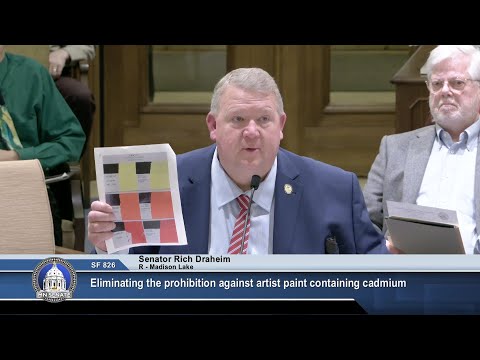
Senate File 826, amended, would modify parts of the 2023 lead and cadmium consumer product prohibitions to exempt or delay certain items (pens, mechanical pencils, professional artist materials, some key types). The committee adopted an author’s amendment and recommended the bill to the Environment, Climate and Legacy Committee.
Senate File 826, introduced by Sen. Robert Draheim, would adjust recent Minnesota restrictions on lead and cadmium in consumer products. Committee members and industry witnesses described unintended consequences of the 2023 law and sought targeted changes to avoid harming artists, hardware supply chains and other businesses.
The committee adopted the author’s A2 amendment and later voted to recommend the amended bill be re‑referred to the Environment, Climate and Legacy Committee. The motion to move the bill was put by Sen. Frentz and carried by voice vote.
Testimony from independent retailers and manufacturers stressed economic and technical concerns. Darren Rennie, co‑owner of WetPaint in St. Paul, said artist paints and related supplies account for about “30% of our annual sales” and warned that bans on lead‑ and cadmium‑based colors have driven customers to out‑of‑state suppliers. “Lead and cadmium based colors are essential tools on the artist’s palette,” Rennie testified.
Manufacturers and trade groups cautioned that some uses—particularly certain keys and solder in key fobs—lack commercially viable alternatives in sufficient volumes or without performance problems. An industry representative said most metal keys are brass containing lead to improve machinability and that alternatives may damage lock cores or ignition systems. The representative noted California’s 1.5% lead standard and said Minnesota’s implementation is stricter.
The Minnesota Pollution Control Agency (MPCA) opposed a blanket exemption, urging the committee to favor transition time and to “drive innovation” toward lead‑free products. Tom Johnson, Government Relations Director for MPCA, said the agency recommended additional transition time for certain items and noted prior legislative pauses used to study pens and key fobs. Johnson also referenced a Department of Health study that found roughly 64% of tested keys had detectable lead using XRF screening.
Senators described the bill as an attempt to balance public health goals—MPCA and legislators repeatedly stressed there is “no safe level” of lead exposure—with practical implementation concerns for artists and key manufacturers. The committee approved the A2 amendment and recommended passage and referral to the environment committee.
Formal committee actions: A2 amendment adopted by voice vote (moved by Sen. Rasmussen). Motion by Sen. Frentz that Senate File 826 as amended be recommended to pass and be re‑referred to the Environment, Climate and Legacy Committee carried by voice vote.